



Malaysian politics is organised under a federal constitutional monarchy model, combining traditional monarchical institutions with a modern parliamentary system. The nation has a King as the head of state, who is elected on a rotational basis, a Prime Minister as the head of government, and a bicameral Parliament representing 13 states and federal territories.
Contents
Overview of the Malaysian political system
Malaysian politics is built on the foundation of a federal constitutional monarchy operating under a Westminster-style parliamentary model. This means that state power is divided between the federal and state levels, and between the legislative, executive, and judicial branches. The supreme legal document governing the entire system is the Federal Constitution.
This model was formed with the birth of the independent Federation of Malaya and subsequently the Federation of Malaysia. A prominent feature is the parallel existence of traditional monarchical institutions in many states with a modern administrative and legislative apparatus. This combination creates a state structure with a distinct historical legacy.
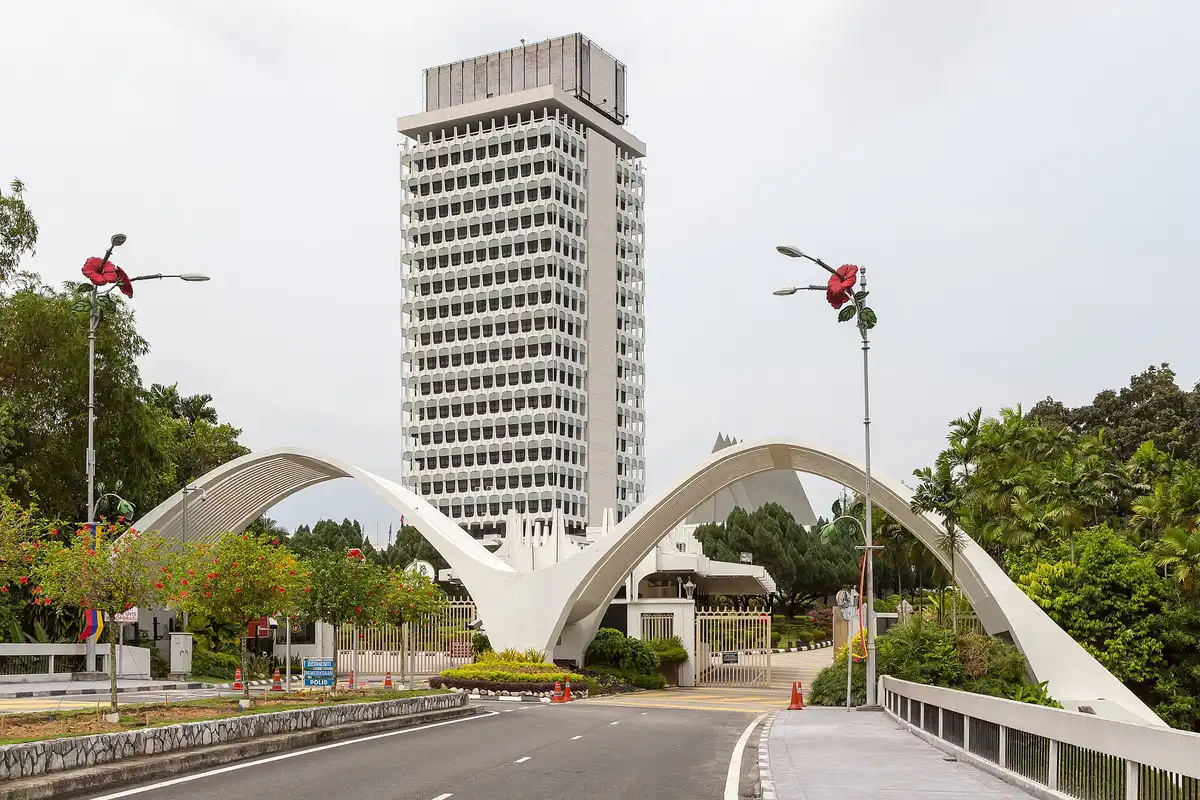
The legislative capital and symbol of the country is Kuala Lumpur, where the Parliament is located. Meanwhile, many federal executive agencies are based in Putrajaya, an administrative centre planned to relieve pressure on the capital. Understanding the political system helps to visualise how a multi-ethnic, multi-religious nation organises power and maintains balance between communities.
Considering a residency programme? The Prosperous Living Investment team assesses your profile free of charge and advises on the pathway that fits your goals.
Federal Constitution and legal foundation
The Federal Constitution is the foundational law that defines the state structure, delineates authority between the federal government and the states, and enshrines fundamental rights. It is the document with the highest legal authority; no other law may contradict the constitution.
The Constitution establishes the principle of separation of powers among three branches: the legislature belongs to Parliament, the executive belongs to the government headed by the Prime Minister, and the judiciary belongs to the court system. The Constitution also defines the position of the King as the head of state, the role of the Conference of Rulers, and the mechanism for constitutional amendments.
Furthermore, the Federal Constitution divides legislative authority into categories: areas under federal jurisdiction, areas under state jurisdiction, and areas that may be regulated by both levels. According to the government portal Malaysian Government Portal, this structure shapes how public policies are enacted and implemented nationwide.
Each state also has its own state constitution, operating within the framework of the Federal Constitution. The parallel between the federal and state constitutions reflects the federal nature of the state, where states retain a certain degree of autonomy in areas within their jurisdiction.
The Yang di-Pertuan Agong and the rotational system
The head of state of Malaysia is the King, with the official title Yang di-Pertuan Agong (commonly understood as the Supreme King). A unique feature of this institution is that the King does not succeed by lineage across the entire federation, but is elected through a rotational mechanism among the heads of the monarchical states.
Among the 13 states of the federation, there is a group of states with a monarchy, each having a king or ruler (commonly called a Sultan). These rulers form the Conference of Rulers. This council has the role of electing the King for a fixed term, following the rotational practice among the monarchical states.
The King holds a symbolic and constitutional role as head of state. In practice, the King exercises most powers on the advice of the government and the Prime Minister, in accordance with the principles of a constitutional monarchy. However, the constitution also grants the King certain powers, including roles related to the appointment of the Prime Minister and certain parliamentary procedures.
The King is also considered the patron of certain traditional and religious institutions. The combination of this unique rotational system with a modern parliamentary system is one of the characteristics that distinguishes the Malaysian state model from many other constitutional monarchies in the world.
Conference of Rulers and the role of the monarchical states
The Conference of Rulers is a specific institution within the federal political structure. The composition of the council includes the rulers of the monarchical states and the heads of the non-monarchical states. This council meets periodically and has several functions recognised by the constitution.
The most important function of the Conference of Rulers is to elect and remove the King and Deputy King through a rotation mechanism. Furthermore, the Conference is consulted on certain matters related to special privileges, the position of traditional institutions, and specific constitutional provisions.
The existence of the Conference reflects how Malaysia preserves the role of traditional monarchical institutions within the framework of a modern state. The monarchical states retain their historical status while operating within the common federal system. To understand the origins of these institutions, one may refer to further information on Malaysia history through the periods of the Malay kingdoms and the formation of the federation.
Prime Minister and the executive branch
The head of government and the holder of executive power in practice is the Prime Minister. By parliamentary convention, the Prime Minister is appointed by the King based on being a member of the House of Representatives who commands the confidence of the majority of its members. This is the core principle of the model of government responsible to parliament.
The Prime Minister heads the Cabinet, which brings together ministers in charge of various areas of public policy. The Cabinet is collectively responsible to Parliament for the government’s actions. Ministers are typically selected from members of Parliament, in accordance with parliamentary system conventions.
The executive branch implements laws passed by Parliament, manages the federal administrative apparatus, and plans and executes national policy. A professional civil service supports the government in performing these functions nationwide.
Because the government must maintain the confidence of the House of Representatives, the relationship between the executive and the legislature is closely intertwined. When a government no longer commands a majority, this may lead to changes in leadership or the calling of elections, according to constitutional processes. This article does not evaluate specific parties or individuals but merely describes the general operating mechanism of the institution.
Bicameral Parliament: Dewan Rakyat and Dewan Negara
The legislative body at the federal level is Parliament, which is organized according to a bicameral model. Parliament consists of two houses: the House of Representatives (Dewan Rakyat) and the Senate (Dewan Negara). Together with the King, these two houses constitute the federal legislative power as stipulated by the constitution.
The House of Representatives (Dewan Rakyat) is the elected house, consisting of members directly elected from constituencies across the country during general elections. The House of Representatives is where most bills are initiated and debated, and it is the house that determines confidence in the government. The role of the House of Representatives is therefore central to political life.
The Senate (Dewan Negara) consists of appointed members and members representing the states. A portion of senators are elected by state legislatures, while the remainder are appointed by the King on the advice of the government. The Senate reviews bills and acts as a house of review, complementing the work of the House of Representatives.
The standard legislative process requires a bill to be reviewed by both houses, then receive royal assent to become law. According to the information portal of the Parliament of Malaysia, the two houses perform legislative, oversight, and representative functions within the constitutional framework. To understand more about the general context of the country, one may refer to the overview on Malaysia.

Federal system: 13 states and federal territories
Malaysia is a federation consisting of 13 states and several federal territories. The states span two geographical regions: the Malay Peninsula (West Malaysia) and the part on the island of Borneo, which includes two large states, Sabah and Sarawak (East Malaysia). This structure reflects the process of federal formation through many historical stages.
Each state has its own legislature and state government, led by a head of state government. States have jurisdiction in areas defined by the constitution, such as certain land matters and traditional institutions, while nationwide areas fall under federal jurisdiction.
The two states of Sabah and Sarawak on the island of Borneo have certain privileges and special status within the federation, linked to the context of their accession to the federation. This creates a certain diversity in the relationship between the central government and the member states.
Federal territories, including the capital area and administrative centre, are placed under the direct management of the federal government rather than having their own state government. The distribution of power between the federal and state levels is a core feature of the institution, closely tied to the country’s geographical and historical structure.
Judicial and legal system
Malaysia’s judicial branch operates independently with the function of interpreting and applying the law. The court system is organized into multiple levels, from lower courts to higher courts, and at the top is the federal supreme court. The courts have jurisdiction to hear civil, criminal, and certain constitutional cases.
Malaysia’s legal system is significantly influenced by common law due to its historical context. Additionally, for certain matters related to the Muslim community, there is a Syariah court system operating within defined jurisdiction, primarily concerning family law and certain personal matters for Muslims.
The coexistence of civil courts and Syariah courts reflects the multi-religious nature of society. The scope of jurisdiction for each system is defined within the framework of the constitution and law, with a demarcation between federal and state jurisdiction in certain areas.
Judicial independence is considered a pillar of the rule of law, ensuring that disputes are resolved on the basis of law. This system contributes to maintaining legal order and institutional stability.
Elections and political participation
Malaysia’s political life is operated through periodic general elections, in which voters elect members of the House of Representatives and members of state legislatures. The election process is organized and managed by a specialized electoral body, in accordance with election laws.
The electoral system is based on constituencies, with each unit electing one representative. The results of the general election determine the balance of power in the House of Representatives and thereby influence the formation of the government. The party or coalition that wins the support of the majority of the House of Representatives members typically forms the government.
The right to political participation, including the right to vote for eligible citizens, is recognized within the country’s legal framework. The voting age and specific conditions are stipulated in law and may be adjusted over time through legal amendments.
This article describes the electoral mechanism as a component of the institution, without analyzing the results of specific parties or individuals. The focus is on how the election process connects the will of the voters with the formation of representative bodies and the government.
Malaysian politics in relation to economy and society
The political structure has a profound influence on how development policy is planned and implemented. In Malaysia’s model, the federal government is responsible for many important macroeconomic policies, while states participate in areas within their jurisdiction. Coordination between the two levels shapes the general policy environment.
As a multi-ethnic, multi-religious nation, Malaysia’s political institutions also reflect efforts to balance interests between different communities. Some of the country’s public policies are designed within the context of this social characteristic, and maintaining harmony between groups is a goal frequently emphasized in public life.
Institutional stability and the predictability of the legal framework are factors often mentioned when discussing the development environment. To better understand the development picture, one may refer to the article on the Malaysian economy with its diverse industrial and service structure.
In general, Malaysia’s federal constitutional monarchy political system is the result of a long historical process, combining tradition and modernity. Understanding the components of the institution helps to visualize how this nation organizes power and maintains the operation of the state across a territory spanning two geographical regions.
Accompanying you on your journey in residency investment
The Prosperous Living Investment team advises on pathways, assesses profiles and manages investments transparently for every residency, citizenship and international property objective.
Free profile assessmentWhere life gets prosperous