


German politics is built on the Basic Law (Grundgesetz), promulgated on 23/05/1949, one of the most stable and influential models of parliamentary democracy in Europe. The structure was designed after the Second World War with a clear goal: to permanently prevent the re-emergence of dictatorship while ensuring a deep division of powers between the federal level and the 16 member states.
It is a federal parliamentary democratic republic, with separation of powers both horizontally (legislature – executive – judiciary) and vertically (federation – states). This dual structure creates a complex web of checks and balances, a hallmark of the political system of modernGermany. This article analyses in detail the institutions of power and how German politics works.
Detailed article onGermany.
Message
The Basic Law (Grundgesetz) — the legal foundation
The Basic Law of the Federal Republic of Germany was adopted by the Parliamentary Council on 08/05/1949 and came into force on 23/05/1949. It was originally designed as a provisional constitution for West Germany, intended to be replaced by a permanent constitution after German reunification. However, after Unity Day on 03/10/1990, the Basic Law was retained with minor amendments and applied to the whole of unified Germany.
The Basic Law has 146 articles and opens with the founding declaration of Article 1: “Human dignity shall be inviolable”. This is a direct response to the crimes of the Nazi regime, placing human and civil rights above all state power. The first 19 fundamental rights cannot be altered or abolished even if approved by a majority in Parliament.
It contains three core principles that cannot be amended (known as the “eternity clause” — Ewigkeitsklausel under Article 79(3)):
- Germany’s federal structure and the participation of the states in the legislative process.
- The principles in Article 1 on human dignity and fundamental rights.
- The principles in Article 20 on democracy, the rule of law, the social state and federalism.
Any amendment to the Basic Law requires a two-thirds majority in both the Bundestag and the Bundesrat. As of 2025, the Basic Law has been amended more than 60 times, reflecting its ability to adapt to new challenges such as reunification, European integration and the “Zeitenwende” security turning point after 2022.
Considering a residency programme? The Prosperous Living Investment team assesses your profile free of charge and advises on the pathway that fits your goals.
The federal structure and Germany’s 16 states
Germany is a federal state of 16 states (Bundesland, plural: Bundesländer), comprising 13 territorial states and 3 city-states: Berlin, Hamburg and Bremen. Each state has its own constitution, its own parliament (Landtag) and its own government headed by a Minister-President (Ministerpräsident). They vary enormously in size: from Bavaria (Bayern) with 13 million people to Bremen with just 670,000.
The 16 states are: Baden-Württemberg, Bavaria, Berlin, Brandenburg, Bremen, Hamburg, Hesse, Mecklenburg-Vorpommern, Lower Saxony, North Rhine-Westphalia, Rhineland-Palatinate, Saarland, Saxony, Saxony-Anhalt, Schleswig-Holstein and Thuringia. Five eastern states (plus Berlin) were re-established after East Germany acceded to the Federal Republic of Germany in 1990.
The division of powers between the federal and state levels is clearly set out in the Basic Law:
- Exclusive federal competence: foreign affairs, defence, currency, immigration law, citizenship law, aviation and federal railways.
- Exclusive state competence: education (from early childhood to university), culture, police, media and local welfare policy.
- Shared competence: the economy, labour, the environment, public health, transport and some civil matters.
Each state has considerable self-government in its areas of competence. This is why Germany’s education system has 16 different models, and why police and security rules can differ between states. Each state also has its own public broadcaster, which together form the joint federal ARD network.
Bundestag — the Federal Parliament
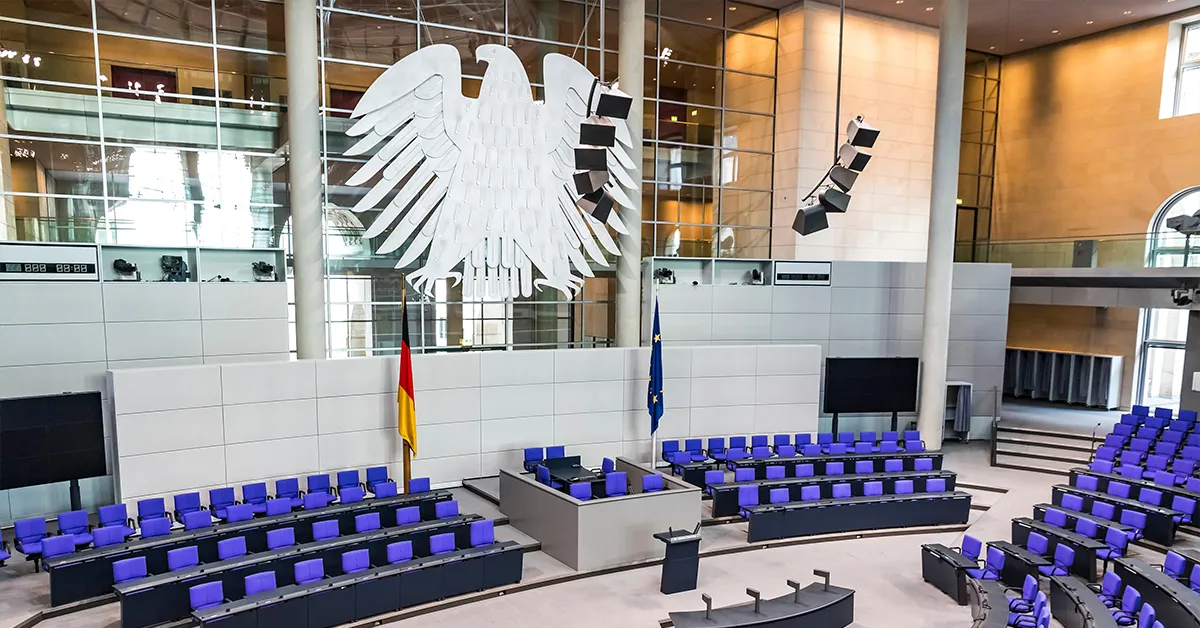
The Bundestag is the main legislative body and the only institution in German politics directly elected by the people. It has been housed in the historic Reichstag building in Berlin since 1999, after the government moved from Bonn to Berlin. About 8,000 people visit the building every day.
Under the electoral reform that took effect from the 21st Bundestag, the number of seats is fixed at 630, down from previous terms that often exceeded 700 seats due to “overhang” and “balance” seats. Members of the Bundestag (Bundestagsabgeordnete) are elected every 4 years by German citizens aged 18 and over through a mixed-member proportional system.
German voters cast two votes in each Bundestag election:
- First vote (Erststimme): for a specific candidate in their constituency. The candidate with the most votes in that constituency wins directly.
- Second vote (Zweitstimme): for a party list at state level. This vote determines each party’s share of seats in the Bundestag.
A party must reach a minimum threshold of 5% of the vote nationally or win at least 3 direct seats to be represented in the Bundestag. This rule is designed to prevent the excessive fragmentation of parliament seen in the Weimar Republic.
The Bundestag’s powers are very broad: passing laws, approving the federal budget, ratifying international treaties, electing the Federal Chancellor, scrutinising the government through question sessions and committees of inquiry, and approving deployments of the Bundeswehr abroad. The Bundestag also elects half of the judges of the Federal Constitutional Court.
The 21st Bundestag election on 23/02/2025 put the CDU/CSU alliance in first place with 28.6% of the vote, while the SPD won only 16.4% — the worst result in the party’s history. Friedrich Merz was elected Chancellor on 06/05/2025 after the CDU/CSU and SPD formed a coalition.
Bundesrat — the Federal Council
The Bundesrat represents the 16 states at federal level and acts as the upper chamber in Germany’s bicameral system. However, unlike the US Senate or the Australian Senate, the Bundesrat does not have equal power with the Bundestag — an important difference to note.
The Bundesrat has 69 members, appointed by the state governments (not directly elected). The number of votes per state depends on population: the most populous states have 6 votes and the small states 3. Bavaria, Lower Saxony and North Rhine-Westphalia each have 6 votes, while Bremen, Hamburg and Saarland have only 3 each. A state’s votes must be cast as a bloc; if members from the same state vote differently, all of that state’s votes are invalid.
According to Bundesrat, the body has three core functions: protecting the interests of the states vis-à-vis the federation and the European Union, ensuring that the states’ administrative experience is incorporated into federal legislation, and acting as a political counterweight to the Bundestag and the federal government.
The Bundesrat’s power depends on the type of law under consideration:
- Consent laws (Zustimmungsgesetze): laws that directly affect state administration, finances shared between the federation and the states, or amendments to the Basic Law. The Bundesrat has an absolute veto — without the Bundesrat’s approval, the law cannot take effect.
- Objection laws (Einspruchsgesetze): other laws on which the Bundesrat has only a right of objection; the Bundestag can override the objection with a corresponding majority.
When the Bundestag and Bundesrat disagree, the matter is referred to the Mediation Committee (Vermittlungsausschuss), made up of 16 members of the Bundestag and 16 members of the Bundesrat, to negotiate a compromise. Because state elections follow different calendars, the make-up of the Bundesrat can change several times during a single Bundestag term, posing significant political challenges for the federal government.
The Chancellor and the Federal Government
The Federal Chancellor (Bundeskanzler) is the head of government and the most powerful politician in German politics. Under Article 65 of the Basic Law, the Chancellor “determines and is responsible for the general guidelines of policy”. This is the principle of Kanzlerdemokratie (chancellor democracy) — a distinctive feature of German politics.
The Chancellor is not directly elected by voters but is elected by the Bundestag on the proposal of the Federal President. To be elected Chancellor, a candidate must win an absolute majority of the members of the Bundestag (the so-called “chancellor majority” — Kanzlermehrheit). In the history of the Federal Republic of Germany, 10 people have held the office of Chancellor, from Konrad Adenauer (1949-1963) to the current Friedrich Merz.
An important feature of the German system is the “constructive vote of no confidence” (konstruktives Misstrauensvotum) under Article 67 of the Basic Law. The Bundestag can remove the sitting Chancellor only by simultaneously electing a new Chancellor by an absolute majority. This mechanism was designed to avoid the political instability of the Weimar era, when many governments were toppled without a successor. As of 2025, only one vote of no confidence has ever succeeded: Helmut Kohl replacing Helmut Schmidt in 1982.
The Federal Government consists of the Chancellor and the Federal Ministers (Bundesminister). The Chancellor proposes ministers for appointment by the President. Each minister runs their own portfolio independently but must follow the general policy guidelines set by the Chancellor. The current Vice-Chancellor is Lars Klingbeil, who is also Minister of Finance in the Merz cabinet.
The Federal President
The Federal President (Bundespräsident) is the head of state, with a largely ceremonial and representative role. Unlike the US or French presidents, the German President holds no substantive executive power — a deliberate response to the strong presidency of the Weimar era that paved the way for Hitler’s rise to power.
The President is not directly elected but is chosen by the Federal Convention (Bundesversammlung). This body consists of all members of the Bundestag and an equal number of delegates chosen by the 16 state parliaments, convened solely to elect the President. The President must be at least 40 years old and may be re-elected once, with each term lasting 5 years.
Frank-Walter Steinmeier has been President since 2017 and was re-elected for a second term in 2022. He previously served as German Foreign Minister for two periods (2005-2009 and 2013-2017) before becoming head of state.
The President’s powers include: signing laws into force, representing Germany in foreign relations, concluding international treaties, appointing and dismissing ministers on the Chancellor’s proposal, and appointing federal judges and senior officers. The President can refuse to sign a law if they believe it violates the Basic Law — a power rarely used but an important safeguard.
The Federal Constitutional Court
The Federal Constitutional Court (Bundesverfassungsgericht) in Karlsruhe is the highest judicial body and one of the most powerful courts in the world. It reviews the constitutionality of laws, administrative decisions and court rulings at every level.
The Court has 16 judges divided into two senates of 8 judges each. Half of the judges are elected by the Bundestag and half by the Bundesrat — both by a two-thirds majority, ensuring broad political consensus. Judges serve a single 12-year term with no re-election and must retire at 68. These requirements are intended to protect judicial independence from political pressure.
The Court’s jurisdiction is very broad, handling about 5,000 cases a year — significantly more than the US Supreme Court. The main types of cases include:
- Individual constitutional complaints (Verfassungsbeschwerde): citizens may complain directly when they believe their fundamental rights have been violated.
- Disputes between federal state bodies.
- Review of the constitutionality of laws at the request of ordinary courts.
- Disputes between the federation and the states.
- Banning unconstitutional parties (it banned the Communist Party KPD in 1956 and the neo-Nazi SRP in 1952).
Rulings of the Federal Constitutional Court are binding on all state bodies and final — there is no possibility of appeal.
The main political parties
Germany’s multi-party system is governed by the Basic Law, which gives parties the role of “participating in the formation of the political will of the people” (Article 21). Five major parties are represented in the 21st Bundestag:
- CDU/CSU (Christian Democratic Union – Christian Social Union): the conservative centre-right alliance, the leading party in the 2025 election with 28.6% of the vote. The CDU operates nationwide except in Bavaria, where the CSU takes its place.
- SPD (Social Democratic Party): Germany’s oldest centre-left party, founded in 1863. It won 16.4% in 2025 — the worst result in its history.
- AfD (Alternative for Germany): a right-wing populist party founded in 2013, growing strongly especially in the East.
- The Greens (Bündnis 90/Die Grünen): an environmentalist left-leaning party with major influence on climate issues.
- Die Linke (The Left): a left-wing party, strong in the eastern states that were once part of East Germany.
A multi-party system combined with the 5% threshold and mixed-member proportional representation means that almost no party ever wins an absolute majority in the Bundestag. German governments are almost always coalitions, with coalition agreements hundreds of pages long negotiated after elections. The current Merz government is a coalition of the CDU/CSU and SPD — a “grand coalition” similar to those of the Merkel era.
Elections and 2026 — a test for the Merz government
2026 has many important state elections, seen by analysts as a major test for the Merz federal government. Five Landtag elections are taking place in Baden-Württemberg, Rhineland-Palatinate, Saxony-Anhalt, Mecklenburg-Vorpommern and Berlin — home to more than a quarter of Germany’s population.
In the two eastern states of Saxony-Anhalt and Mecklenburg-Vorpommern, the AfD leads the polls with support of 39% and 38% respectively, far ahead of its rivals. The CDU/CSU and SPD together reach only 34% and 32% in these states. The results of these state elections will not only affect the composition of the Bundesrat but also be an important indicator of voters’ acceptance of Merz’s reform programme.
State electoral systems differ somewhat from the federal level, but all are based on proportional representation. Each state has its own minimum threshold (usually 5%), a different number of Landtag seats (from 51 in Saarland to 199 in North Rhine-Westphalia) and its own electoral cycle, lasting 5 years instead of the Bundestag’s 4.
Summary
German politics is the product of a costly historical lesson: designing multiple layers of checks and balances to permanently prevent the return of dictatorship. The combination of deeply decentralised federalism, a bicameral system, a strong Constitutional Court, the constructive vote of no confidence and the 5% electoral threshold has created one of the most stable democracies in the world over the past almost 80 years.
For Vietnamese people interested in studying, working or investing in Germany, understanding German politics is very important, because many decisions affecting foreign nationals (such as immigration policy, recognition of qualifications, labour rules and income tax) are divided between the federal and state levels. A policy in force in Bavaria may not apply in the same way in Berlin or Hamburg. Knowing which authority is responsible helps migrants and investors navigate Germany’s complex but highly transparent legal environment accurately.
Accompanying you on your journey in residency investment
The Prosperous Living Investment team advises on pathways, assesses profiles and manages investments transparently for every residency, citizenship and international property objective.
Free profile assessmentWhere life gets prosperous