

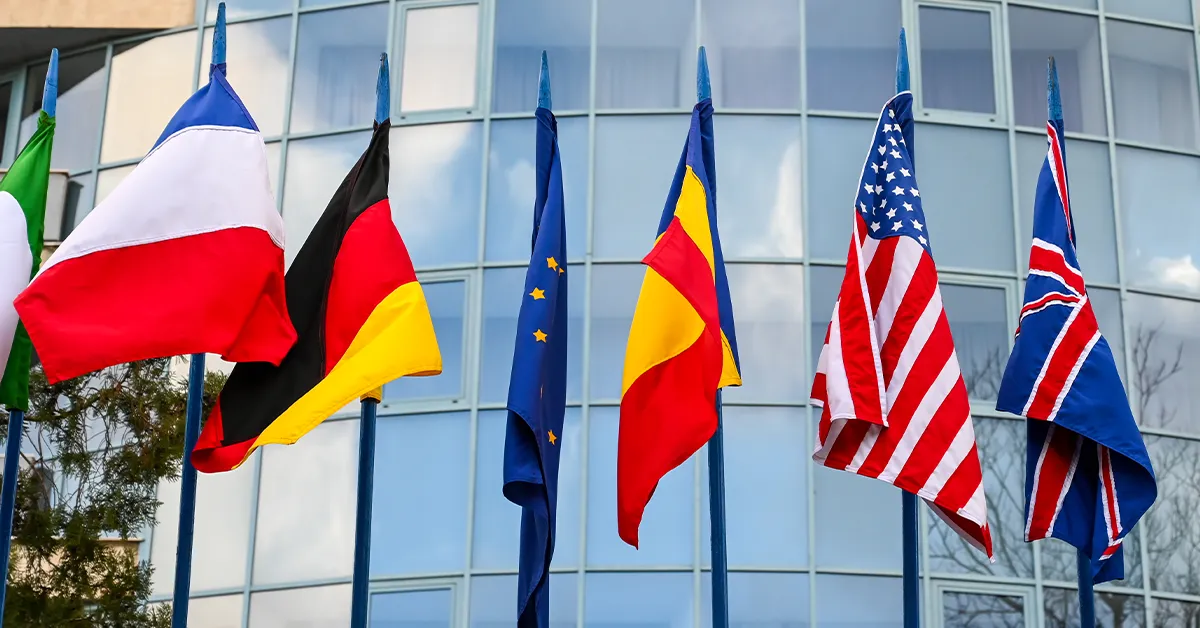
Germany’s international relations make up one of the most influential and active diplomatic systems in the world. As the largest economy in the European Union (EU) and the third-largest in the world, Germany plays a pillar role in almost all multilateral international organisations. According to theGerman Federal Foreign Office (Auswärtiges Amt), Germany’s foreign policy is built on three founding principles: commitment to democratic values and human rights, a preference for multilateral solutions, and cooperation through European integration.
After the Second World War, Germany chose the model of a “Zivilmacht” (civilian power) — using economics and diplomacy rather than military force to address international issues. However, after the Russia-Ukraine conflict from February 2022, and especially under the Friedrich Merz government,Germanyhas made a historic “Zeitenwende” (turning point) in security and defence policy. This article analyses in detail the main pillars of Germany’s international relations and their impact on Germany-Vietnam relations.
Detailed article onGermany.
Message
Germany in the European Union (EU)
The EU is the most important framework in Germany’s international relations. As one of the six founding countries of the European Economic Community (the forerunner of the EU) in 1957 through the Treaty of Rome, Germany regards European integration as vital to its national interests.
Germany is the most influential country in the EU for several structural reasons:
- Budget contributions: Germany is the largest contributor to the EU budget, accounting for about 24% of the total budget in 2024 — about 33.4 billion EURO a year. Receiving back far less than it contributes, Germany acts as the bloc’s “financial locomotive”.
- Economic size: Germany’s GDP accounts for 25% of total EU GDP and 23.7% of the eurozone. Every major EU economic decision has to take Germany’s position into account.
- Central position: Frankfurt am Main is home to the European Central Bank (ECB) — the most powerful institution in the EU’s monetary architecture.
- Political representation: Germany has 96 seats in the European Parliament — the largest number of the 27 member states.
Germany continues to push for EU enlargement. It supports the accession of Ukraine, Moldova and the Western Balkan countries (Albania, North Macedonia, Montenegro, Serbia, Bosnia & Herzegovina, Kosovo). In debates on EU institutional reform, Germany supports abolishing individual vetoes on foreign policy decisions — a change that could help the EU respond more quickly to international crises.
The Merz government has launched a programme of “Germany as Europe’s engine”, committing to strengthen Germany’s leadership in tackling the continent’s most important crises: the war in Ukraine, climate change, illegal migration, and economic competition with China and the United States.
Considering a residency programme? The Prosperous Living Investment team assesses your profile free of charge and advises on the pathway that fits your goals.
The Franco-German axis and the Weimar Triangle
The Franco-German axis is regarded as the “twin engine” of European integration. This special bilateral relationship is institutionalised through two founding treaties:
- The Élysée Treaty (22/01/1963): signed by President Charles de Gaulle and Chancellor Konrad Adenauer, formally turning France and Germany from historic enemies (through three major wars in 1870, 1914 and 1939) into strategic partners.
- The Aachen Treaty (22/01/2019): signed by President Emmanuel Macron and Chancellor Angela Merkel on the 56th anniversary of the Élysée Treaty, extending cooperation to new areas such as joint defence, the digital economy and education.
The two countries hold regular meetings of a joint Council of Ministers (Conseil des Ministres Franco-Allemand) and have a Franco-German Parliamentary Assembly (Assemblée parlementaire franco-allemande), established in 2019 with 50 members from each country’s parliament. Joint military forces such as the Eurocorps (1992) and the Franco-German Brigade (1989) symbolise deep security cooperation.
However, Franco-German relations also have traditional tensions. France emphasises strategic autonomy and nuclear energy, while Germany prioritises transatlantic cooperation and closed all its nuclear power plants in 2023. The eurozone sovereign debt crisis (2010-2015) also left scars, when Germany was criticised by France and Southern Europe for imposing overly harsh austerity.
The Weimar Triangle (Weimarer Dreieck) is a trilateral cooperation mechanism between Germany, France and Poland, established in 1991 to support Poland’s integration into the EU and NATO. After the Russia-Ukraine conflict, the mechanism was strongly revived. In March 2024, the leaders of Germany, France and Poland held a summit in Berlin, agreeing on a strategy to support Ukraine and the EU’s collective defence.
Germany and NATO: its role after the 2022 Zeitenwende
Germany joined NATO on 09/05/1955 and plays a central role in the alliance’s collective defence structure. After the fall of the Berlin Wall in 1989 and the collapse of the Soviet Union in 1991, Germany cut defence spending significantly, from 2.8% of GDP in 1990 to 1.1% of GDP in 2014.
The Russia-Ukraine conflict from 24/02/2022 prompted Germany to make a historic “Zeitenwende” — a term coined by former Chancellor Olaf Scholz in a speech to the Bundestag on 27/02/2022. Two main reforms were announced:
- A special 100 billion EURO fund (Sondervermögen) for the Bundeswehr.
- A commitment to spend 2% of GDP on defence in line with the NATO target.
However, under the Scholz government (2021-2025), progress on the Zeitenwende was slow. When Friedrich Merz became Chancellor on 06/05/2025, he pushed defence reform far beyond expectations:
- March 2025: the Bundestag passed an amendment to the Basic Law exempting defence spending above 1% of GDP from the “debt brake” (Schuldenbremse).
- The defence budget rose from 86 billion EURO in 2025 to 108.2 billion EURO in 2026 — a record in modern German history.
- A commitment to reach 3.5% of GDP for core defence by 2029 — six years ahead of NATO’s 2035 deadline. Plus an additional 1.5% of GDP for infrastructure and broader security under NATO’s new Hague 2025 target.
- A plan to borrow a further 400 billion EURO over the next 5 years to modernise the Bundeswehr.
- The goal of making the Bundeswehr “the strongest conventional army in Europe”.
NATO Secretary General Mark Rutte praised Germany’s commitment at a joint press conference with Chancellor Merz on 11/12/2025: “Germany reaching 3.5% of GDP by 2029 is very impressive — a change of resolve that shows exactly the kind of commitment we need to ensure our security.”
Germany has made important concrete contributions to NATO:
- The permanent 45th Brigade in Lithuania (4,800 troops, fully operational by 2027): an unprecedented step, as Germany permanently stations troops abroad for the first time since the Second World War.
- Rapid reaction forces: Germany is the largest contributor to the NATO Response Force (NRF).
- Baltic Air Policing and missile defence: German aircraft patrol the airspace of the Baltic states and provide protection along NATO’s extended flanks.
- An investment of 41 billion EURO in defence space capabilities (announced 10/2025).
Germany in the G7, G20 and OECD
Germany is a founding member of the world’s largest multilateral economic forums:
- G7: Germany has taken part since its founding in France in 1975, when it was the G6. As one of the 7 leading industrial economies, Germany has hosted the G7 summit several times — most recently at Schloss Elmau (Bavaria) in 2022.
- G20: Germany has taken part since its founding in 1999 and hosted the G20 summit in Hamburg in 2017.
- OECD (Organisation for Economic Co-operation and Development): Germany has been a member since 1961, contributing significantly to economic and policy reports.
- BIS (Bank for International Settlements) in Basel: the Bundesbank is one of the 6 largest central banks involved in its governance.
In these forums, Germany consistently supports the rules-based multilateral trading system. This is vital for the world’s third-largest exporting economy, with exports equal to 50.3% of GDP.
The trade war under the Trump 2.0 administration (since 2025) poses a major challenge for German economic diplomacy. The United States has imposed new tariffs on European goods, especially cars — directly affecting German manufacturers such as BMW, Mercedes-Benz and Volkswagen. Germany has responded by stepping up the diversification of its export markets towards India, Brazil and Southeast Asian countries.
Germany and the United Nations
Germany has been a member of the United Nations since 18/09/1973 — later than many other countries because of its division during the Cold War. West Germany and East Germany joined at the same time and merged their memberships in 1990 after reunification.
Germany is the third-largest contributor to the regular UN budget and one of the largest voluntary donors to development and humanitarian programmes. Germany has held a non-permanent seat on the Security Council six times (1977-78, 1987-88, 1995-96, 2003-04, 2011-12, 2019-20).
One of Germany’s long-term diplomatic goals is reform of the Security Council to gain a permanent seat — together with Japan, Brazil and India in the G4 group. However, reform efforts have been blocked by China and some other countries.
Germany is also home to many important UN bodies:
- The UN Bonn Campus in Bonn: 25 UN organisations, notably the UNFCCC (Framework Convention on Climate Change) and UNV (United Nations Volunteers).
- Information and training centres of UNESCO, UNHCR and FAO in several cities.
Relations with the United States
Germany-US relations have been one of Germany’s most important bilateral relationships in the post-war era. The United States was West Germany’s main ally in the Cold War and played a key role in German reunification in 1990.
Today, Germany-US relations combine close cooperation with growing tensions:
Areas of cooperation:
- The United States overtook China to become Germany’s largest single trading partner in 2024, accounting for more than 10% of exports.
- Germany is the second-largest contributor to NATO after the United States.
- More than 35,000 US troops are stationed in Germany — Ramstein Air Base is the most important US command base in Europe.
- Deep intelligence cooperation through the “Five Eyes Plus” network (although Germany is not a formal Five Eyes member).
Areas of tension:
- The tariff policy of the Trump 2.0 administration hits German car and machinery exports hard.
- US pressure to increase defence spending — an issue Germany has responded to positively with the Zeitenwende.
- Differences in approach to China, climate change and global trade.
- NSA surveillance and European digital sovereignty.
On his 2025 visit to Washington, Chancellor Merz emphasised the message that Germany is taking on greater responsibility for European defence — a change the Trump administration welcomed, while maintaining pressure on the trade balance.
Relations with China and Asia
China was Germany’s largest trading partner for many years before being overtaken by the United States in 2024. Germany-China relations underwent a profound reshaping in the 2020s.
During the Merkel era (2005-2021), Germany pursued a policy of “Wandel durch Handel” (change through trade) — hoping that close economic ties with China would encourage political openness. Volkswagen, BMW and BASF invested billions of euros in the Chinese market and became heavily dependent on revenue from it.
However, since 2022, Germany has adjusted its policy:
- July 2023: Germany published its first China Strategy, defining China as a “partner, competitor and systemic rival”.
- Restricting Chinese investment in critical infrastructure — such as the port of Hamburg (COSCO was allowed to buy only 24.9% instead of 35%).
- Reducing dependence on Chinese raw materials and markets in strategic sectors.
- Gradually excluding Chinese suppliers (Huawei, ZTE) from 5G networks by 2026.
Besides China, Germany is strengthening relations with other Asian countries. Its strategic partnerships with Japan (2017), South Korea (2018) and India (2000) have been upgraded. Germany-Vietnam cooperation is also part of this “diversification” strategy.
Germany’s support for Ukraine after the conflict with Russia
Germany is the second-largest supporter of Ukraine in the world (after the United States) in financial, military and humanitarian terms. Germany’s total commitments to Ukraine by the end of 2025 amounted to about 50 billion EURO, including:
- Military aid: more than 28 billion EURO, including Leopard 2 tanks, Patriot and IRIS-T air defence systems, Panzerhaubitze 2000 howitzers, ammunition and Marder infantry fighting vehicles.
- Financial and budget support: 17 billion EURO.
- Humanitarian aid: 5 billion EURO.
- Refugee support: more than 1.1 million Ukrainians have been taken in by Germany since 2022.
Germany’s 2026 budget allocates 11.5 billion EURO to support Ukraine — the highest annual amount since the conflict began. Germany also leads the Coalition of the Willing — a group of European countries committed to sustaining support for Ukraine even if the United States reduces its commitment.
However, Germany’s position still has important limits. Germany has refused to supply long-range Taurus cruise missiles to Ukraine for fear of escalation. Germany also opposes the idea of deploying German troops directly in Ukraine after the conflict ends — a caution reflecting its historical legacy and domestic political pressure.
The Germany-Vietnam Strategic Partnership since 2011
Germany-Vietnam relations were established in September 1975, shortly after Vietnam’s reunification. The two countries upgraded relations to a Strategic Partnership on 11/10/2011 during Chancellor Angela Merkel’s visit to Vietnam — making Germany one of Vietnam’s first European strategic partners.
Across the pillars of cooperation:
- Trade: Germany is Vietnam’s largest trading partner in the EU. Bilateral trade reached about USD 12 billion in 2024, with Vietnam running a trade surplus with Germany. The EU-Vietnam Free Trade Agreement (EVFTA), in force since 08/2020, has strongly boosted trade.
- Investment: Germany has more than 480 FDI projects in Vietnam with total registered capital of about USD 2.8 billion, concentrated in manufacturing, supporting industries and services. Bosch, Siemens, BASF, Mercedes-Benz and Bayer all have a significant presence.
- Development cooperation: Germany is one of the largest ODA donors to Vietnam, especially in green energy, vocational training, the environment and sustainable urban development. GIZ (the German Agency for International Cooperation) has more than 200 experts in Vietnam.
- Education and training: Vietnam is one of Germany’s important source markets for international students in Asia. About 8,000-10,000 Vietnamese students are studying at German universities. The Vietnamese-German University (VGU) in Bình Dương is the most prominent bilateral higher education project.
The Vietnamese community in Germany is estimated at about 200,000 people, divided into two main groups: the community in the former West (mostly boat people who fled after 1975 and their families) and the community in the former East (contract workers from the German Democratic Republic era and their descendants). Vietnamese in Germany are known for their strong commitment to education — students of Vietnamese origin attend Gymnasium at twice the average rate of immigrant students.
According to the German Embassy in Vietnam, 2025-2026 marks the 50th anniversary of Germany-Vietnam diplomatic relations (1975-2025). The two countries have held many commemorative activities and upgraded cooperation, especially in three priority areas: the energy transition, skilled workforce training and legal dialogue.
Summary
Germany’s international relations are undergoing their most important transformation since reunification in 1990. The combination of the Russia-Ukraine conflict, systemic competition with China, US tariff pressure and the need to secure Europe after the Zeitenwende has pushed Germany from its traditional role as a “civilian power” to a “multi-dimensional power” — combining economic, diplomatic and military strength. The commitment to spend 3.5% of GDP on defence by 2029, a record defence budget of 108.2 billion EURO in 2026 and the goal of building Europe’s strongest army are the clearest signs of this shift.
For Vietnamese people, the Germany-Vietnam Strategic Partnership creates practical opportunities in many areas: studying at tuition-free German universities, working through the EU Blue Card and Chancenkarte visa channels, investing in the EU’s most stable market, or accessing German government development support for green projects in Vietnam. 2025-2026, marking 50 years of diplomatic relations, is a favourable time for Vietnamese individuals and businesses to expand their connections with one of Vietnam’s most influential partners in Europe.
Accompanying you on your journey in residency investment
The Prosperous Living Investment team advises on pathways, assesses profiles and manages investments transparently for every residency, citizenship and international property objective.
Free profile assessmentWhere life gets prosperous