


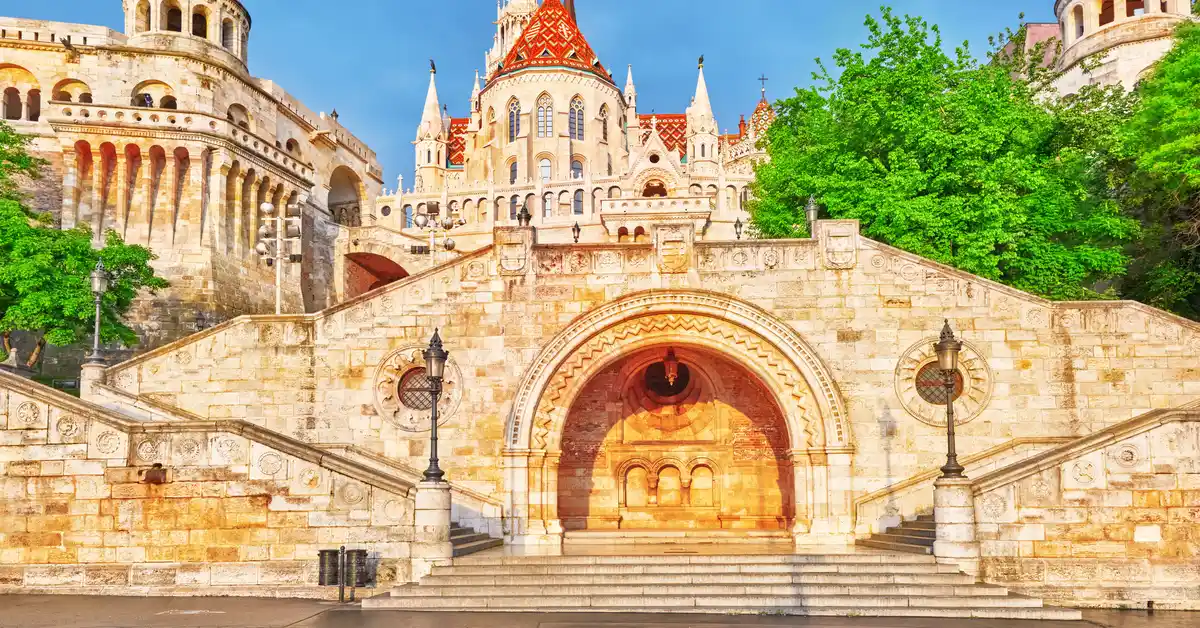
The entire history of Hungary is a journey of more than one thousand years, beginning when the Magyar tribes set foot in the Carpathian Basin at the end of the 9th century. From the medieval kingdom of King Saint Stephen I to the European Union member state of today, this nation has gone through many major ups and downs.
Contents
Overview of the flow of Hungarian history
To grasp the profile of this Central European nation, one can divide Hungarian history into several major consecutive stages. Each stage is associated with a decisive turning point, from the early days of nation-building to the process of contemporary European integration. A chronological approach helps the reader clearly see the continuity as well as the ruptures in the nation’s destiny.
The first stage is the appearance of the Magyars and the formation of the kingdom under King Saint Stephen I around the year 1000. This was followed by the Middle Ages, then the period of division between the Ottoman Empire and the Habsburg dynasty. Entering the modern era, the 1867 Compromise gave birth to the Austro-Hungarian regime, opening a period of brilliant development for Budapest and the entire kingdom.
The 20th century witnessed intense turmoil: the 1920 Treaty of Trianon, two world wars, the 1956 revolution and finally the peaceful democratic transition in 1989 and 1990. The culmination of the integration process was joining the European Union in 2004. The following sections will delve into each of these periods in turn.
Considering a residency programme? The Prosperous Living Investment team assesses your profile free of charge and advises on the pathway that fits your goals.
The Magyars and the early days of nation-building
The story of Hungarian history is often told from the time the Magyar tribes migrated into the Carpathian Basin, the fertile plain in Central Europe where the Danube flows. This event, often called the “land-taking” (honfoglalás), took place around the end of the 9th century. The Magyars were a nomadic people speaking a language belonging to the Finno-Ugric family, distinct from the majority of their surrounding Slavic and Germanic neighbours.
According to tradition, the chieftain Árpád is considered the one who led the Magyar tribes into the new land and laid the foundation for the ruling dynasty that followed. In the early period, the Magyars were famous for their horse-riding expeditions across Europe. However, after several military defeats against Western powers, they gradually shifted from a nomadic lifestyle to settling down and adopting the influence of Christian civilisation.
Learning about this period is linked to the broader story of Hungary, a landlocked country whose identity was shaped from the very first centuries. The transition from a tribal confederation to an organised state paved the way for the birth of the Kingdom of Hungary.
King Saint Stephen I and the Christian kingdom in the year 1000
A major turning point in Hungarian history was the coronation of István (Stephen I) around the year 1000, a milestone often cited as the birth of the Kingdom of Hungary. As a descendant of the Árpád dynasty, he was crowned according to tradition and maintained close ties with the Roman Catholic Church.
King Stephen I established Christianity as the spiritual foundation of the kingdom, reorganised the administration into counties, and built a system of dioceses. Thanks to these contributions, he was later canonised by the Church and honoured as the founding king. St. Stephen’s Day remains one of the most important national holidays for the Hungarian people.
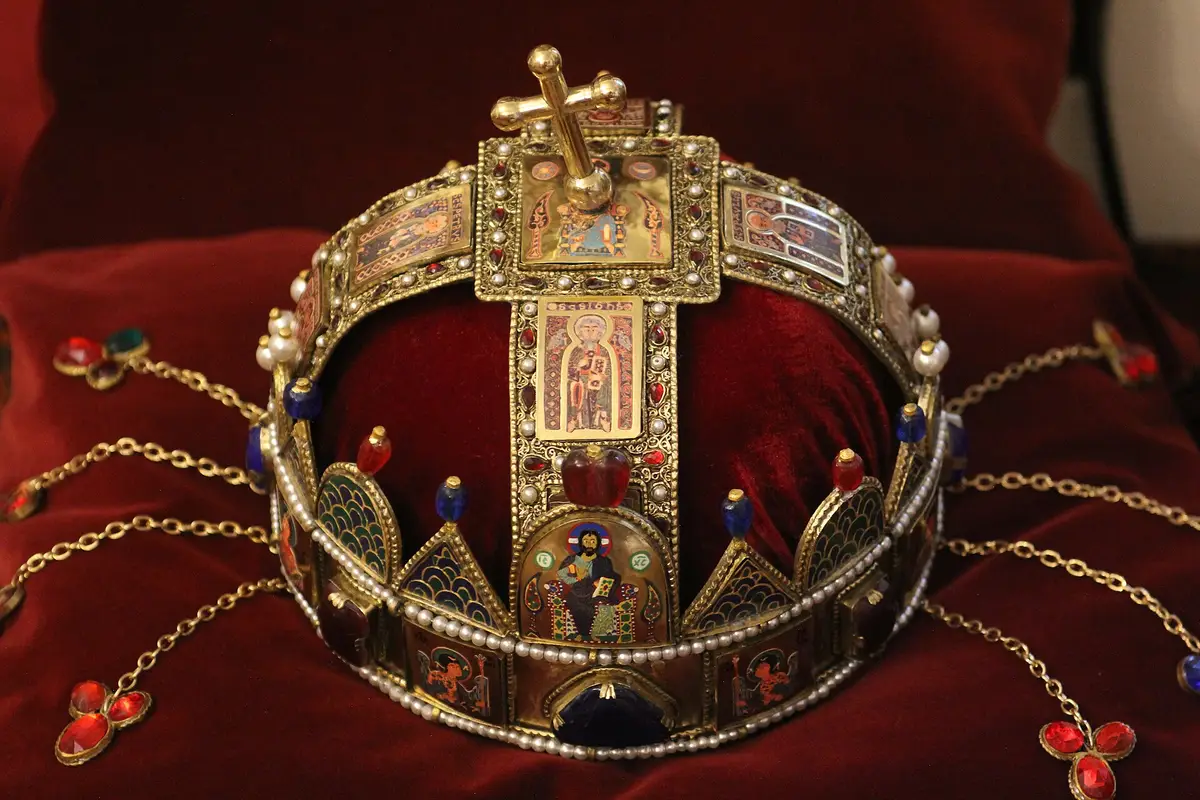
Under the Árpád dynasty, which lasted for several centuries, the kingdom gradually consolidated its position in Central Europe. The Holy Crown of Stephen became a sacred symbol of sovereignty, a legacy that remains deeply embedded in Culture of Hungary to this day. This dynasty lasted until the early 14th century, when the Árpád line died out and the throne passed to other houses.
The Middle Ages and the peak before the turmoil
After the end of the Árpád dynasty, the Kingdom of Hungary was ruled by kings from various foreign houses, including the French-originated Anjou dynasty. This was a period when the kingdom expanded its influence and developed its economy, particularly thanks to precious mineral mines and trade routes connecting Central Europe with the East.
One of the most frequently mentioned figures is King Matthias Corvinus, who reigned in the 15th century. His reign is associated with a court rich in Renaissance spirit, promoting scholarship, art, and a famous royal library. During this period, Hungary was one of the most significant kingdoms in the region.
However, the threat from the rising Ottoman Empire in the south grew increasingly severe. Prolonged border conflicts placed the kingdom under existential pressure. Furthermore, internal tensions among the nobility weakened the collective defence, paving the way for serious events in the early 16th century.
The Ottoman yoke and the rise of the Habsburgs
In the early 16th century, the Kingdom of Hungary suffered a heavy defeat against Ottoman forces at the Battle of Mohács. After this event, Hungarian territory was gradually divided into several parts: a large central region under Ottoman control, a western and northern part belonging to the Habsburg dynasty, and the Principality of Transylvania in the east, which maintained relative autonomy.
For many decades, the Hungarian lands became a battlefield between two great empires. Modern-day Budapest, which formed from settlements on both sides of the Danube, was also under Ottoman influence during this period, leaving marks such as the Turkish-style baths that are still mentioned today.
By the end of the 17th century, military campaigns by the Christian alliance had pushed Ottoman power out of most of the Carpathian Basin. As a result, the Habsburg dynasty in Vienna gradually asserted its rule over most of the Hungarian territory. This transition opened a new era, in which the Hungarians repeatedly struggled to protect their autonomy against the Habsburg court.
The 1848 Revolution and the aspiration for freedom
During the wave of revolutions that swept across Europe in 1848, the Hungarians also rose up to demand reforms and broader autonomy within the framework of the Habsburg Empire. This movement was associated with figures such as the politician Lajos Kossuth and the poet Sándor Petőfi, who became symbols of the national spirit.
The revolution initially won many concessions and declared important civil rights. However, the movement was later suppressed with the intervention of external forces supporting the Habsburg court. Although a military failure, the events of 1848 left a deep mark and nurtured the Hungarian desire for self-determination.
The spirit of 1848 was later remembered as one of the sacred milestones of national history. Lessons from this revolution also helped shape important political compromises in the following decades, as both sides realised the need for a new arrangement for the relationship between Vienna and Budapest.
The Austro-Hungarian Empire of 1867 and the golden age of Budapest
In 1867, a historic compromise between the Habsburg court and the Hungarian political elite gave birth to the dual monarchy of Austria-Hungary. Under this arrangement, Hungary gained broad autonomy with its own government and parliament, although it still shared certain common areas such as defence and foreign affairs with the Austrian part of the empire.
The Austria-Hungary period is considered a time of strong economic and urban development. Budapest was officially formed from the unification of the cities of Buda, Óbuda, and Pest, rising to become a major metropolis with many magnificent architectural works. Many of the city’s famous landmarks today were created during this period.
This was also a time of flourishing science, art, and civic life. The railway system, industry, and education were significantly expanded. However, the ethnic diversity within the empire and underlying national tensions remained a major challenge, and those tensions would be clearly revealed as Europe entered the Great War.
World War I and the 1920 Treaty of Trianon
The Austro-Hungarian Empire participated in the First World War on the side of the Central Powers and suffered a heavy defeat. When the war ended, the empire dissolved, and the peoples within it gradually separated into independent nations or were incorporated into neighbouring countries.
For Hungary, the greatest consequence was the Treaty of Trianon signed in 1920. Under this treaty, the former Kingdom of Hungary lost most of its territory and a significant portion of its Hungarian-speaking population, who from then on lived outside the borders of the new nation. Trianon became one of the deepest and most sensitive wounds in the collective memory of the Hungarian people.
The loss of territory at Trianon had a long-term impact on Hungarian politics as well as the national consciousness throughout the 20th century. Many Hungarian communities in neighbouring countries have preserved their language and culture, making the issue of the diaspora and regional relations a constant topic in national life.
The interwar period and World War II
After Trianon, Hungary entered the interwar period with much political and economic instability. The country was organised as a kingdom in name but without a king, led by a regent for most of this period. The desire to revise the terms of Trianon was a persistent political motivation.
When the Second World War broke out, Hungary gradually leaned towards the Axis powers, partly in the hope of regaining lost lands. This decision pushed the country into the war with tragic consequences, including massive loss of life and tragedies for the Jewish community and other population groups.
In the final stages of the war, Hungarian territory became a fierce battlefield, and Budapest suffered a devastating siege that caused heavy damage to the city. When the war ended, Hungary fell into the Soviet sphere of influence, opening a completely new chapter in the country’s modern history.
The socialist period and the 1956 revolution
After the Second World War, Hungary became a socialist state modelled on the Soviet Union, within the Eastern Bloc. Political, economic, and social life were profoundly reorganised, with a centrally planned economy and a one-party political system.
In 1956, dissatisfaction with the regime and the desire for reform erupted into the Hungarian Revolution, one of the most remembered events of the 20th century. Citizens and students took to the streets to demand greater freedom and independence. This movement was later crushed by military intervention, leading to a wave of many Hungarians leaving the country.
Although suppressed, the spirit of 1956 was honoured as a symbol of the desire for freedom. In the following decades, Hungary gradually adopted some economic adjustments that were relatively more open than many other countries in the region. These incremental changes prepared the foundation for the major transition at the end of the 1980s.
Democratic transition 1989–1990
In the late 1980s, a wave of change swept across Eastern Europe, and Hungary was one of the leading nations in this transition. Between 1989 and 1990, the country shifted from a single-party socialist state to a democratic republic with a multi-party system and free elections.
Hungary played a notable role by loosening its western border controls, a symbolic move that contributed to the major shifts in Europe at the time. The transition in Hungary was relatively peaceful, achieved through dialogue and institutional reform rather than violent conflict.
This shift laid the foundation for Hungary’s modern political system, with a revised constitution and new democratic institutions. The country began to reorient itself toward the West in terms of politics, economy, and security, paving the way for its accession to key international organisations in the following years.
European integration and EU accession in 2004
After transitioning to democracy, Hungary pursued the goal of deep integration with the West. The country joined the European Union in 2004, during a major expansion that welcomed many Central and Eastern European nations. This was considered a significant milestone, marking Hungary’s full return to the European political and economic fold.
Joining the European Union provided Hungary with access to a vast single market, development resources, and the freedom of movement for its citizens within the bloc. Prior to this, Hungary had also joined the transatlantic military alliance, further strengthening its security orientation toward the West.
Many of the country’s historical and cultural legacies are internationally recognised. The United Nations Educational, Scientific and Cultural Organization has inscribed several sites in Hungary on the World Heritage list, according to information from UNESCO. This reflects the depth of a civilisation shaped over more than one thousand years.
Today, to fully understand the profile of this nation, one often places the flow of the past alongside contemporary life, from state institutions to spiritual values. Hungarian history, therefore, is not just a series of past events but a key to explaining the identity of a nation in the heart of Central Europe.
Accompanying you on your journey in residency investment
The Prosperous Living Investment team advises on pathways, assesses profiles and manages investments transparently for every residency, citizenship and international property objective.
Free profile assessmentWhere life gets prosperous