

Singapore’s economy is one of the most remarkable success stories of the 20th and 21st centuries. From a country lacking natural resources with GDP per capita of only about USD 500 in 1965, the island nation has risen to become Asia’s leading developed economy, with GDP per capita exceeding USD 67,000 in 2024.
This article analyses the size, sector structure, financial system, tax policy, free trade agreement network and challenges facing Singapore’s economy in the current international context. This is essential background for Vietnamese investors, businesses and individuals interested in opportunities in Singapore.
Detailed article onSingapore.
Message
Overview of the size and growth of Singapore’s economy
According to official figures from theMinistry of Trade and Industry Singapore (MTI), the economy grew 4.8% for the whole of 2025, following 4.4% growth in 2024. In the fourth quarter of 2025 alone, GDP rose 5.7% year on year, the highest since 2021.
Singapore’s GDP per capita in 2024 was about USD 67,706 according to World Bank data, ranking in the global top 10. At purchasing power parity (PPP), GDP per capita exceeds USD 150,000, placing Singapore among the two richest countries in the world alongside Luxembourg.
The overall size of the economy was around USD 514 billion at current prices for 2024. Singapore’s trade-to-GDP ratio exceeds 320%, one of the highest in the world, reflecting an open economy heavily dependent on imports and exports.
The Monetary Authority of Singapore (MAS) eased monetary policy twice in 2025 to cope with pressure from global trade tensions. MTI raised its growth forecast for 2026 from about 1.0% to 3.0% to between 2.0% and 4.0%, reflecting a recovery in manufacturing and business confidence.
Considering a residency programme? The Prosperous Living Investment team assesses your profile free of charge and advises on the pathway that fits your goals.
The four main pillars of Singapore’s economy
Singapore’s economy is built on four main industrial pillars, each contributing to GDP and creating jobs in different ways. This diversification helps the island nation reduce risk when a particular sector faces difficulties.
High-tech manufacturing
Manufacturing accounts for about 17% to 20% of GDP, making it the largest sector by value added. In the fourth quarter of 2025, the sector grew 15.0% year on year, the largest contributor to overall economic growth. Key manufacturing clusters include electronics and semiconductors, biomedical sciences, chemicals and oil refining, and transport and precision engineering.
Singapore is one of the world’s most important semiconductor manufacturing hubs, with plants run by major groups such as Micron, GlobalFoundries and TSMC. The biomedical sector is also thriving thanks to the presence of leading multinational pharmaceutical companies.
Financial and insurance services
Finance and insurance is one of the most important pillars, contributing about 14% of GDP and making Singapore one of Asia’s four largest financial centres alongside Hong Kong, Tokyo and Shanghai. More than 200 international banks have regional headquarters or branch offices there.
In particular, Singapore is the largest private wealth management centre in Southeast Asia. According to the Singapore Asset Management Survey 2024 published by the Monetary Authority of Singapore (MAS), total assets under management (AUM) in the island nation’s fund management industry reached SGD 6.07 trillion at the end of 2024, up 12% from 2023. The number of licensed fund management companies in Singapore reached 1,298. Single-family offices are also growing rapidly thanks to supportive policies and tax advantages.
Logistics, aviation and trade
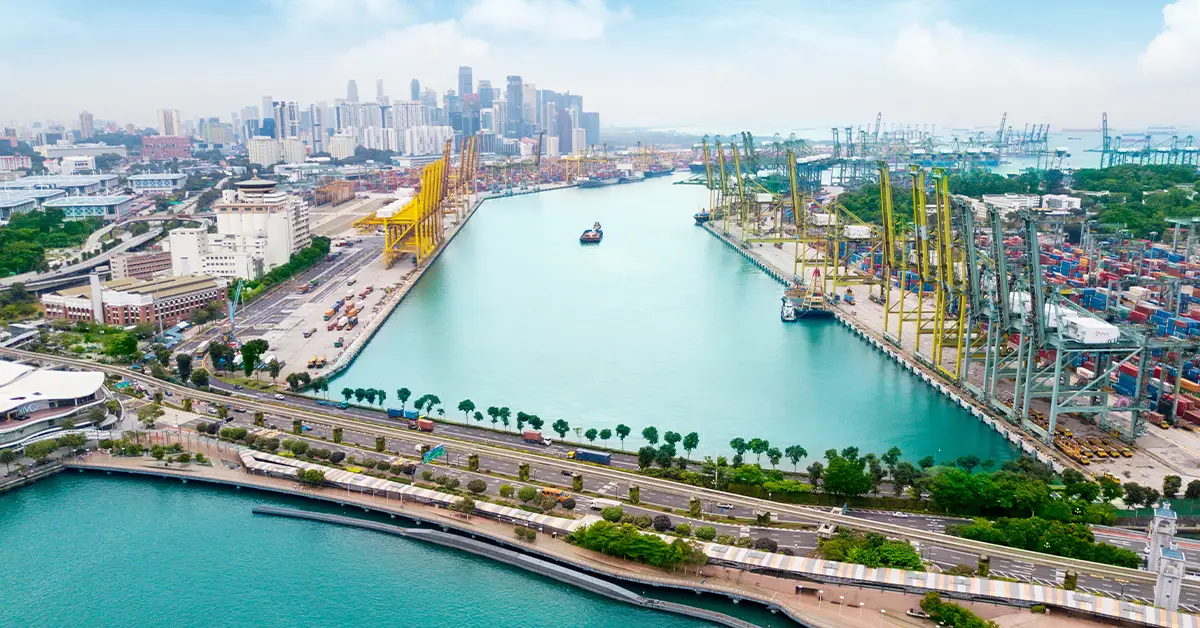
The Port of Singapore is consistently ranked in the world’s top two for container throughput, second only to Shanghai. Changi Airport is one of the busiest airports in the world and among the most highly rated for service quality. Its strategic location at the crossroads of major shipping routes helps the island nation maintain its role as a regional logistics hub.
Wholesale trade and transport contribute about 20% of GDP. The recovery of global trade in 2024 and early 2025 supported growth in this sector, with container throughput at Singapore’s ports rising 5.4% in 2024.
Professional services and information technology
Information and communications together with professional services account for a growing share of Singapore’s economic structure. Financial technology (Fintech), artificial intelligence, strategic consulting and legal services are all thriving thanks to the government’s talent and investment attraction policies.
The annual Singapore Fintech Festival has become one of the largest fintech conferences in the world, attracting tens of thousands of participants from more than 130 countries. This demonstrates the island nation’s standing as an innovation hub.
The financial system and the Monetary Authority of Singapore
The Singapore dollar (SGD) is the official currency, managed under a managed float exchange rate regime against a basket of the currencies of its main trading partners. This model differs from most other countries, which conduct monetary policy through interest rates.
The Monetary Authority of Singapore (MAS) acts as the central bank and as the integrated regulator of the entire financial sector, from banking and insurance to securities and fund management. This integrated supervisory model is considered effective in maintaining financial stability and preventing systemic risk.
The Singapore Exchange (SGX) is the second-largest stock exchange in Southeast Asia after Indonesia, with more than 600 listed companies. The island nation is also one of the largest foreign exchange trading centres in the world, ranking third after London and New York.
The stability of the SGD and a transparent legal environment are key attractions for international investors. Singapore’s inflation rate in 2025 was just 0.9%, showing a high degree of price stability while many major economies still face inflationary pressure.
The tax system and business environment in Singapore
Singapore’s tax system is designed to encourage investment, business and wealth accumulation. This is one of the main reasons the island nation is consistently ranked among the best business environments in the world in reports by the World Bank and the Heritage Foundation.
The maximum corporate income tax rate is 17%, among the lowest of developed economies. Start-ups and small businesses also enjoy substantial tax relief in their early years. Partial tax exemption schemes reduce the effective tax rate even further.
Personal income tax is progressive, ranging from 0% on income up to SGD 20,000 to a maximum of 24% on income above SGD 1 million a year. For non-residents, tax is generally charged at 15% or 22% depending on the type of income. The Goods and Services Tax (GST) has been 9% since 2024, up from the 8% applied in 2023.
A notable feature is that Singapore has no capital gains tax, no inheritance tax and no dividend tax for individuals. This makes the island nation an ideal destination for family offices, investment funds and ultra-high-net-worth individuals (UHNWIs) seeking to optimise their wealth structures.
Free trade agreements and international integration
Singapore pursues a thoroughly open trade strategy, having signed more than 27 bilateral and multilateral free trade agreements (FTAs) with partners around the world. This network covers most of the world’s major economies, from the United States and China to the European Union and ASEAN countries.
The island nation is an active member of key regional economic frameworks. The Comprehensive and Progressive Agreement for Trans-Pacific Partnership (CPTPP) and the Regional Comprehensive Economic Partnership (RCEP) are the two most important multilateral frameworks Singapore belongs to. The ASEAN Economic Community also facilitates the flow of goods, services, capital and labour between member states.
The US-Singapore Free Trade Agreement, in force since 2004, has significantly boosted trade between the two sides. However, in April 2025, the US administration imposed a 10% baseline tariff on goods imported from Singapore as part of its reciprocal tariff policy. This development creates new challenges for bilateral trade, although the rate is much lower than for other partners.
Vietnam – Singapore agreements and the upgrade of relations to a Comprehensive Strategic Partnership in 2025 have opened a phase of deeper cooperation. The Vietnam – Singapore Industrial Park (VSIP) network remains a symbol of bilateral economic cooperation over nearly three decades.
Challenges and outlook for Singapore’s economy
Although Singapore’s economy continues to grow, the island nation faces several structural challenges in the medium and long term. Identifying these challenges helps investors and businesses develop the right strategy when entering the market.
The biggest challenge is excessive dependence on international trade. With a trade-to-GDP ratio above 320%, any disruption in global supply chains, US-China trade tensions or geopolitical risks can directly affect the economy. The tariff situation in 2025 is a concrete example.
The second challenge is rapid population ageing. A fertility rate below 1.0 child per woman combined with high life expectancy puts heavy pressure on healthcare, pensions and the workforce. The government must step up selective immigration and invest in automation to offset labour shortages.
High business and living costs are another challenge. Singapore is consistently ranked among the most expensive cities in the world, putting pressure on small and medium-sized businesses as well as the middle-income workforce. The government has rolled out many support programmes, but the issue remains a hot topic in public debate.
In addition, competitive pressure from regional financial centres such as Hong Kong, Dubai and Shanghai requires Singapore to keep innovating. The government is investing heavily in new areas such as artificial intelligence, the green economy, renewable energy and the digital economy to maintain its competitive edge in the future.
Summary
Singapore’s economy is vivid proof that a small country without natural resources can achieve world-leading prosperity through smart economic policy, a transparent legal system and a consistently open trade strategy. Four diversified industrial pillars and a friendly tax environment create lasting appeal for international investors.
For the Vietnamese business and investor community, a clear understanding of the structure and drivers of Singapore’s economy is an important foundation for making the right investment, business or settlement decisions. With its extensive FTA network, favourable tax policies and central regional position, the island nation remains one of the top destinations for business expansion or wealth restructuring plans amid major shifts in the global economy.
Accompanying you on your journey in residency investment
The Prosperous Living Investment team advises on pathways, assesses profiles and manages investments transparently for every residency, citizenship and international property objective.
Free profile assessmentWhere life gets prosperous