

Although it covers only about 735 km² and has just over 6 million people, Singapore plays a role in the international system far beyond its geographic size. Since gaining independence in 1965, the island nation has built a wide diplomatic network with more than 190 countries and become home to many important international organisations in the Asia-Pacific.
This article analyses the core principles of foreign policy, its standing in international organisations, and the relations with major powers and strategic partners ofSingapore, with a focus on relations with Vietnam, which were upgraded to a Comprehensive Strategic Partnership in 2025.
Detailed article onSingapore.
Message
Core principles of Singapore’s foreign policy
Singapore’s foreign policy rests on three main principles formed under the late Foreign Minister Sinnathamby Rajaratnam and maintained to this day. These principles have helped the small island nation survive and thrive in the region’s complex geopolitical environment.
The first principle is pragmatism and the protection of national interests. Singapore does not pursue ideological values in international relations but focuses on economic interests, security and strategic stability. The country maintains relations with any partner that can deliver practical benefits, regardless of their political system.
The second principle is balance among the major powers. Singapore is especially careful not to lean too far towards any major power, particularly the United States and China. This strategy is known as “not choosing sides” and is the foundation that allows the island nation to maintain close ties with both superpowers even as tensions between them escalate.
The third principle is respect for international law. As a small state, Singapore depends on a rules-based order to safeguard its sovereignty and interests. The island nation actively supports the United Nations Convention on the Law of the Sea (UNCLOS), resolves disputes through international courts and complies with World Trade Organization rules.
Considering a residency programme? The Prosperous Living Investment team assesses your profile free of charge and advises on the pathway that fits your goals.
Singapore and ASEAN: founding role and regional leadership
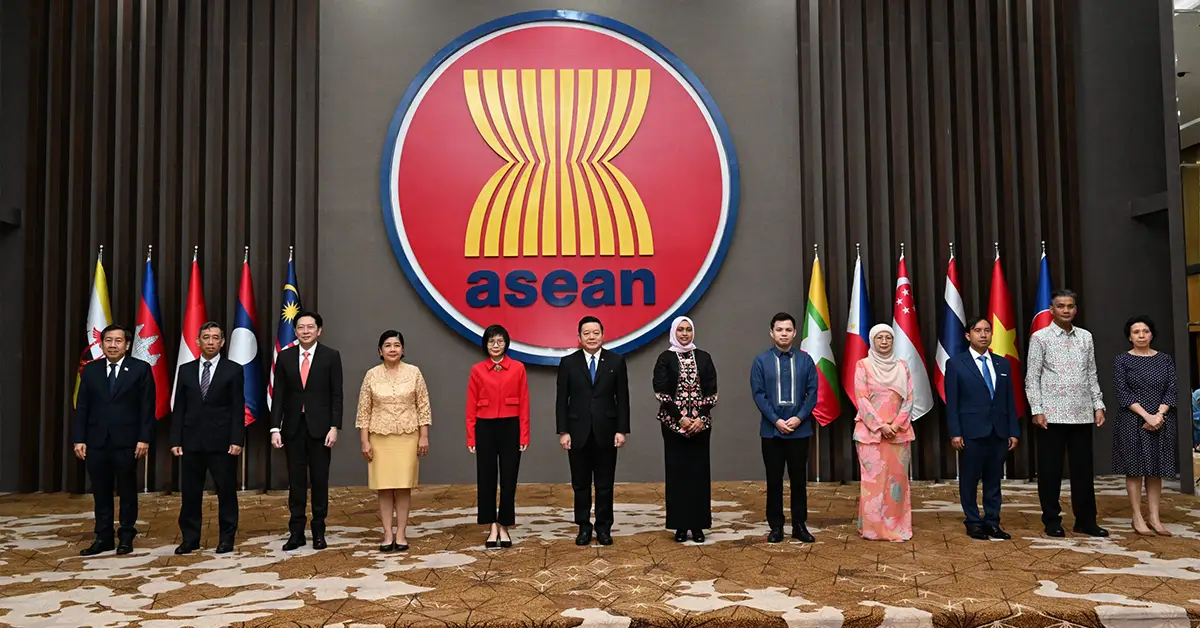
Singapore is one of the five founding members of the Association of Southeast Asian Nations (ASEAN), established on 08 August 1967 together with Indonesia, Malaysia, the Philippines and Thailand. The Bangkok Declaration laid the foundation for what is today the most influential regional organisation in Southeast Asia, with 10 member states.
Within ASEAN, Singapore acts as a driving force for economic integration and innovation. The island nation has twice held the ASEAN Chairmanship, in 2007 and 2018. In 2026, Singapore again takes on the role of ASEAN Chair, leading the region through challenges in the digital economy, climate change and the energy transition.
The ASEAN Economic Community (AEC) was established in 2015 with major contributions from Singapore in building its mechanisms and standards. The island nation is also at the heart of many regional initiatives such as the ASEAN Digital Economy Framework Agreement, the ASEAN Power Grid and infrastructure connectivity programmes.
Beyond ASEAN, Singapore is also a member of broader forums such as the East Asia Summit, the ASEAN Regional Forum and ASEAN+3. The Asia-Pacific Economic Cooperation (APEC) Secretariat has been based in Singapore since 1992, along with the Pacific Economic Cooperation Council Secretariat.
Singapore’s relations with the United States and China
The United States and China are the two largest partners in Singapore’s international relations in terms of both trade and strategic influence. How the island nation balances these two powers precisely reflects the “not choosing sides” strategy of Singaporean diplomacy.
Relations with the United States date from Singapore’s independence in 1965. The year 2026 marks 60 years of diplomatic relations between the two countries. The US-Singapore Free Trade Agreement, in force since 2004, was the first US FTA with an Asian country. Defence cooperation is also very close, with Singapore allowing the US Navy access to logistics facilities on the island.
However, 2025 saw new tensions when the US administration imposed a 10% baseline tariff on goods imported from Singapore as part of its global reciprocal tariff policy. Although the rate is much lower than for other partners, it remains a challenge for bilateral trade relations.
Singapore – China relations have also developed strongly since the two established diplomatic ties in 1990. China is now the island nation’s largest trading partner. The China-Singapore Free Trade Agreement has been upgraded several times, underpinning bilateral investment and trade flows of more than SGD 150 billion a year.
A special factor is that ethnic Chinese make up about 74% of Singapore’s population, creating a cultural bridge with China. However, the island nation always emphasises an independent Singaporean identity and does not allow any major power to influence its internal decisions through ethnic channels.
Singapore – Vietnam relations: Comprehensive Strategic Partnership
Vietnam – Singapore relations are one of the bright spots in Singapore’s international relations and an important bilateral relationship for both countries. On 12 March 2025, the two countries officially upgraded relations to a Comprehensive Strategic Partnership during General Secretary Tô Lâm’s visit to Singapore.
Notably, Vietnam is the first and so far the only ASEAN country with which Singapore has established a Comprehensive Strategic Partnership. This reflects the special importance Singapore places on its relationship with Vietnam, above its other partners in Southeast Asia.
As of January 2025, Singapore is the largest ASEAN investor in Vietnam and the second-largest foreign investor after South Korea, with 3,951 active projects and total registered capital of USD 84.14 billion. Investment spans 18 of 21 economic sectors and 54 of Vietnam’s 63 provinces and cities, concentrated in manufacturing, real estate and energy.
The Vietnam – Singapore Industrial Park (VSIP) network has been a flagship of bilateral economic cooperation for nearly three decades. As of early 2026, there are 20 VSIP parks in 14 provinces and cities of Vietnam, attracting more than USD 18.7 billion in investment and creating jobs for more than 300,000 workers.
Bilateral trade reached USD 9.16 billion in 2022, more than USD 9 billion in 2023, and rose 14.7% in 2024. In the first two months of 2025, trade exceeded USD 4.9 billion, up 27.15% year on year. Singapore is currently Vietnam’s eighth-largest export market.
Singapore’s international relations with multilateral organisations
Singapore is an active member of more than 60 international and multilateral organisations, playing a role far beyond the size of a small island state. This broad participation reflects the multilateral diplomatic strategy that has underpinned Singapore’s international relations since independence.
At theUnited Nations, Singapore joined as the 117th member on 21 September 1965, just over a month after declaring independence. The island nation has been elected twice as a non-permanent member of the UN Security Council, most recently for the 2001 – 2002 term. Singapore also actively contributes personnel to UN peacekeeping missions.
In economics and trade, Singapore was a founding member of the World Trade Organization (WTO) in 1995 and is consistently rated one of the most open economies in the world. The island nation is also party to major regional economic agreements such as the Comprehensive and Progressive Agreement for Trans-Pacific Partnership (CPTPP) and the Regional Comprehensive Economic Partnership (RCEP).
Singapore has been a member of the Commonwealth since 1965, the Non-Aligned Movement since 1970, the Islamic Financial Services Board (IFSB) and many other specialised bodies. The island nation is also an observer at many European and Latin American organisations.
The Singapore passport and diplomatic strength
The Singapore passport is consistently ranked among the most powerful in the world by independent international passport indices. Singaporean citizens have visa-free or visa-on-arrival access to more than 190 countries and territories, a figure only a handful of countries achieve.
The strength of the Singapore passport reflects three factors: its standing as one of the world’s most developed economies, a transparent and internationally recognised legal system, and a wide diplomatic network with bilateral visa waiver agreements. The island nation has signed visa waiver agreements with most developed countries and many developing economies.
Compared with theVietnamese passport, the gap in passport power reflects the clear difference in diplomatic standing and degree of international integration between the two countries. This is one of the reasons many Vietnamese individuals and businesses are interested in pathways to Singapore permanent residence and citizenship to expand their global mobility.
For Singapore passport holders, key markets such as the United States, the Schengen Area of the European Union, the United Kingdom, Japan, South Korea and Australia offer visa-free entry or fast electronic visas. This is a significant benefit for entrepreneurs, investors and professionals who travel internationally often.
Summary
Singapore’s international relations demonstrate the power of pragmatic diplomacy and a balancing strategy in a complex geopolitical environment. From its status as a founding member of ASEAN to a network of strategic partners across continents, the island nation has built a reputation far beyond its geographic size.
For Vietnam, the upgrade to a Comprehensive Strategic Partnership in March 2025 opens a new, deeper phase of cooperation in the digital economy, renewable energy, carbon credits and international financial connectivity. It is an important opportunity for businesses and investors in both countries to leverage their complementary strengths during the major regional economic shifts ahead.
Accompanying you on your journey in residency investment
The Prosperous Living Investment team advises on pathways, assesses profiles and manages investments transparently for every residency, citizenship and international property objective.
Free profile assessmentWhere life gets prosperous