


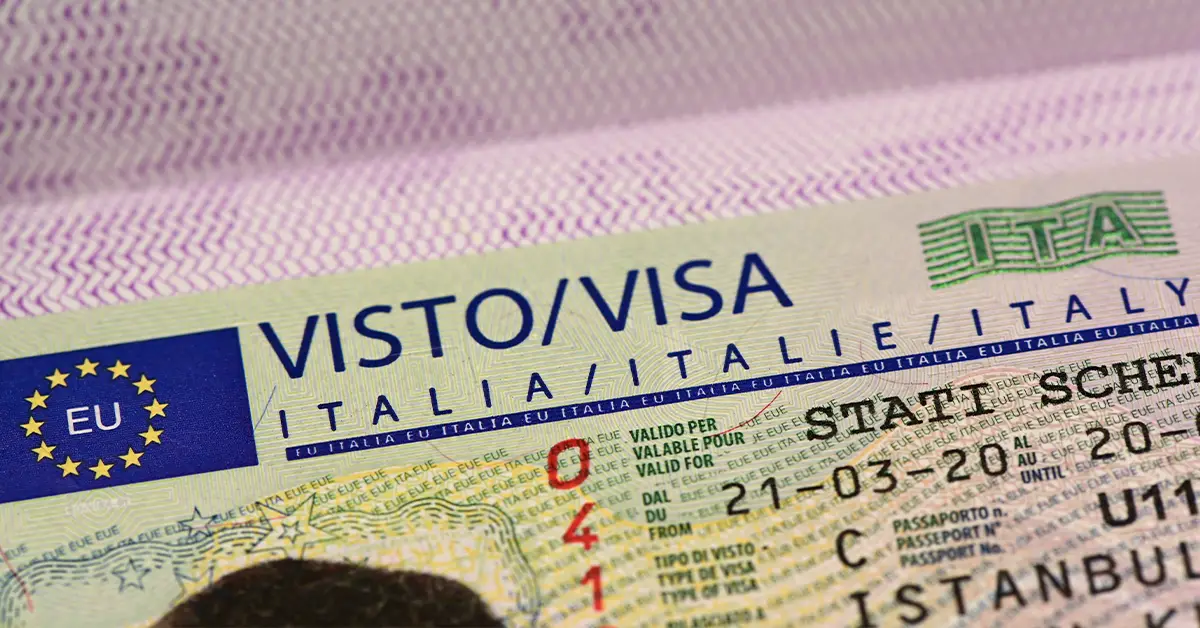
The Italy Investor Visa is an official residence by investment programme run by the Italian government, allowing non-EU citizens to obtain a 2-year residence permit in Italy through a qualifying investment, starting from EUR 250,000. The programme was introduced by Law no. 232 of 11/12/2016 and formally launched in 2017; it is widely known by its common name, the Italy Golden Visa.
Unlike the European residence programmes based on property, this programme focuses entirely on capital invested in the Italian economy — from innovative startups and company shares to government bonds or philanthropic donations. Its outstanding strength is that the programme requires no actual residence in Italy, making it a strategic choice for Vietnamese investors who want to hold EU residence rights without relocating entirely.
A detailed article onThe country of Italy.
Message
An overview of the programme and the managing authority
The Italy Investor Visa is run by the Ministry of Enterprises and Made in Italy (MIMIT), through the Investor Visa for Italy (IV4I) Committee. The whole application process is carried out through the official electronic portalinvestorvisa.mise.gov.it, ensuring transparency and ease of access for international investors.
Investors receive an initial 2-year residence permit, renewable for 3 years at a time on a continuing basis provided the investment is maintained. Spouses and eligible children under 18 may be included in the application, allowing the whole family to enjoy EU residence rights through one main application.
An important legal feature is that the programme is set out in the Italian Immigration Code (Article 26-bis), rather than being a temporary policy that could easily be abolished as some other programmes could. This legal stability is an important factor when weighing a long-term investment route.
The investor residence permit opens a lawful route to a long-term residence card (carta di soggiorno) after 5 years of maintaining the investment, and ultimately to Italian citizenship after 10 years of continuous lawful residence.
Considering a residency programme? The Prosperous Living Investment team assesses your profile free of charge and advises on the pathway that fits your goals.
Four Italy Investor Visa investment routes
Italian law provides four eligible investment routes for the programme. Each route has a different capital level, purpose and risk.
Innovative startups: EUR 250,000
This is the route with the lowest investment threshold, suited to individual investors wanting access to Italy’s innovation economy. Applicants must invest at least EUR 250,000 in an innovative startup recognised on Italy’s official list, updated weekly on the startup.registroimprese.it portal.
This route attracts technology entrepreneurs and venture investors, but carries high risk given the volatile nature of startups. Investors need to assess the business model, founding team and market potential carefully before deciding.
Joint-stock companies: EUR 500,000
This route requires an investment of at least EUR 500,000 in an Italian joint-stock company — listed or unlisted. It is the most popular option thanks to its range: investors can choose from thousands of eligible companies in technology, tourism, energy and manufacturing.
The great advantage is the chance to recover the capital through dividends, share price growth, and the ability to exit the investment after the 5-year holding period. Some investors choose the indirect route of investing in a company operating a hotel or commercial property project — since buying property directly does not qualify for this programme.
Philanthropic donation: EUR 1,000,000
This route requires a donation of at least EUR 1 million to a project of significant public benefit. The eligible fields comprise culture, education, scientific research, and the protection of artistic heritage and the environment.
Unlike the other routes, a philanthropic donation is non-refundable — the investor does not recover the capital. However, this option suits high-net-worth individuals who want to make a meaningful contribution to Italian society while obtaining EU residence rights.
Italian government bonds: EUR 2,000,000
This is the route with the highest threshold, requiring an investment of at least EUR 2 million in Italian government bonds with at least 2 years remaining to maturity. It is the financially safest route because the risk of an Italian government default is extremely low.
Investors receive stable interest and can recover the capital when the bonds mature. However, the high investment threshold means this route suits only those with large wealth or those seeking to optimise a long-term capital preservation strategy.
The Italy Investor Visa application process
The Italy Investor Visa process is rated the fastest among the EU residence by investment programmes. The total time from filing to receiving the residence permit is around 3 to 6 months, considerably shorter than the Golden Visas of many other countries.
The first step is creating an account on the MIMIT electronic portal and completing the application. Applicants submit personal details, a CV, their choice of investment route, and the required documents such as passport, proof of financial resources and criminal record certificate. The application is signed with an electronic signature recognised in Italy and submitted through the online portal.
The second step is assessment by the Secretariat of the Investor Visa Committee. Where the file is complete, the Committee assesses it and issues the Nulla Osta — a certificate of no impediment, valid for 6 months. The Nulla Osta is a precondition for applying for the visa at the Italian Embassy.
The third step is applying for a type D visa (national visa) at the Italian mission in the applicant’s country of residence. The deadline for filing is 6 months from receipt of the Nulla Osta. In Vietnam, applicants file at the Italian Embassy in Hanoi or the Italian Consulate General in Ho Chi Minh City.
The final step is entering Italy and applying for the residence card (permesso di soggiorno) within 8 days of arrival in Italy. The investor then has 3 months to make the committed investment. Failure to maintain the investment throughout the term of the permit leads to cancellation of residence rights.
Residence rights and Schengen access
The Italy Investor Visa residence permit opens up many important benefits for investors and their families. Holders are permitted to live, work and study in Italy without needing a further work permit.
Access to the Schengen area is the greatest advantage. Italian residence card holders may travel freely in the other 28 Schengen member states without a visa, for up to 90 days in every 180. This is a valuable privilege for businesspeople operating across European borders.
The Italian public health system (Servizio Sanitario Nazionale) is one of the highest-quality systems in the world, ranked in the global top 10 by the WHO. Residence card holders may register with this system at a relatively low cost. Children have access to free state education from primary school to university.
Italian tax policy also has a special incentive for new residents: the flat tax programme of EUR 100,000 a year on all income arising outside Italy (the Impatriate Regime for HNWI), applying for up to 15 years. This is an optimal choice for investors with large worldwide income.
The route from residence to Italian citizenship
The Italy Investor Visa opens the way to two higher levels of residence status: a long-term residence card after 5 years and Italian citizenship after 10 years.
After 5 years of maintaining the investment and lawful residence (continuous actual residence is not required), investors may apply for the EU long-term residence card (carta di soggiorno). This card is valid for 10 years, is renewable, and allows the holder to move freely and live in any EU country for longer than the ordinary Schengen rules permit.
After 10 years of continuous lawful residence, investors become eligible to apply for Italian citizenship. The conditions comprise proving Italian language ability at B1 on the CEFR, compliance with the law, financial stability and social integration. Italy permits dual nationality, meaning Vietnamese investors need not renounce their original citizenship.
The Italian Parliament is currently debating a proposal to shorten the naturalisation period from 10 to 5 years for Investor Visa holders. Where this is passed, the programme would become one of the fastest routes to EU citizenship through investment.
A comparison with the Golden Visas of other EU countries
Understanding the differences between the EU residence programmes helps investors choose the one that suits their long-term objectives.
Compared withPortugal Golden Visa, the Italian programme has a lower investment threshold (EUR 250,000 against EUR 500,000 for investment funds in Portugal). Portugal has a 5-year route to citizenship — faster than Italy (10 years) — but Italy requires no actual residence while Portugal requires 7 days a year.
Compared withThe Greece Golden Visa, the Italian programme has no property route — Greece’s main strength, with thresholds from EUR 250,000 to EUR 800,000 depending on the area. However, Italy offers a clearer route to citizenship and has a more diverse economy than Greece.
Compared withMalta residence by investment, Italy has considerably lower upfront costs but a longer route to citizenship. Malta grants EU citizenship through naturalisation in 12 to 36 months but at a total cost above EUR 800,000.
Advantages and drawbacks to weigh
Every residence by investment programme has its own strengths and limitations. Investors need to weigh these carefully before deciding.
The outstanding advantages comprise the low investment threshold (from EUR 250,000), the quick processing (3-6 months), no actual residence requirement, dual nationality permitted after 10 years, and free access to Schengen. In particular, the programme is protected by primary legislation (Article 26-bis of the Italian Immigration Code), giving it high legal stability.
The main limitation is the absence of a direct property route — an important difference from Portugal or Greece. The 10-year period to citizenship is also longer than many other European programmes. In addition, the requirement of Italian at B1 level for naturalisation is a considerable barrier for investors with no plans to reside in the country.
Conclusion
The Italy Investor Visa is an attractive option for Vietnamese investors wanting an EU residence permit at a reasonable cost with a transparent procedure. The combination of a low investment threshold from EUR 250,000, a quick 3-6 month process, no actual residence requirement and a clear route to citizenship creates a particularly strong value proposition among the European residence programmes.
The programme suits investors with a long-term view of the EU best — particularly businesspeople expanding their European operations, families wanting quality education options for their children, and individuals seeking tax efficiency through the EUR 100,000 a year flat tax regime. Working with professional advisers is an important step in choosing the right investment route and making sure the application meets the IV4I Committee’s due diligence standards.
Accompanying you on your journey in residency investment
The Prosperous Living Investment team advises on pathways, assesses profiles and manages investments transparently for every residency, citizenship and international property objective.
Free profile assessmentWhere life gets prosperous