


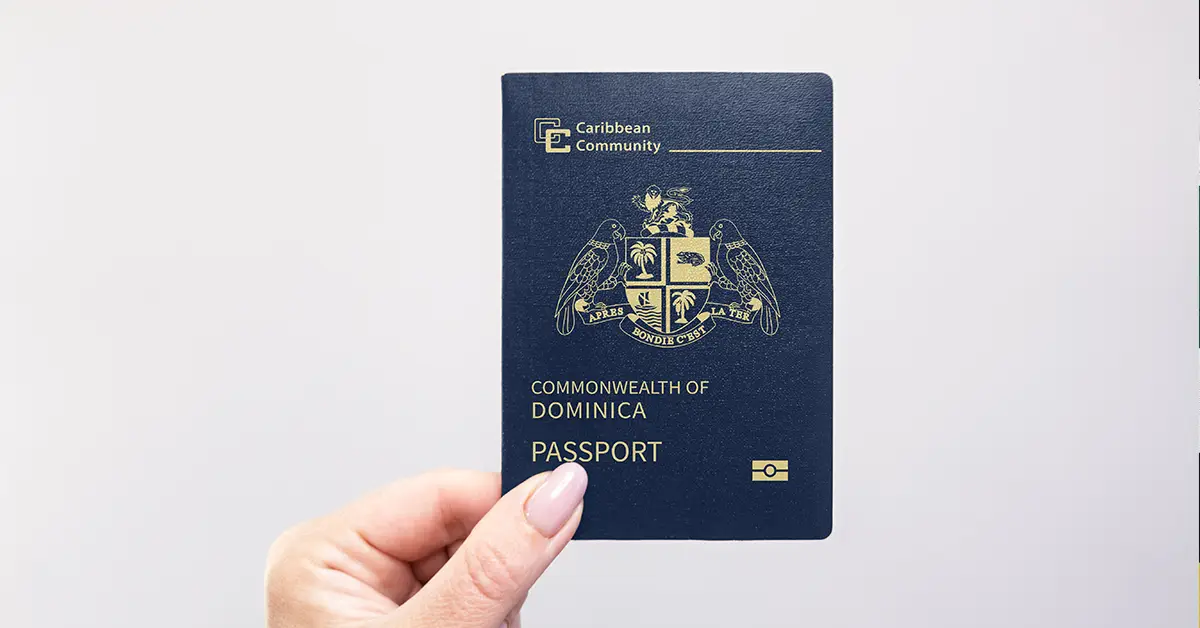
The Dominica passport is the official travel document issued to citizens of the Commonwealth of Dominica, valid for 10 years and renewable indefinitely. Current passports meet the ICAO Document 9303 biometric standard, with an electronic chip storing facial and fingerprint biometric data. As of 2026, the passport gives visa-free or visa-on-arrival access to 140 to 145 countries and territories.
The standing of the Dominica passport has come under significant pressure in 2025 to 2026 due to diplomatic measures by the United States and the European Union related to the Citizenship by Investment (CBI) Programme. Understanding the current situation and trends helps citizens and investors ofDominicaplan their travel appropriately.
Message
Features and design of the Dominica passport
The modern Dominica passport has a dark blue cover with Dominica’s coat of arms embossed in gold in the centre. The coat of arms features the sisserou parrot (an endemic species) on a central shield surrounded by traditional agricultural symbols, representing the island’s natural and historical heritage. Above the coat of arms is the text “COMMONWEALTH OF DOMINICA” and below it “PASSPORT/PASSEPORT”, reflecting a bilingual English-French colonial legacy.
The Dominica biometric passport has 32 pages for visas and entry and exit stamps, plus a data page. The data page contains personal details (full name, date of birth, place of birth, sex, nationality), the passport number, date of issue, expiry date, a biometric photo and the holder’s signature. The machine-readable zone (MRZ) at the bottom complies with ICAO standards, allowing automatic reading at border crossings worldwide.
An RFID electronic chip embedded in the passport stores biometric data, including a digitised facial image and fingerprints (for passports issued since 2018). The data is encrypted and protected by a digital certificate from the Dominica Passport Office, ensuring authenticity and preventing counterfeiting. Each passport has a unique serial number beginning with a letter identifying its type and year of issue.
Considering a residency programme? The Prosperous Living Investment team assesses your profile free of charge and advises on the pathway that fits your goals.
Current types of Dominica passport
Dominica issues three types of passport under the Passport Act of 1965, as amended several times. The dark blue Regular Passport is the most common, issued to all eligible Dominican citizens. This is the passport received by CBI Programme participants. The fee is about $90 USD for adults and $60 USD for children under 16.
The red Diplomatic Passport is issued to diplomats, members of the government, ambassadors and certain officials designated by the President. It offers broader visa-free access, but numbers are tightly controlled and it cannot be obtained through the CBI programme. Misuse of diplomatic passports once caused international controversy, and Dominica has reformed the issuing process since 2018.
The brown Official Passport is issued to civil servants on official duty abroad and their family members. It is valid for the duration of the posting and must be returned at the end of it. Official passports are used less than regular and diplomatic passports because of the small size of the state apparatus.
Freedom of travel with the Dominica passport
The Dominica passport has ranked between 39th and 44th in the Henley Passport Index in recent years, with visa-free or visa-on-arrival access to more than 140 countries and territories. The Schengen Area allows visa-free entry for stays of up to 90 days in any 180-day period for tourism and business. This is the Dominica passport’s most important benefit.
The United Kingdom allows Dominican citizens visa-free entry for stays of up to 6 months under arrangements between the UK and CARICOM. After Brexit, this status was maintained through the CARIFORUM-UK Economic Partnership Agreement signed in 2019. The United Kingdom is also the most popular destination for Dominican citizens because of its large diaspora of about 80,000 people.
Notable Asian destinations include Hong Kong (90 days visa-free), Singapore (30 days visa-free), Malaysia (30 days), Thailand (30 days at the airport) and the Philippines (30 days). Mainland China requires a regular visa but has a simplified process for CARICOM citizens. Japan and South Korea require regular visas. Most Latin American countries allow visa-free entry or visa on arrival.
See theDominica passport visa-free listfor more on where you can travel with this passport.
The impact of US and EU policy in 2025-2026
The standing of the Dominica passport has been significantly affected by US and European Union policy in 2025 to 2026. President Trump issued an executive order in December 2025 imposing partial travel restrictions on Dominican citizens, citing the CBI programme as a security concern. It was the first time the United States had applied such a measure to a small Caribbean island nation.
In January 2026, the US Department of State froze immigrant visa processing for Dominica, creating difficulties for Dominicans planning to settle or reunite with family in the United States. A few weeks later, the Department of State cut the validity of tourist and business visas for Dominicans from 10 years to just 3 months. This was an unprecedented diplomatic measure against a country with traditionally good relations, with a major impact on the Dominica passport.
The European Union warned in December 2025 that operating a CBI programme could be grounds for triggering the Schengen visa suspension mechanism. Although visa-free Schengen access remained in place in early 2026, the European Commission continues to monitor Dominica’s reforms closely. Dominica’s tightening of CBI due diligence from 2024 to 2026 aims to ease this pressure.
Applying for a Dominica passport for the first time
Dominican citizens can apply for their first passport at the Attorney General’s Office in Roseau or at the Wesley Public Service Centre in the north of the island. Required documents include an original birth certificate, a national ID card, two biometric photos meeting the standard (face forward, no glasses, white background), a fully completed application form and certification by an authorised civil servant or lawyer.
The fee for a first passport is $90 USD for adults and $60 USD for children under 16, paid in cash or by bank transfer at the office. Processing usually takes 10 to 15 working days under normal conditions. In urgent cases, expedited processing in 3 to 5 days is available for an additional $50 USD.
For people granted citizenship through the CBI Programme, the passport is issued at the same time as citizenship is approved and sent via the Authorised Agent or the nearest Dominican embassy. The process usually takes 3 to 9 months from the initial CBI application. Receiving a CBI passport through an authorised agent simplifies the process for applicants living abroad. See the articleDominica citizenship by investmentfor the detailed process.
Find details on the government website athere.
Renewing and replacing a passport
A Dominica passport can be renewed or replaced when it is close to expiry (6 months before the expiry date is usually recommended) or when all visa pages have been used. For people living in Dominica, the process is similar to a first application but simpler, as their details are already in the database. The replacement fee is $90 USD and processing takes 7 to 10 working days.
People living abroad can apply to replace their passport at the nearest Dominican embassy or consulate. In cities without a Dominican diplomatic mission, applicants can contact an Honorary Consul of Dominica if there is one. The fee abroad is slightly higher, about $120 USD to $150 USD, due to service and diplomatic courier charges. Processing usually takes 4 to 8 weeks because applications must be sent to Roseau.
The old passport must be returned or cancelled by punching holes when a new passport is issued. The cancelled passport can be kept as a souvenir. A lost passport must be reported immediately to the police and to a Dominican embassy or consulate to prevent misuse. Replacing a lost passport is more complicated and requires additional evidence of the circumstances of the loss.
Passports for people granted citizenship through CBI
People granted Dominican citizenship through the Citizenship by Investment Programme receive a regular passport identical to that of native-born Dominicans. There is no marking on the passport showing that the holder is a CBI citizen. The serial numbers and design are exactly the same. This differs from some other countries with CBI programmes that issue separate passports.
The CBI passport process begins after the application has been approved by the CBIU and the oath of allegiance has been taken (this can be done online for applicants abroad). The passport is issued at the Attorney General’s Office in Roseau and forwarded through the Authorised Agent or a Dominican diplomatic mission for delivery. The whole process from approval to receiving the passport usually takes 4 to 6 weeks.
CBI passports have the same 10-year validity and entitlements as regular passports. However, CBI passport holders should note that since December 2023, Dominica has banned name changes within 5 years of receiving CBI citizenship, a measure to prevent passports being used to conceal identity. Violations can lead to automatic revocation of citizenship.
Security and anti-counterfeiting features
The Dominica passport applies many security and anti-counterfeiting measures under ICAO Document 9303. Physical security features include hidden images (visible only under UV light), multi-layer offset printing, colour-shifting ink, a hologram on the data page and security fibres in the paper. The data page uses tough polycarbonate that is hard to delaminate.
The RFID electronic chip stores biometric information, including a high-resolution digitised facial image, four-finger fingerprints (for passports issued since 2018) and an authenticating digital signature issued by the Dominica Passport Office. The chip uses Basic Access Control (BAC) and Extended Access Control (EAC) security protocols to prevent data being skimmed while the passport is in a pocket or suitcase.
The CBIU maintains a central biometric database linked to Interpol and international security organisations. When a CBI passport is revoked (as in 68 cases between June 2024 and April 2026), the information is immediately updated in Interpol’s Stolen and Lost Travel Documents (SLTD) database. This ensures other countries can detect and refuse entry to revoked passports.
Summary of the Dominica passport
The Dominica passport retains significant value, with visa-free access to 140 countries including the Schengen Area and the United Kingdom, unrestricted dual citizenship and a relatively convenient issuing and renewal process. The modern biometric passport complies with the latest ICAO standards and applies many advanced security measures.
However, diplomatic pressure from the United States, with visa validity cut from 10 years to 3 months, and the EU’s threat to suspend Schengen access pose serious challenges for 2026 to 2027. Dominica’s reforms tightening CBI due diligence and strengthening governance may help partly restore the passport’s standing in the long term, but citizens and investors need to follow policy developments closely in order to plan accordingly.
Accompanying you on your journey in residency investment
The Prosperous Living Investment team advises on pathways, assesses profiles and manages investments transparently for every residency, citizenship and international property objective.
Free profile assessmentWhere life gets prosperous