

Singapore’s politics operate as a parliamentary republic based on the British Westminster model, with specific adaptations to suit the circumstances of a multi-ethnic island nation. The People’s Action Party (PAP) has governed continuously since 1959 — a rare record among modern democracies — giving the island nation’s political life its distinctive character.
This article analyses Singapore’s institutional structure, the roles of the branches of government and the features of its party system, based on official information from Parliament, the Office of the President and relevant agencies. It is essential background for Vietnamese people interested in the island nation’s political and legal environment when investing or settling there.
Detailed article onSingapore.
Message
Singapore’s political institutional structure
Singapore is a unitary parliamentary republic, meaning it has no federal or provincial structure like many other countries. All power is concentrated at the national level, with local administration handled through Town Councils and sector-specific statutory bodies.
The Constitution of the Republic of Singapore — first enacted in 1965 after separation from Malaysia — is the island nation’s supreme law. The Constitution has been amended many times to keep pace with the country’s development, including important amendments in 1991 that gave the President additional powers over certain key government decisions.
The Singaporean state is divided into the three traditional branches of government. The executive comprises the President, the Prime Minister and the Cabinet. The legislature is the unicameral Parliament. The judiciary is headed by the Chief Justice. However, the degree of separation and checks and balances between the branches has its own features compared with the original Westminster model.
Singapore’s legal system is based on English common law, supplemented by Acts of Parliament. Singapore’s courts apply the doctrine of precedent and may refer to rulings from other Commonwealth countries. In addition, certain rules for the Muslim community are administered through the Syariah Court in family and inheritance matters.
Considering a residency programme? The Prosperous Living Investment team assesses your profile free of charge and advises on the pathway that fits your goals.
The role of the President of Singapore
The President is Singapore’s head of state, representing the island nation in diplomatic relations and official ceremonies. Before the 1991 constitutional reform, the President held only a ceremonial role, was elected by Parliament and had no substantive power.
After the 1991 reform, the President is directly elected by Singaporean voters for a 6-year term and has the power to veto certain key government decisions. Specifically, the President oversees the use of accumulated national reserves, approves certain senior public sector appointments and can intervene in internal security matters in special circumstances.
The requirements to stand as a presidential candidate in Singapore are relatively strict. Candidates must be Singapore citizens, at least 45 years old, and have senior experience in the public or private sector (such as chief executive of a company with at least SGD 500 million in shareholders’ equity for 3 years). These requirements aim to ensure the President is capable of overseeing complex financial and economic matters.
The current President is Tharman Shanmugaratnam, who took office in September 2023. He is Singapore’s ninth President and the first person of Tamil descent to hold the post by direct popular election, winning by a landslide. He previously held many senior government positions, including Deputy Prime Minister and Chairman of the Monetary Authority of Singapore (MAS).
The Office of the President is located at the Istana — a historic residence built in 1869 during British colonial rule. The Istana opens to the public on certain major holidays each year, reflecting the democratic and people-oriented spirit of Singapore’s institutions.
The role of the Prime Minister and Cabinet in Singapore’s politics
The Prime Minister is the head of government and holds real executive power. Under Westminster convention, the Prime Minister is the leader of the party with a majority of seats in Parliament. The President formally appoints the Prime Minister as the Member of Parliament who commands the confidence of the majority.
The current Prime Minister is Lawrence Wong, who took office on 15 May 2024. He is the fourth Prime Minister in Singapore’s history and the first born after the island nation gained independence in 1965. He previously served as Deputy Prime Minister and Minister for Finance, as well as Chairman of the Monetary Authority of Singapore.
Singapore’s Cabinet consists of the Prime Minister and the Ministers heading individual ministries. The island nation currently has 16 ministries and several ministry-level agencies covering areas from Finance, Trade and Industry and Defence to Education, Health, and Culture, Community and Youth. Deputy Prime Ministers coordinate major policy clusters.
An important feature of Singapore’s politics is the high salaries paid for senior public office. Singapore’s Prime Minister is one of the highest-paid heads of government in the world, at about SGD 2.2 million a year following the 2011 salary review. This policy is designed to attract high-calibre talent into the public sector and reduce incentives for corruption.
The Corrupt Practices Investigation Bureau (CPIB) is an independent agency under the Prime Minister’s Office with the power to investigate any corruption case regardless of rank. Singapore is consistently ranked among the cleanest countries in the world in Transparency International’s Corruption Perceptions Index. This is one of the standout achievements of Singapore’s political system.
The Parliament of Singapore and its system of Members
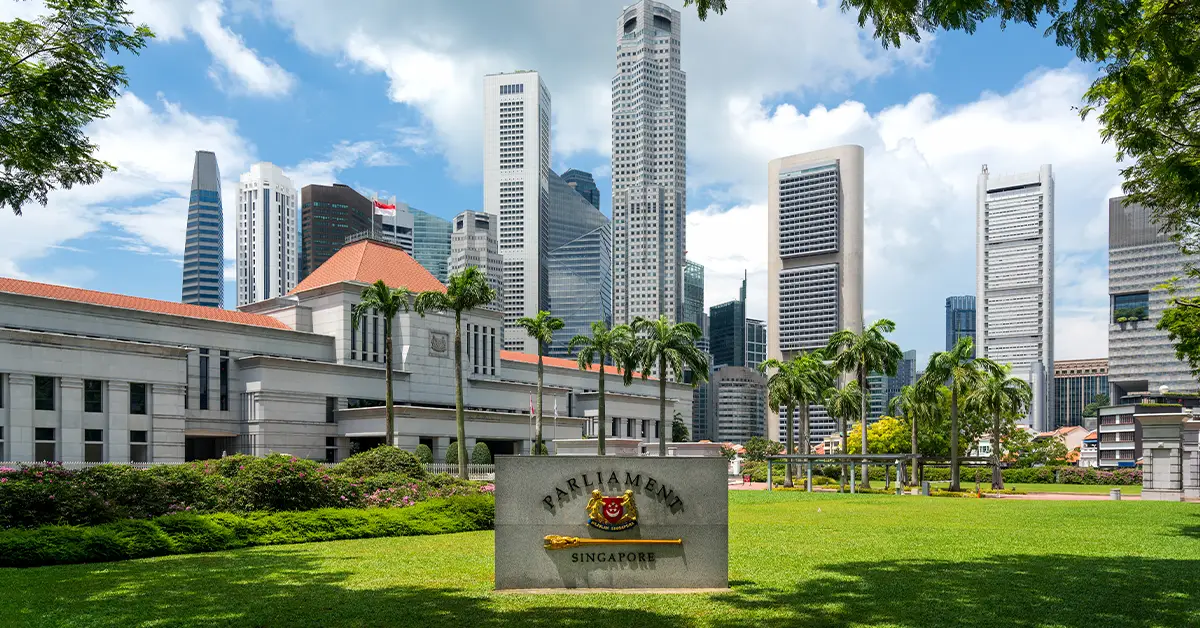
The Parliament of Singapore is the island nation’s sole unicameral legislature, housed in Parliament House in the central civic district. According tothe Parliament of Singapore, the current 14th Parliament has 104 members, comprising directly elected Members of Parliament and special Members under the island nation’s distinctive arrangements.
Singapore’s electoral system has two types of constituencies: Single Member Constituencies (SMCs) and Group Representation Constituencies (GRCs). GRCs were introduced in 1988; voters elect a team of 4-6 candidates from the same party, at least one of whom must represent a minority community (Malay, Indian or other).
Besides directly elected Members, Parliament has two types of special members. Non-Constituency Members of Parliament (NCMPs), introduced in 1984, are opposition candidates with the highest vote shares who did not win their seats. This mechanism ensures at least 12 opposition Members in Parliament, though not necessarily through electoral victory.
Nominated Members of Parliament (NMPs), introduced in 1990, are non-partisan professionals who have made significant contributions in fields such as the arts, science, business or the community. There are up to 9 NMPs, serving 2.5-year terms. This mechanism aims to add expert voices to the legislative process.
The Parliament of Singapore works mainly in English, although Members may speak in Mandarin, Malay or Tamil. Simultaneous interpretation is provided so that all Members and members of the public following proceedings can understand. Parliamentary sittings are broadcast live and archived publicly.
The People’s Action Party and the opposition parties
The People’s Action Party (PAP) has governed Singapore continuously since 1959, a rare record among modern democracies. The party was founded in 1954 by Lee Kuan Yew and a group of young activists, initially with a left-leaning orientation and an alliance with labour movements.
After coming to power, the PAP purged communist elements from the party and shifted to pragmatic policies supporting a managed market economy. The party’s core philosophy emphasises pragmatism, effective governance, multicultural harmony and national security. The slogan “First World Oasis in a Third World Region” reflects its founding vision.
The PAP maintains a tight organisational structure with strict membership rules and a rigorous candidate selection process. Candidates usually have outstanding academic backgrounds and senior professional experience, and undergo a thorough assessment. The “generational leadership” system (4G, 5G…) reflects a systematic plan for handing over power across generations.
The main opposition party is the Workers’ Party (WP), founded in 1957. The WP positions itself as a moderate, non-extremist opposition party focused on the practical social and economic issues facing ordinary people. In the 2025 general election, the WP retained control of Aljunied GRC and Hougang SMC, and also held Sengkang GRC.
Other opposition parties include the Progress Singapore Party (PSP), founded in 2019, and the Reform Party (RP). Although they have not won many seats in Parliament, these parties provide alternative voices in political debate. General elections are usually held every 5 years, most recently in May 2025, when the PAP won with a higher vote share than in 2020.
Singapore’s political system is often described as a multi-party democracy on paper that operates as a dominant-party state in practice. International analysts call the model a “limited democracy” or “soft authoritarianism”, while the Singapore government defines it as a “pragmatic democracy” suited to the circumstances of a small island nation.
Singapore’s judicial and legal system
Singapore’s judiciary is independent of the other branches of government and highly regarded internationally for its efficiency and transparency. According to the World Justice Project Rule of Law Index, Singapore is consistently ranked among the world’s top countries for law enforcement and order and security.
The court structure has two main tiers. The Supreme Court comprises the High Court and the Court of Appeal. The State Courts handle most smaller civil and criminal cases. There are also specialised courts such as the Family Justice Courts, the Employment Claims Tribunals and the Syariah Court for Islamic matters.
The Chief Justice heads the judiciary and is appointed by the President on the advice of the Prime Minister. Supreme Court judges are appointed in the same way. This arrangement ensures judicial independence while maintaining a link with the executive within the parliamentary framework.
Singapore’s laws are known for their severity in some areas. The death penalty still applies to serious drug offences and murder. Caning is imposed for certain offences such as robbery, assault and vandalism of public property. Drug laws are particularly strict, with heavy penalties even for small quantities.
For business and investment matters, Singapore applies laws to high international standards. The island nation is one of the world’s leading international arbitration hubs through the Singapore International Arbitration Centre (SIAC). Its systems for protecting intellectual property, enforcing commercial contracts and resolving disputes are highly regarded by the global business community.
Summary
Singapore’s politics are a unique combination of a Westminster-style parliamentary system and specific adaptations suited to the multi-ethnic circumstances of a small island nation. Political stability over decades, combined with an effective legal system and a high-quality civil service, is an important foundation for the island nation’s economic success.
For Vietnamese investors and entrepreneurs, understanding Singapore’s political structure helps assess the business environment and plan appropriately for the long term. Institutional stability, strict rule of law and transparent governance are the factors behind the island nation’s lasting appeal to the international business community.
Accompanying you on your journey in residency investment
The Prosperous Living Investment team advises on pathways, assesses profiles and manages investments transparently for every residency, citizenship and international property objective.
Free profile assessmentWhere life gets prosperous