



Understanding the demographics of Uruguay reveals a South American nation rich in European identity but with a very small population of only about 3.4 million people. It is a highly urbanised society, predominantly of Spanish and Italian descent, which is ageing significantly and stands out for a secular tradition rarely seen in the region.
Contents
Overview of Uruguay’s demographics
Uruguay is one of the smallest nations in South America. The total population currently stands at approximately 3.4 million, a modest figure compared to its giant neighbours, Argentina and Brazil. According to international classifications, it is a high-income country with a human development index among the highest in Latin America.
What makes Uruguay’s demographic picture unique is not its size but its structure. It is a nearly fully urbanised society with predominantly European roots, currently undergoing an ageing process and maintaining low fertility rates. These characteristics make Uruguay closer to the model of many developed nations than the typical Latin American pattern.
The country’s official statistical agency, the National Institute of Statistics (Instituto Nacional de Estadística), is the foundational data source for population analysis. Census figures and interim estimates are published periodically, though readers should note that all population figures have a margin of variation over time.

Considering a residency programme? The Prosperous Living Investment team assesses your profile free of charge and advises on the pathway that fits your goals.
Population size and density
With approximately 3.4 million residents spread across a territory larger than many countries with similar populations, Uruguay has a relatively low population density. Most of the country consists of sparsely populated grasslands and ranching areas, while residents are concentrated in a few urban centres. The contrast between vast spaces and a small population is a defining feature.
Uruguay’s population growth rate has long been very low, even stagnating during many periods. The main reasons are a prolonged decline in fertility rates combined with the emigration of a portion of the youth during times of economic difficulty. Consequently, the national population grows much more slowly than the South American average.
Compared to Uruguay’s vast geography, population distribution is highly uneven. To better understand the natural landscape where the population lives, one can refer to Geography of Uruguay with its plains, low rolling hills and Atlantic coastline. It is the vast grassland terrain that has shaped the concentrated population distribution we see today.
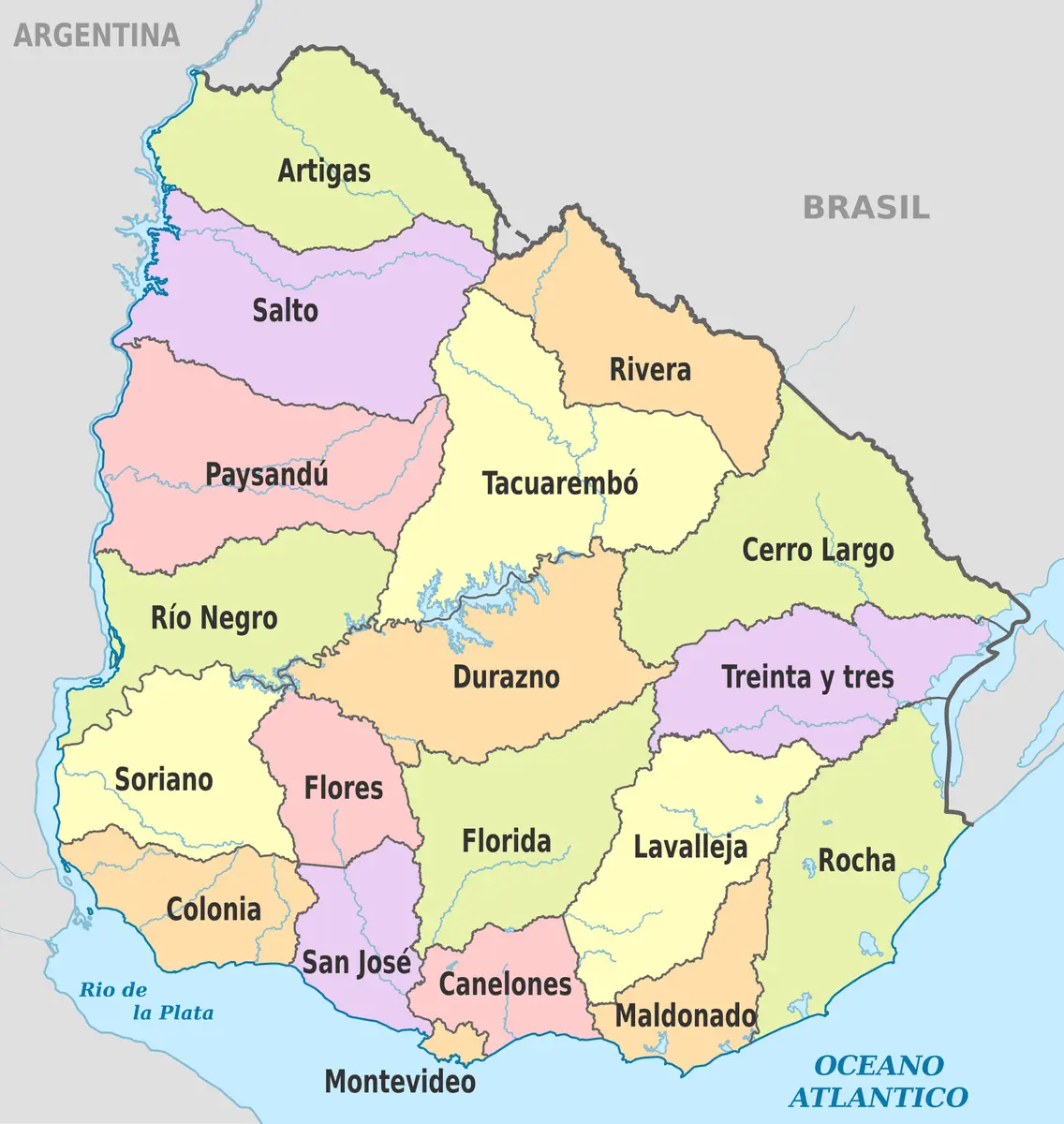
According to National Institute of Statistics of Uruguay (INE), the majority of the population is concentrated in the capital, Montevideo, and its surrounding metropolitan area, while the interior provinces have a much lower density. The trend of ageing and low fertility continues to shape the population structure in recent decades.
High urbanisation and the role of Montevideo
Uruguay is one of the most urbanised countries in Latin America. The vast majority of the population lives in cities and towns, while the rural population is very small. This is the result of early modernisation and a service-ranching economic model that does not require a large agricultural workforce like many other countries.
The centre of the urban picture is the capital, Montevideo. This city and its surrounding metropolitan area account for a very large proportion of the national population, estimated at between one-third and nearly half of the total. Montevideo is simultaneously the administrative and economic centre, the gateway port and the cultural hub of the country.
This strong concentration in a single city creates a “head-heavy” phenomenon in the urban structure. Besides Montevideo, cities such as Salto, Paysandú and Ciudad de la Costa serve as regional centres, but their scale is much smaller. Most political, financial and higher education activities still revolve around the capital.
The high level of urbanisation has clear demographic consequences: urban lifestyles are often associated with low fertility, late marriage and small household sizes. These factors further reinforce the population ageing trend that Uruguay is experiencing, while also placing pressure on urban infrastructure in the capital region.
Origins of the population: a predominantly European heritage
The most prominent feature of Uruguay’s demographics is the overwhelming proportion of the population of European descent. Most Uruguayans today are descendants of waves of migration from Europe in the 19th and early 20th centuries, the largest of which were of Spanish and Italian origin. These two communities have profoundly shaped the nation’s ethnic profile.
In addition to these two large groups, there are smaller communities of French, German, Portuguese and other European origins. The strong wave of immigration through the port of Montevideo during this period transformed Uruguay into a society with a strong Old World imprint, from architecture and cuisine to language and daily customs.
The Spanish-Italian blend also helps explain many aspects of Uruguayan culture, from culinary habits to the rhythm of social life. Interested readers can learn more through the article on Uruguayan culture, where European heritage blends with the Río de la Plata identity to create a distinct character.
Afro-Uruguayan communities and indigenous minorities
Beyond the majority European component, Uruguay also has an Afro-Uruguayan community which, although a minority, plays an important cultural role. The ancestors of this community largely arrived during the era of the transatlantic slave trade. They have left a deep artistic legacy, most notably the rhythm of candombe drumming.
The indigenous component of Uruguay’s population is very small compared to many Andean or Central American countries. During the colonial period and the early years of nationhood, the Charrúa indigenous community and other groups declined sharply. Today, a portion of the population reports having some indigenous ancestry, but the purely indigenous group is almost negligible.
This ethnic background is clearly different from most of Latin America, where indigenous or mestizo components often make up a large proportion. The relative absence of an indigenous population makes Uruguay, along with Argentina, one of the most “Europeanised” South American societies in demographic terms.
- European origin (Spanish, Italian and others): the overwhelming majority.
- Afro-Uruguayan community: a minority but with significant cultural influence.
- Pure indigenous component: almost negligible in the modern population.
Population ageing and low fertility rates
One of the most notable demographic features of Uruguay is the process of population ageing. The country entered the demographic transition stage much earlier than many countries in the region, with fertility rates declining over several decades and average life expectancy steadily increasing. As a result, the proportion of elderly people in the population is relatively high.
Uruguay’s fertility rate has long been low, close to or below the replacement threshold. As each woman has fewer children on average and life expectancy increases, the population pyramid gradually narrows at the base and widens at the top. This is a classic sign of a demographically mature society.
Ageing brings both opportunities and challenges. On one hand, a qualified workforce and a stable society are a good foundation. On the other hand, the high ratio of elderly dependents places pressure on the pension and healthcare systems. Uruguay has had a tradition of a welfare state since the early 20th century, so these pressures are given special attention in policy planning.
The ageing age structure is also closely related to the training system and human resources. Readers can see more about Uruguay education to understand how this country maintains the quality of its human resources in the context of a shrinking youth population and the increasingly urgent need to improve labour productivity.
Life expectancy and population health
Average life expectancy in Uruguay is among the highest in Latin America, reflecting a relatively developed healthcare system and stable living standards. Life expectancy for women is generally higher than for men, a common global pattern, which contributes to increasing the proportion of women in the elderly population.
Basic health indicators, such as the infant mortality rate in Uruguay, are relatively low compared to the regional average. According to data from international organisations such as the United Nations Development Programme, the country maintains a high Human Development Index, with healthcare and life expectancy being key components.
Alongside an ageing population, Uruguay’s disease burden is gradually shifting towards non-communicable diseases associated with age and urban lifestyles, such as cardiovascular disease and cancer. This is a common trend in societies that have completed their demographic transition and possess a mature population.
Language and the Río de la Plata identity
Spanish is the de facto official language and is used by almost the entire population. The local variant of Spanish belongs to the Río de la Plata group, sharing many characteristics with the dialect spoken in Buenos Aires, from intonation to specific regional pronoun usage.
The influence of Italian through waves of migration has left its mark on everyday vocabulary and pronunciation. In the border region with Brazil, a segment of the population uses a dialect blending Portuguese and Spanish, commonly referred to as portuñol, which reflects the cultural intersection of the border area.
High linguistic homogeneity is a factor that reinforces a unified national identity. Unlike many countries with large indigenous communities speaking their own languages, Uruguay has almost no significant internal language barriers, which contributes to its relatively high level of social cohesion.
Secular traditions and the religious landscape
Uruguay is renowned as one of the most secular societies in Latin America. While many countries in the region have strong religious influences in public life, Uruguay separated church and state very early in its modern history, making secularism a core part of its national identity.
The proportion of people who do not follow any religion or do not practice a religion in Uruguay is unusually high compared to the Latin American average. Alongside the large non-religious group, Roman Catholicism remains the faith with the largest number of followers, alongside Protestant communities and other smaller religious groups.
Secularism is clearly reflected in the official calendar and administrative language, as many holidays with religious origins have been renamed in a neutral manner. This tradition is linked to the reformist legacy of the early 20th century and explains why Uruguay is often cited as an open, socially progressive society in the region.
Migration, households and future trends
Uruguay’s demographic history is linked to migration in both directions. The country was once a destination for European immigration waves, but during periods of economic crisis, many Uruguayans, especially qualified young people, have gone abroad to seek opportunities. This “brain drain” phenomenon impacts the age structure of the population.
Household size in Uruguay tends to be smaller, reflecting low fertility rates and urban lifestyles. The number of single-person and small-family households is increasing, while the multi-generational family model is gradually declining. The age of marriage and the age of first childbirth also tend to be later than in previous generations.
In recent years, Uruguay has also welcomed new waves of immigrants from several countries in the region, contributing to the workforce and diversifying the population. However, the scale of these migration flows is not yet large enough to reverse the overall ageing trend.
Looking to the future, demographic scenarios suggest that Uruguay is likely to remain a society with a stable or very slowly growing population, with an increasingly large proportion of elderly people. This picture shapes long-term policy priorities regarding pensions, healthcare, and productivity, while reinforcing Uruguay’s position as a mature, stable society in the South American region.
Accompanying you on your journey in residency investment
The Prosperous Living Investment team advises on pathways, assesses profiles and manages investments transparently for every residency, citizenship and international property objective.
Free profile assessmentWhere life gets prosperous