



German skilled worker immigration has become one of the most attractive lawful immigration routes in Europe since the Skilled Immigration Act (Fachkräfteeinwanderungsgesetz) was comprehensively reformed over 2023–2024. Germany currently faces a shortage of more than 1.5 million skilled workers, particularly in information technology, engineering, healthcare, elderly care and education.
This article gathers together the three main routes for workers from outside the EU/EEA wanting to settle in Germany: the EU Blue Card, the Opportunity Card (Chancenkarte) under the 6-point system, and the Work Visa for those already holding an employment contract. The content is drawn from the official sources of the German Federal Ministry of the Interior (BMI) and the government-run “Make it in Germany” portal.
A detailed article onthe country of Germany.
Message
An overview of German skilled worker immigration
The German skilled worker immigration system has been reformed around three main “pillars” to address the skilled labour shortage. According toMake it in Germany— the German government’s official portal — the new law divides into three pillars: the qualification pillar, the experience pillar and the potential pillar.
The qualification pillar applies to those with a university degree or a vocational qualification recognised in Germany, usually alongside the EU Blue Card or traditional Work Visa route. The experience pillar allows those with work experience but without a qualification recognised in Germany still to apply for settlement, provided they meet the minimum salary threshold.
The potential pillar is the most important innovation, with the launch of the Opportunity Card (Chancenkarte) on 01/06/2024 — a points-based job-seeker visa allowing foreign workers to come to Germany to look for work directly without a prior employment contract. This is Germany’s first points system in the history of its immigration law, inspired by Canada’s Express Entry model.
All these routes lead to a temporary residence permit (Aufenthaltserlaubnis), which may be converted to permanent residence (Niederlassungserlaubnis) after 3–4 years of living and working in Germany under specific conditions. From there, settlers may apply for German citizenship after 5 years (reduced from 8 years before the 2024 reform).
Considering a residency programme? The Prosperous Living Investment team assesses your profile free of charge and advises on the pathway that fits your goals.
The EU Blue Card — the most popular route
The EU Blue Card is a residence and work permit for professionals with a university degree wanting to work in Germany in a field matching their qualification. It is the most popular route for highly qualified people, particularly information technology specialists, engineers, doctors and researchers.
The basic conditions comprise a university degree recognised in Germany or its equivalent (checkable through the anabin.kmk.org database), a binding employment contract in Germany with a salary meeting the minimum threshold, and work matching the field of study. There is no mandatory German language requirement before arrival (although German is a great advantage for integration).
The minimum salary threshold for the EU Blue Card is adjusted annually against average earnings. In 2026, the threshold is EUR 50,700 a year for ordinary occupations and around EUR 45,300 a year for bottleneck occupations and new graduates. The bottleneck occupations comprise healthcare, natural sciences, mathematics, engineering (STEM), information technology and teaching.
A great advantage of the EU Blue Card is the fast route to permanent residence: after 27 months of continuous work in Germany and German at A1 level, Blue Card holders may apply for the Niederlassungserlaubnis. With German at B1, the period falls to 21 months. This is the fastest route of all the work-based settlement categories in Germany.
The family members of an EU Blue Card holder (spouse and children under 18) are granted family reunification visas quickly, with no minimum German requirement, and the spouse has the right to work full-time immediately on arrival in Germany. This is a particular advantage over many other countries with complex family sponsorship requirements.
The Opportunity Card (Chancenkarte) — the 6-point system
The Opportunity Card is Germany’s new job-seeker visa, in force since 01/06/2024. According to theGerman Federal Ministry of the Interior, this visa allows skilled workers from outside the EU to come to Germany for up to 12 months to look for formal employment, without a contract before entry.
There are two routes to the Opportunity Card. The first is for those with a foreign or German qualification already fully recognised — they receive the Opportunity Card directly without going through the points system. The second applies the points system to those whose qualifications are not fully recognised.
The Opportunity Card points system requires at least 6 points out of a total of 14, calculated across six criteria. Work experience: 2 years in the past 5 scores 2 points, 5 years or more scores 3 points. German language ability: A1 scores 1 point, A2 scores 2, B1 scores 3, B2 or above scores 4. English at B2 or above scores 1 point.
The applicant’s age: under 35 scores 2 points, 35–39 scores 1 point. A connection with Germany (living in Germany for at least 6 months in the past 5 years, not counting tourism): 1 point. An accompanying spouse who also meets the conditions: 1 point. A qualification in a bottleneck occupation (Engpassberuf): 1 point.
Opportunity Card holders are permitted to work part-time for up to 20 hours a week while looking for work. They may also take a trial placement (probeweise Beschäftigung) of up to 2 weeks with each potential employer. On finding formal employment, Opportunity Card holders may convert to the appropriate work visa (EU Blue Card or Work Visa) without leaving Germany.
Applicants must prove they can support themselves throughout the job search — usually by depositing around EUR 1,100 a month in a blocked account (Sperrkonto) at a German bank, equivalent to around EUR 13,200 for a year.
The Work Visa for those holding an employment contract
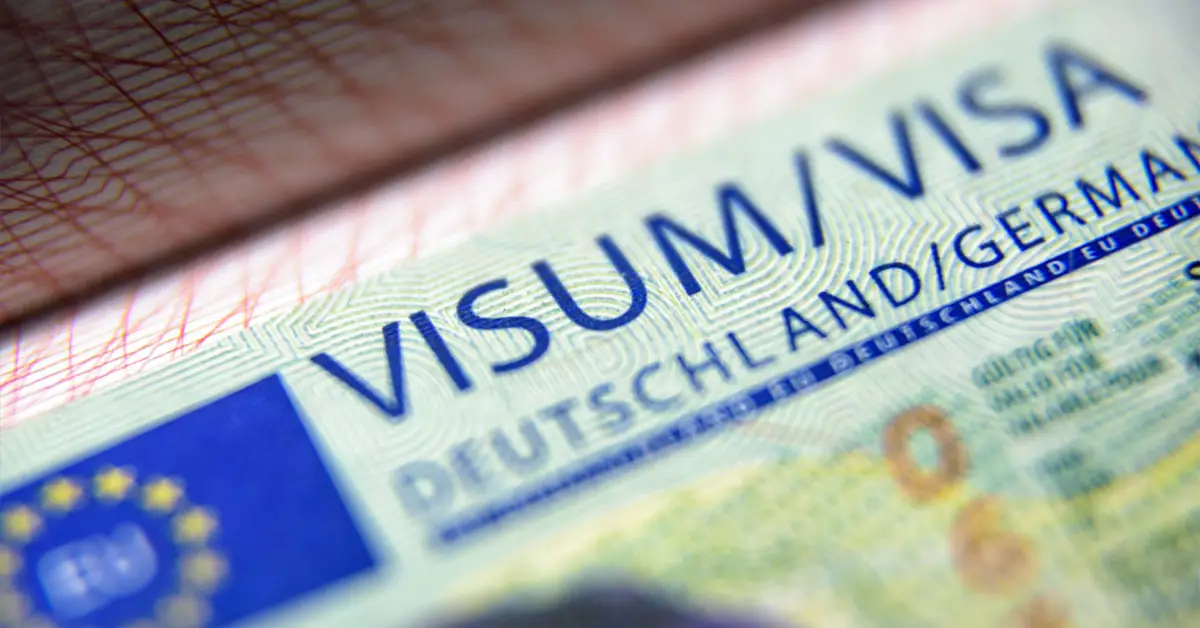
The Work Visa (Arbeitsvisum) is the traditional route for those who already hold an employment contract in Germany before applying. It suits applicants who have found work through international recruitment agencies, online job fairs, or personal networks.
The Work Visa conditions comprise a binding employment contract in Germany, a qualification matching the occupation (a university degree or a vocational qualification equivalent to 2 years’ training), and a check and approval by the Federal Employment Agency (Bundesagentur für Arbeit) — apart from exempt cases. The salary must match the local market and be no lower than the collective wage (Tariflohn) for the corresponding occupation.
An important innovation from the 2024 reform is the “experience pillar”: workers with at least 2 years’ experience in the occupation and a foreign qualification of at least 2 years’ training recognised in their country of origin but not fully recognised in Germany may still be granted a Work Visa where the salary threshold reaches EUR 45,630 a year (the 2026 level) or a collective agreement applies. This is an important opening for mid-level skilled workers without a university degree.
For regulated professions such as healthcare (doctors, nurses), teaching, law and architecture, workers must have their professional qualification recognised by the relevant state authority (Landesbehörde) before practising. This process usually takes 6–18 months and may require additional examinations, an adaptation course or an equivalence assessment.
German language requirements and credential recognition
German is an important factor even though the German skilled worker immigration routes do not always require it. For the EU Blue Card, no German is required at the visa stage, but B1 is a condition for the Niederlassungserlaubnis after 21 months. For a Work Visa in a non-regulated occupation, German is likewise not mandatory but B1–B2 is usually a practical employer requirement.
For the points-based Opportunity Card, German is one of the main scoring criteria. German at A1 is enough for at least 1 point, but to reach the 6-point total most applicants need German at at least A2 or B1 combined with experience. For regulated professions such as nursing, medicine and teaching, professional German at B2 or C1 is a mandatory condition for practising.
Credential recognition (Anerkennung) is an important and time-consuming step. The official portal anerkennung-in-deutschland.de (run by the German government) helps identify the competent recognition authority for each occupation and each state. Recognition costs range from EUR 100–600 per application, with processing taking 3–6 months depending on the occupation.
For qualifications not fully recognised, applicants may choose: an adaptation course (Anpassungsmaßnahme), an equivalence examination (Kenntnisprüfung), or the new “experience pillar” route where the salary threshold is high enough. Adaptation courses usually last 6–18 months and may come with their own study visa.
From residence permit to permanent residence and citizenship
German skilled worker immigrants initially receive a temporary residence permit (Aufenthaltserlaubnis) valid for 1–4 years depending on the route. To convert to permanent residence (Niederlassungserlaubnis), settlers must meet conditions on time resident, social contributions, knowledge of the law and German language ability.
For the EU Blue Card, the route to permanent residence is the fastest: 33 months with German at A1, or 21 months with German at B1. For an ordinary Work Visa, 4 years of work is needed together with German at B1 and 48 months of pension insurance contributions. The other conditions comprise full health insurance, no criminal record, and suitable accommodation for the applicant and family.
To apply for German citizenship under the reformed law in force from 27/06/2024, the minimum residence period has been reduced from 8 years to 5 (3 years in cases of “special integration achievement”). Germany now accepts dual (and multiple) nationality — an important historic change allowing those naturalising to keep their original citizenship.
The German citizenship conditions comprise: 5 years’ lawful residence, German at B1, passing the Einbürgerungstest on German law and history (33 multiple-choice questions), supporting oneself without reliance on social benefits, having no serious criminal record, and a commitment to the German constitution and democratic values. For the spouse of a German citizen, the period falls to 3 years.
The risks and important points
German skilled worker immigration has several particular features to prepare for carefully. First, the language barrier is a major challenge. Although many large technology companies and startups in Berlin and Munich use English as their main language, most small and medium-sized German companies (the Mittelstand) require German at B1–B2. Investing 6–12 months in learning German before moving is the optimal strategy.
Second, the credential recognition process (Anerkennung) can take months. Bachelor’s degrees from Vietnamese universities rated H+ (H-plus) in the anabin database are usually recognised automatically. Degrees from other institutions may need a detailed assessment. For vocational qualifications, the recognition process is usually more complex and time-consuming.
Third, the cost of living in Germany is fairly high, particularly in Munich, Hamburg, Frankfurt and Berlin. A single person usually needs at least EUR 1,500–2,000 a month, and a family of 4 needs EUR 3,500–5,000 a month depending on the city. Rent is the largest expense and may take 30–45% of net income.
Fourth, German administrative procedures are famously slow and complex. Getting an appointment at the Foreigners’ Office (Ausländerbehörde) can take 1–3 months. Registering an address (Anmeldung), opening a bank account, registering for health insurance and signing a tenancy agreement can all be difficult without German. Many people engage a settlement adviser (Einwanderungsberater) in the early stages.
Conclusion
German skilled worker immigration has become considerably more flexible and open since the Skilled Immigration Act reform of 2023–2024. The three main routes comprise the EU Blue Card for professionals with a university degree, the Opportunity Card for those wanting to come to Germany to look for work directly, and the Work Visa for those already holding an employment contract — each suiting a different group.
Germany’s great advantage over other European destinations is the moderate 2026 EU Blue Card salary threshold (EUR 45,300–50,700 a year), the fastest route to permanent residence (21–33 months), and the new citizenship policy accepting multiple nationality and reducing the residence period to 5 years. For skilled technical, healthcare and information technology workers from Vietnam, Germany is one of the most worthwhile European destinations to consider today in a long-term settlement plan.
Accompanying you on your journey in residency investment
The Prosperous Living Investment team advises on pathways, assesses profiles and manages investments transparently for every residency, citizenship and international property objective.
Free profile assessmentWhere life gets prosperous