

Larnaca real estate: developing areas and investment opportunities in 2026

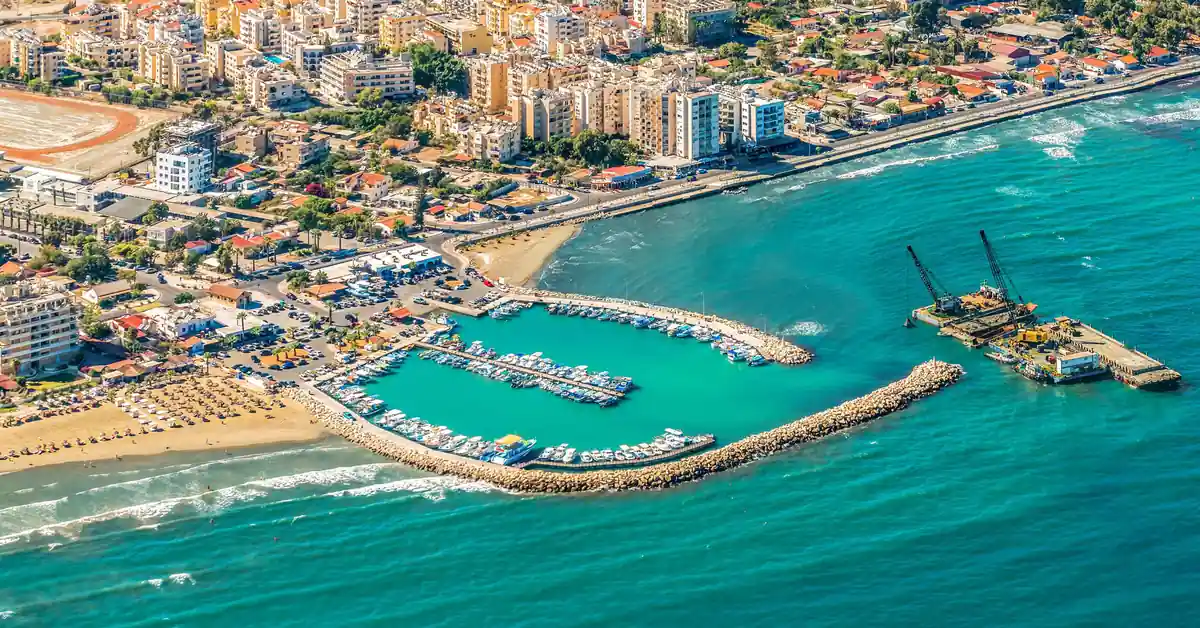
Larnaca real estate is emerging as the fastest-growing market in Cyprus in 2026, thanks to a combination of low entry prices, proactive urban planning and two major infrastructure projects under way at the same time. While Limassol has hit a price ceiling of around 7,500–9,200 EUR per square metre in its high-end areas, Larnaca still averages 2,100–2,400 EUR per square metre — only a third of the equivalent segment in its western rival. This is a clear opportunity for Vietnamese investors seeking a balance between rental yield and price growth potential.
Message
Larnaca’s strategic position on the map of Cyprus
Larnaca is the third largest city ofCyprusafter Nicosia and Limassol, with a district population of more than 145,000. Larnaca lies on the southeast coast of the island, a 40-minute drive from Nicosia and 60 minutes from Limassol via the A1 motorway.
Larnaca International Airport (LCA) is Cyprus’s number one air gateway, with more than 8 million passengers in 2023 and 100 flights a day. This is a key reason Larnaca real estate enjoys better international connectivity than any other city on the island, especially for short-term rentals and digital nomads.
Larnaca Port — the oldest port in Cyprus — and Larnaca Marina are just a few minutes’ walk from the city centre, forming a 3 km coastal development axis from Finikoudes through Mackenzie to the new marina area. This axis is the focus of both public and private investment in 2024–2030.
Climate and living conditions
Larnaca enjoys a typical Mediterranean climate with 320 days of sunshine a year, average winter temperatures of 13–17°C and summer temperatures of 28–32°C. Larnaca’s coast has two European Blue Flag beaches, Finikoudes and Mackenzie, ensuring water quality and services for tenants.
The cost of living in Larnaca is about 25–30% lower than in Limassol and about 10% lower than in Paphos. A couple can live comfortably on 2,000–2,500 EUR a month, including rent, food, transport and personal expenses. This is why Larnaca strongly attracts young families and technical staff moving from Limassol.
International community and language
Foreigners make up about 20% of the district’s population, mainly British, Israeli, Russian and Lebanese, and more recently Indian and Vietnamese. English is widely used in banking, healthcare and commerce, so investors who do not speak Greek face no obstacles.
UCLan Cyprus (a branch of the UK’s University of Central Lancashire, operating since 2012) and the American University of Cyprus (opened in 2021) are based in Larnaca, creating steady rental demand from international students. This also supports long-term rental liquidity in the areas near the campuses.
Considering a residency programme? The Prosperous Living Investment team assesses your profile free of charge and advises on the pathway that fits your goals.
Two infrastructure projects shaping the value of Larnaca real estate
Larnaca real estate is being supported by two major infrastructure projects under way in 2025–2027. Both have a direct impact on home prices and rental yields in the surrounding areas.
Larnaca Marina and Port redevelopment
The Larnaca port and marina redevelopment project is worth 1.2 billion EUR in total, the largest private infrastructure project in Cyprus’s history. However, its implementation went through major upheaval in 2024–2025.
In December 2025, the Cypriot government formally cancelled its contract with Kition Ocean Holdings — the Cypriot–Israeli joint venture that originally won the tender — over a dispute about financial guarantees. The Cyprus Ports Authority has taken over the port for interim operation and the Cyprus Marine & Maritime Institute (CMMI) manages the marina, while the Hellenic Republic Asset Development Fund (HRADF/TAIPED) prepares a new masterplan.
According to an announcement by the Cyprus Ministry of Transport in early 2026, maintenance and upgrading of the marina is expected to be completed around September 2026, with the Yacht Club and Nautical Club buildings completed around December 2027. Later phases include building Cyprus’s first private island with 45 luxury villas with private moorings, 332,449 square metres of commercial space and about 10,000 square metres of educational facilities.
Although progress is slower than originally planned, property investors in the surrounding areas still benefit from long-term expectations. The Mackenzie area and central Larnaca DE1 recorded price rises of 11% in 2024 on the back of these expectations.
Larnaca International Airport expansion (Phase 2)
Phase 2 of the Larnaca airport expansion has a budget of 95 million EUR out of a total 170 million EUR for the two airports (Larnaca and Paphos). According to the official announcement ofHermes Airports, the groundbreaking took place on 05/06/2025 and completion is expected within 30 months — that is, by late 2027 or early 2028.
The expansion adds 20,000 square metres of floor space for departures and arrivals, new aircraft gates, additional baggage belts, new passport control and security points, and more aircraft stands. Once complete, the airport’s capacity will rise from 8.5 million to 12.4 million passengers a year — an increase of 46%.
Cypriot President Nikos Christodoulides has linked the project to two strategic goals: Cyprus holding the rotating Presidency of the Council of the European Union in the first half of 2026, and its plan to join the Schengen Area. Cyprus is working to complete its internal procedures in 2026, opening the prospect of free Schengen passenger flows to Larnaca in the near future.
Prices and segments by area in Larnaca
Larnaca property prices vary clearly by area, from luxury seafront apartments in Mackenzie to moderately priced family villas in Oroklini. Q4 2025 data from the RICS Cyprus Property Price Index shows a district-wide average of 2,100–2,400 EUR per square metre, expected to rise to 2,300–2,600 EUR per square metre by the end of 2026.
Mackenzie Beach — the high-end seafront segment
Mackenzie is Larnaca’s fastest-changing area, stretching along the coast south of the airport. It has been dubbed the “fastest-changing neighbourhood”, with a wave of cafés, international restaurants and boutique apartment projects springing up over the past 3 years.
New apartments in Mackenzie currently cost 3,500–4,500 EUR per square metre in the mid-to-high segment. Gross yields reach 6.5–8% thanks to an extremely strong short-term rental market — a seafront 1-bedroom apartment can achieve 95% occupancy from April to October. Annual price growth is forecast at 6–8% in 2026.
A long-term positive factor for Mackenzie is the new Cyprus University of Technology campus under construction, with a budget of 16.4 million EUR (with EU support). The marine sciences faculty is expected to be completed in summer 2027, welcoming 1,500–2,000 students — adding steady long-term rental demand.
Drosia and Faneromeni — residential centres
Drosia and Faneromeni are two central Larnaca areas with many schools, hospitals and offices. They are the top choice of Cypriot and expat families living long-term.
Apartments in Drosia currently cost 2,300–2,800 EUR per square metre, with gross yields of 5.5–6.5% mainly from long-term lets of 12–24 months. The area has been identified as one of the “gentrifying neighbourhoods” of all Cyprus, with price growth of 5–10% a year in 2024–2026.
2-bedroom apartments in Drosia usually rent for 1,000–1,400 EUR a month, and 3-bedroom apartments for 1,300–1,800 EUR a month. Vacancy is below 5% for professionally managed units.
Livadia — a fast-growing outer area
Livadia is on the eastern edge of Larnaca and is seeing the district’s strongest residential expansion, with a wave of new complexes, schools and shopping centres. Its proximity to the new marina and the A3 motorway makes it an ideal mid-term growth area.
3-bedroom maisonettes in Livadia start from 295,000 EUR (about 2,300 EUR per square metre), 30–40% cheaper than in Mackenzie for the same size. Gross yields range from 5.5–6.5% for long-term lets. Off-plan property in Livadia can be 10–20% cheaper than completed units — with the added advantage of flexible payments.
Oroklini and Pervolia — holiday villas
Oroklini (also written Voroklini) is about a 10-minute drive from central Larnaca and is known for its quiet village atmosphere and mountain views. It is a favourite of older expats and remote workers looking for more space than a central apartment.
3–4 bedroom villas in Oroklini, Dhekelia and Pervolia cost from 320,000 EUR to 1 million EUR. Gross yields are 5–6.2% with long-term lets to expat families. Pervolia stands out for Faros Beach (Blue Flag), its lighthouse and Venetian tower — tourist attractions that draw high-end short-term tenants.
Summary of prices and yields by area
For easy comparison, below is a summary of the main areas in the Larnaca district:
- Mackenzie Beach: 3,500–4,500 EUR per square metre, yield 6.5–8% (mainly short-term lets)
- Drosia / Faneromeni: 2,300–2,800 EUR per square metre, yield 5.5–6.5% (long-term lets)
- Livadia: 2,100–2,500 EUR per square metre, yield 5.5–6.5% (good-value off-plan)
- Oroklini / Pervolia: 2,500–3,500 EUR per square metre for villas, yield 5–6.2%
- Skala / Central DE1: 2,000–2,400 EUR per square metre, yield 5–5.8% (resales common)
Investing in Larnaca real estate for Cyprus permanent residence
Larnaca real estate is an attractive choice for Vietnamese investors seeking Cyprus permanent residence under the Permanent Residence Regulation 6(2) programme. Moderate prices make it possible to meet the 300,000 EUR investment threshold with high-quality properties rather than a studio as in Limassol.
Compatibility with the PR 6.2 investment threshold
Under the Council of Ministers rules effective from 02/05/2023,Cyprus residency by investmentunder category 6.2 requires the purchase of at least one new property worth 300,000 EUR excluding VAT, together with passive income from abroad of at least 50,000 EUR a year.
In Larnaca, a budget of 300,000 EUR excluding VAT is enough to buy options such as: a 90 square metre 2-bedroom apartment in Mackenzie or Drosia, a 3-bedroom villa in Livadia or Oroklini, or a 4-bedroom family maisonette in Pervolia. This is a quality of life hard to match on the same budget in Limassol — where 300,000 EUR buys only a 50 square metre 1-bedroom apartment 2–3 km from the sea.
The ability to combine residency and yield is Larnaca’s strength. The same 300,000 EUR property can both meet the PR requirement and generate rental income of 1,500–2,000 EUR a month (equivalent to a 6–8% gross yield) — especially if a professional letting model is chosen.
A warning about 5% and 19% VAT
Investing in Larnaca real estate for PR 6.2 requires buying a new home with the appropriate VAT.Cyprus property VATat the reduced 5% rate applies only to a home that becomes the primary residence, subject to 4 cumulative caps: 130 square metres, 350,000 EUR, 190 square metres and 475,000 EUR.
If an investor buys a 200 square metre home for 350,000 EUR, it falls outside the scope of 5% VAT and will be subject to 19% VAT on the full price. That is an additional 66,500 EUR — which must be carefully factored into the total budget before deciding.
For investors who want only yield and will not use the property as their primary residence, the full 19% VAT applies. However, this VAT can be recovered if the property is bought through a Cyprus Limited company registered for VAT for commercial letting activities.
Choosing off-plan vs resale in Larnaca
Larnaca has a lively off-plan market with many apartment and townhouse projects starting construction in 2024–2026.Off-plan property Cyprusis usually 10–20% cheaper than completed units, with flexible payment plans of a 10–20% deposit and the balance tied to construction progress.
However, off-plan is not suitable for buyers who need PR immediately, because handover takes 2–3 years. For urgent PR applications, choose a completed unit or a project due for handover within 6–12 months to shorten the timeline.
Resales in Larnaca are usually cheaper but do not qualify for PR 6.2 — the programme requires a new purchase from the developer (first sale). Resale buyers are suited only to pure yield investment or the slower Category F route.
The process of buying Larnaca real estate for Vietnamese buyers
The process of buying Larnaca real estate for third-country nationals such as Vietnamese buyers follows the Cap.109 Immovable Property Acquisition (Aliens) Law. The whole transaction takes about 4–6 months from signing the contract to receiving the title deed.
Step 1: Reservation and due diligence
After choosing a unit, the investor pays a reservation deposit of 5,000–10,000 EUR to hold the price for 2–4 weeks. During this period, the Cypriot lawyer carries outdue diligence: checking the developer’s title deed, planning permit, town planning permit, mortgage payment history and zoning restrictions.
Legal fees for due diligence and drafting the contract range from 1,500–3,000 EUR for transactions below 500,000 EUR. This fee is separate from the deposit and will be deducted from the final invoice if the transaction goes ahead.
Step 2: Signing the contract and payment
The Sale Agreement is signed by both parties and then lodged with the Larnaca District Department of Lands and Surveys within 60 days to protect the buyer’s rights. The filing fee is 0.5% of the contract price, up to a maximum of 50 EUR.
Payments usually follow a schedule: 30% after signing, 30% when the structure is complete, 30% on completion of finishes and 10% on handover of the keys. Off-plan schedules may differ depending on the developer.Stamp dutyhas been abolished from 01/01/2026 under Law 239(I)/2025.
Step 3: Council of Ministers approval
Third-country nationals must obtain Council of Ministers approval under Cap.109 before receiving the title deed. The Form Comm.145 application is submitted through the Ministry of the Interior and includes the passport, sale contract, proof of funds and criminal record certificate.
Processing in Larnaca takes about 1–2 months (Limassol takes 30–45 days, Paphos several months). Approval is usually granted to all good-faith applicants without legal problems. The application fee is about 100 EUR.
Step 4: Title deed transfer
Once Council of Ministers approval has been obtained and the developer has issued the title deed for the specific unit, the two parties complete the transaction at the Department of Lands and Surveys. The transfer fee has been cut by 50% from 01/01/2026 for first sales with VAT — making it almost negligible.
An important note: many apartment projects in Larnaca do not have separate title deeds for each unit at handover. In this case, the investor receives a temporary “share certificate” and must wait 1–3 years for the developer to complete the separate title deed process. Choosing a project with a clear title deed plan is a major risk-reduction factor.
Advantages and risks of the Larnaca property market
Before deciding, investors need a clear view of both the positives and the risks of this market. Larnaca is not a perfect market, and volatile factors need to be factored into a long-term plan.
Key advantages
First, it has the lowest entry prices of Cyprus’s coastal cities. Investors can own a high-quality 2-bedroom apartment for 200,000–250,000 EUR — a segment that barely exists in Limassol or Paphos.
Second, the combination of yield and growth. Gross yields of 5.5–8% plus expected price growth of 5–8% a year create a potential total return of 10–14% a year for a well-managed portfolio — far ahead of most European property markets.
Third, outstanding air connectivity thanks to Larnaca International Airport. Once Phase 2 is completed at the end of 2027, capacity of 12.4 million passengers a year will put Larnaca among the leaders in tourism capacity in the Eastern Mediterranean.
Risks to consider
The biggest risk is uncertainty over the progress of Larnaca Marina after the cancellation of the Kition contract. Although the government is speeding up a new masterplan, a scenario in which the project is delayed by another 2–3 years or scaled back is entirely possible. Investors buying “marina-adjacent” apartments at premium prices may face liquidity risk if the marina falls short of expectations.
The second risk is abundant off-plan supply. Larnaca had about 2,824 new residential units under construction (22% of the national total) in 2024 — strong supply pressure could slow price growth in the mid-range segment. Livadia risks over-supply in 2027–2028.
The third risk is dependence on tourism. Mackenzie and the marina area have high short-term yields but are sensitive to swings in international tourism. Regional geopolitical events or an EU economic crisis could cut short-term rental revenue by 30–40% for several months.
The fourth risk is the quality of rental management. Larnaca has fewer world-class professional management companies than Limassol. Foreign investors need to vet a management company’s capability and integrity carefully before signing a long-term contract.
Popular property types in Larnaca
Larnaca real estate is more diverse than many people think — from small seafront studios to spacious family villas in old villages. Understanding the features of each property type helps investors choose a product that fits their goals and budget. See the summary article onCyprus real estate by property type.
Apartments
Apartments are the most common product in Larnaca, accounting for about 60% of transactions in the district. Data from theCyprus Statistical Service (CYSTAT)shows that the Larnaca district was granted 2,824 residential building permits in 2024, mostly for apartment complexes.
New-build apartments in Larnaca have entry prices from 150,000 EUR for a studio, 200,000–300,000 EUR for 1–2 bedroom units in Drosia or Livadia, and 400,000–700,000 EUR for 2–3 bedroom seafront units in Mackenzie. Average sizes are 60–110 square metres depending on layout.
Apartments are easy to manage remotely, have low community fees (200–500 EUR a month), high resale liquidity and suit both short-term and long-term rentals. They are also a popular choice for Vietnamese investors in the PR 6.2 programme with a just-sufficient budget.
Maisonettes and townhouses
A maisonette is a 2–3 storey terraced house with its own garden, typical of Larnaca’s outer areas such as Livadia, Aradippou and Oroklini. This type mainly serves expat families and middle-class Cypriots.
3-bedroom maisonettes in Livadia start from 295,000 EUR, with 130–160 square metres of floor space and a 50–100 square metre garden. They offer the best balance of price and space in Larnaca for budgets below 350,000 EUR.
Long-term rental yields for maisonettes are usually 5.5–6.5%, lower than Mackenzie apartments but more stable because tenants are families staying 2–5 years. Vacancy is below 5% if the location is convenient for schools.
Villas
Villas in Larnaca fall into three clear segments by location. Seafront villas in Mackenzie and Pervolia cost from 800,000 EUR to 3 million EUR, serving international HNWIs and bought mainly for personal use combined with high-end short-term letting.
Villas in Oroklini, Dhekelia and the village of Pyla cost 320,000–800,000 EUR, appealing to older expats and remote workers looking for spacious living. Plots are 300–600 square metres with 180–300 square metres of built area, often with a private pool.
Villas in old villages around Larnaca such as Lefkara, Choirokoitia or Tochni have low entry prices of 200,000–400,000 EUR but poor liquidity. They suit a long-term slow-living goal more than yield investment.
Commercial real estate
Commercial real estate in Larnaca includes offices, street-front shops and warehouses. This segment offers the highest yields of 8–9% in prime locations but requires deep market knowledge and professional management capability.
Offices in central Larnaca DE1 and the Finikoudes area cost 2,500–4,000 EUR per square metre and rent for 12–18 EUR per square metre a month. Street-front shops on Athinon Avenue and Zinonos Kitieos Street cost far more — 8,000–15,000 EUR per square metre.
Vietnamese investors usually do not target the commercial segment because of the difficulties of cross-border management and liquidity risk. It suits investment funds or investors with a company based in Cyprus.
Strategic choices for Vietnamese investors
The choice of area and property type in Larnaca depends on each investor’s strategic goals. There is no “absolute best” choice, only the choice that best fits personal circumstances and expectations.
For maximum yield
Investors who prioritise cash flow should focus on Mackenzie Beach and the marina area with a short-term rental strategy. Gross yields of 6.5–8% combined with price growth of 6–8% a year create the highest total return among Larnaca’s segments.
This requires being ready to manage actively or hire a professional company at a fee of 15–25% of gross income. Investors must also register as Self-Service Accommodation under Law 9(I)/2020 and comply with safety standards.
For combined PR and holiday use
Investors combining permanent residence with owning a holiday home should target Drosia, Oroklini or Pervolia. These areas balance a quiet environment, easy 12-month long-term letting and stable resale liquidity.
A budget of 300,000–400,000 EUR excluding VAT buys a good-quality 3-bedroom villa with enough rooms for the family when visiting Cyprus. A 5–6% yield is a stable level for a long-term portfolio.
For long-term growth
Investors with a 5–10 year horizon should consider off-plan in Livadia or new projects near the marina. The lowest entry prices of 2,100–2,500 EUR per square metre, combined with upside from the marina and airport expansion, create potential cumulative price growth of 25–40% over 5 years.
This strategy requires patience (waiting 2–3 years for handover) and tolerance of delivery risk. In return, entry costs are lowest and the room for capital appreciation is widest.
Summary and next steps
Larnaca real estate is in the “early momentum” stage of its growth cycle — characterised by relatively low prices, infrastructure projects under way and a growing international community. The window of opportunity for Vietnamese investors who want to enter the market before a re-rating is still wide but gradually narrowing, as prices in Mackenzie and Drosia rose 6–11% a year in 2024–2026.
Investment decisions should be based on three core factors: personal goals (yield, PR, holiday use or capital growth), a realistic budget including 5% or 19% VAT, and tolerance of the risk around Larnaca Marina’s progress after the Kition contract cancellation.
The next step for Vietnamese investors considering Larnaca is a 5–7 day on-site visit, viewing 8–12 units in different areas and working with a local lawyer before deciding. See our other analyses of the overall Cyprus market and the Cyprus residency by investment process for a full picture before committing funds.
Accompanying you on your journey in residency investment
The Prosperous Living Investment team advises on pathways, assesses profiles and manages investments transparently for every residency, citizenship and international property objective.
Free profile assessmentWhere life gets prosperous