


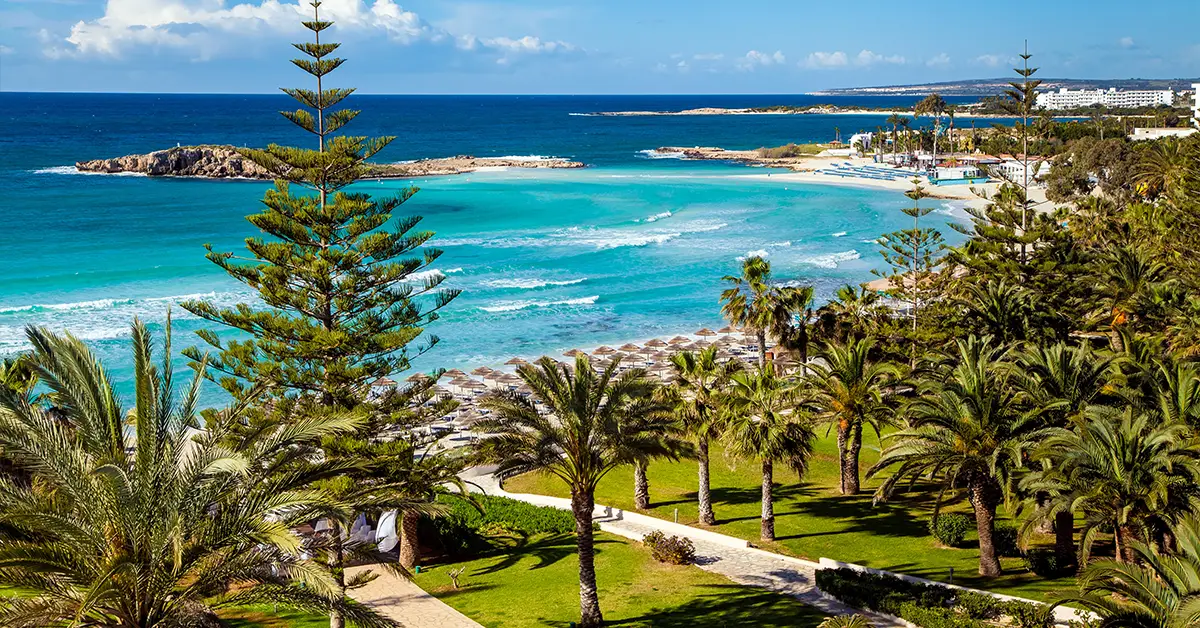
The international relations of Cyprus are shaped by its strategic location at the crossroads of Asia, Europe and Africa, a complex colonial history, the division of the island since 1974 and membership of the European Union since 2004. This small island, with a population of under 1 million in the south, has built a wide diplomatic network and acts as a bridge between Europe and the Eastern Mediterranean.
This article analyses the main pillars of Cypriot foreign policy, including relations with the European Union, the United Nations and Eastern Mediterranean countries, the reunification issue and bilateral relations with Vietnam. The content is current to the first half of 2026, when Cyprus holds the rotating Presidency of the Council of the European Union for the second time in its history.
Detailed article onThe island nation of Cyprus.
Message
Overall foreign policy
Cyprus pursues a foreign policy that combines commitment to the European Union and close ties with Western partners while maintaining friendly relations with countries in the Eastern Mediterranean. Before joining the EU, Cyprus was an active member of the Non-Aligned Movement, which its first President, Archbishop Makarios III, helped found at the 1961 Belgrade conference. After joining the EU on 01/05/2004, Cyprus gave up full membership and became an observer in the Non-Aligned Movement.
The core strategic goal of Cypriot diplomacy is to resolve the division of the island, secure the withdrawal of Turkish troops from the north and reunify the country on the basis of UN Security Council resolutions. In addition, Cyprus is actively strengthening economic, energy and security cooperation with its neighbours Greece, Israel, Egypt and Lebanon, while expanding relations with new partners in Asia such as Vietnam, India and China.
Ministry of Foreign Affairs of Cyprus, headquartered in Nicosia and headed by Foreign Minister Constantinos Kombos, coordinates all of the country’s diplomatic activity. Cyprus maintains 36 embassies and permanent missions in key capitals, along with many honorary consuls around the world. The island also hosts more than 100 foreign embassies and consulates in Nicosia.
Considering a residency programme? The Prosperous Living Investment team assesses your profile free of charge and advises on the pathway that fits your goals.
Membership of the European Union
Cyprus officially became a member of the European Union on 01/05/2004, together with 9 other countries in the largest enlargement in EU history. It joined the eurozone on 01/01/2008, replacing the Cyprus pound with the euro at a fixed rate of 1 EUR = 0.585274 CYP. Cyprus has also been a member of the Schengen Area since 2025, after a lengthy evaluation process.
Cyprus held the rotating Presidency of the Council of the European Union for the first time in the second half of 2012 and for the second time in the first half of 2026, from 01/01 to 30/06. The motto of the 2026 Presidency is “An Autonomous Union. Open to the World”, announced by President Nikos Christodoulides at the Lefkara Conference Centre on 21/12/2025.
The five overarching priorities of the 2026 Cyprus Presidency are: autonomy through security, defence and preparedness; autonomy through competitiveness; an EU open to the world; an autonomous Union of values for all; and long-term investment through the 2028-2034 multiannual financial framework. Deputy Minister for European Affairs Marilena Raouna directly coordinates the agenda.
During its Presidency, Cyprus is focusing on advancing negotiations on the 2028-2034 Multiannual Financial Framework (MFF), aiming for a negotiating box with reference figures by June 2026, supporting Ukraine in its conflict with Russia, implementing the Pact for the Mediterranean and strengthening EU-NATO defence cooperation. The island hosted an informal summit in Ayia Napa and Nicosia on 23-24/04/2026, attended by European Council President António Costa and the leaders of member states.
The United Nations and international organisations
Cyprus became a member of the United Nations on 20/09/1960, immediately after gaining independence from Britain. The island is also a member of the Commonwealth since 1961, the Council of Europe, the Organization for Security and Co-operation in Europe (OSCE), the International Monetary Fund (IMF), the World Bank and the World Trade Organization (WTO).
The United Nations Peacekeeping Force in Cyprus (UNFICYP) is one of the longest-running peacekeeping missions in the world, established by UN Security Council Resolution 186 on 04/03/1964. The mission was originally deployed to prevent conflict between the Greek Cypriot and Turkish Cypriot communities, and its mandate was later expanded to monitoring the ceasefire and the Buffer Zone after the Turkish invasion of 1974. UNFICYP maintains about 1,000 military and civilian personnel, overseeing the 180 km Buffer Zone that runs across the island and divides the capital Nicosia.
Cyprus takes an active part in multilateral diplomacy on climate change, migration, maritime security and human rights. The island is a party to the 1982 United Nations Convention on the Law of the Sea (UNCLOS) and has declared exclusive economic zones (EEZs) that overlap with those of neighbouring countries. Cyprus is also a member of the International Criminal Court (ICC) and has ratified the main international human rights treaties.
The Cyprus problem
The Cyprus problem has been at the heart of the island nation’s diplomacy since the Greek-backed coup of 15/07/1974 and the Turkish invasion of 20/07/1974. Turkish forces occupy about 37% of the island in the north and forced about 200,000 Greek Cypriots to flee the north, while about 60,000 Turkish Cypriots moved from the south to the north.
On 15/11/1983, Turkish Cypriot leaders declared the “Turkish Republic of Northern Cyprus” (TRNC) in the north of the island, which the UN Security Council declared invalid in Resolutions 541 (1983) and 550 (1984). The TRNC is recognised only by Turkey, while the international community recognises only the government of the Republic of Cyprus as the sole legitimate representative of the whole island.
The Annan Plan, proposed by UN Secretary-General Kofi Annan in 2004, was the most recent reunification effort with a real chance of success. In the referendum of 24/04/2004, 76% of Greek Cypriot voters rejected the plan while 65% of Turkish Cypriot voters supported it. A week later, the Republic of Cyprus joined the EU without the northern part of its territory. New talks at Crans-Montana, Switzerland, in July 2017 also ended in failure over disagreements about Turkey’s role as a security guarantor and foreign troops stationed on the island.
The Republic of Cyprus’s firm position is to seek a settlement based on a bizonal, bicommunal federation with a single sovereignty, single citizenship and single international personality, in line with the relevant UN Security Council resolutions. The island firmly rejects any two-state solution, which Turkey and Turkish Cypriot leader Ersin Tatar have proposed since 2020.
Relations with neighbouring countries
Greece is Cyprus’s most important strategic partner, given the historical, linguistic, religious and cultural ties between the two countries. The two countries maintain regular dialogue at the level of heads of state, prime ministers and foreign ministers. Greece is one of the three guarantor powers under the 1960 Treaty of Guarantee, together with Britain and Turkey, although this arrangement has become controversial since the events of 1974.
Relations with Turkey remain tense because of the division of the island and disputes over exclusive economic zones in the Eastern Mediterranean. Turkey is the only country that recognises the TRNC and keeps about 30,000 troops in the north of the island. The two countries have no direct diplomatic relations, even though both are members of the Council of Europe, and Turkey is a member of NATO (Cyprus is not a NATO member).
Israel, Egypt and Lebanon are important partners in the Eastern Mediterranean. Cyprus has established trilateral partnerships with Greece and Israel since 2016 and with Greece and Egypt since 2014, focusing on energy cooperation, maritime security and counter-terrorism. Cooperation on natural gas in the Aphrodite, Calypso and Glaucus fields with Israel and Egypt is creating the prospect of becoming a regional energy hub.
In 2024 Cyprus launched the Amalthea Initiative, a humanitarian maritime corridor from the port of Larnaca to Gaza to deliver aid to civilians affected by the conflict. The initiative is backed by the European Union, the United States, the UK and the Gulf states, reinforcing Cyprus’s position as a regional humanitarian logistics hub.
Relations with the United States and the UK
Cyprus–US relations have developed strongly since 2020, after the United States lifted the arms embargo imposed in 1987. In 2018 the two countries established cooperation on the Cyprus Center for Land, Open-seas, and Port Security (CYCLOPS) and have expanded joint training programmes. Cyprus was formally designated a Strategic Partner by the United States in 2022, advancing high-level security and intelligence dialogue.
Cyprus–UK relations are complex because of the colonial history and the presence of the two Sovereign Base Areas (SBAs) at Akrotiri and Dhekelia, covering about 254 km² of Cypriot territory. The UK is one of the three guarantor powers under the 1960 Treaty of Guarantee and has a role in resolving the Cyprus problem. The two countries maintain close cooperation in defence, education, tourism and investment.
Vietnam – Cyprus relations
Vietnam and Cyprus established official diplomatic relations in 1975, shortly after Vietnam’s reunification. 2025 marks the 50th anniversary of diplomatic relations between the two countries, with many commemorative activities and cooperation events. Vietnam’s Ambassador to Italy is also accredited to Cyprus, currently Ambassador Dương Hải Hưng, while Cyprus’s Ambassador to India is also accredited to Vietnam, and Cyprus has had an Honorary Consulate General in Ho Chi Minh City since April 2016.
The two countries signed a Double Taxation Avoidance Agreement on 10/12/2025 at the Cyprus Ministry of Finance in Nicosia, signed by Finance Minister Makis Keravnos and Vietnamese Deputy Minister of Finance Cao Anh Tuấn. According to the Cyprus Mail, bilateral trade reached $111.6 million USD, and Cyprus has 28 investment projects in Vietnam with total registered capital of nearly $470 million USD, concentrated in real estate, manufacturing and agriculture.
The Vietnamese community in Cyprus numbers about 7,000 people according to the Cyprus Ministry of Labour and Social Insurance, mainly working in agriculture, services and manufacturing. The two countries are working towards a Memorandum of Understanding on recruiting Vietnamese workers to Cyprus to expand job opportunities in new fields such as services and healthcare. The Cypriot Parliament ratified the EU-Vietnam Investment Protection Agreement (EVIPA) on 14/03/2025, paving the way for a strong increase in Cypriot investment in Vietnam.
The Vietnam-Cyprus Cooperation Forum 2025, co-organised by the Vietnamese Embassy in Italy and the Cyprus Chamber of Commerce and Industry (CCCI) in Nicosia on 27/03/2025, attracted more than 30 Cypriot businesses interested in the Vietnamese market. Potential areas of cooperation identified include pharmaceuticals, information technology, finance, education, tourism and the green economy. With its strategic location in the Eastern Mediterranean, Cyprus is positioned as a gateway for Vietnamese goods to Europe, the Middle East and North Africa.
Future outlook
The 2026 Presidency of the Council of the EU gives Cyprus the opportunity to shape Europe’s strategic priorities at a critical time and to raise the island’s international profile. After the Presidency ends on 30/06/2026, Cyprus will continue to focus on its long-term goals of resolving the division of the island, developing a regional energy hub and expanding its network of strategic partners.
Cyprus Vision 2035 aims to make Cyprus a hub for science, financial technology (fintech), innovation and digital transformation in the Eastern Mediterranean. The island places special emphasis on green energy, a sustainable blue economy and high-value professional services. Relations with Asian countries such as Vietnam, India, China, Singapore and South Korea are expected to grow strongly over the next decade as Cyprus seeks to diversify its partners and reduce dependence on traditional markets.
Cyprus’s participation in the India-Middle East-Europe Economic Corridor (IMEC) shows that the island is positioning itself as a key node on the transcontinental transport and energy routes of the 21st century. Regional initiatives such as the Pact for the Mediterranean and relations with the Gulf Cooperation Council (GCC) reinforce Cyprus’s role as a bridge on new geopolitical axes.
Summary
The international relations of Cyprus combine commitment to the European Union, an active role at the United Nations, strategic cooperation in the Eastern Mediterranean and expanding ties with new partners in Asia. The division of the island since 1974 remains the top foreign policy priority, while the 2026 Presidency of the Council of the EU is raising the island’s international profile. Vietnam–Cyprus relations have entered a new phase after 50 years, with a double taxation agreement and concrete economic cooperation initiatives.
Accompanying you on your journey in residency investment
The Prosperous Living Investment team advises on pathways, assesses profiles and manages investments transparently for every residency, citizenship and international property objective.
Free profile assessmentWhere life gets prosperous