

The Greece Golden Visa vs the Malta MPRP: the choice for mid- and high-tier investors

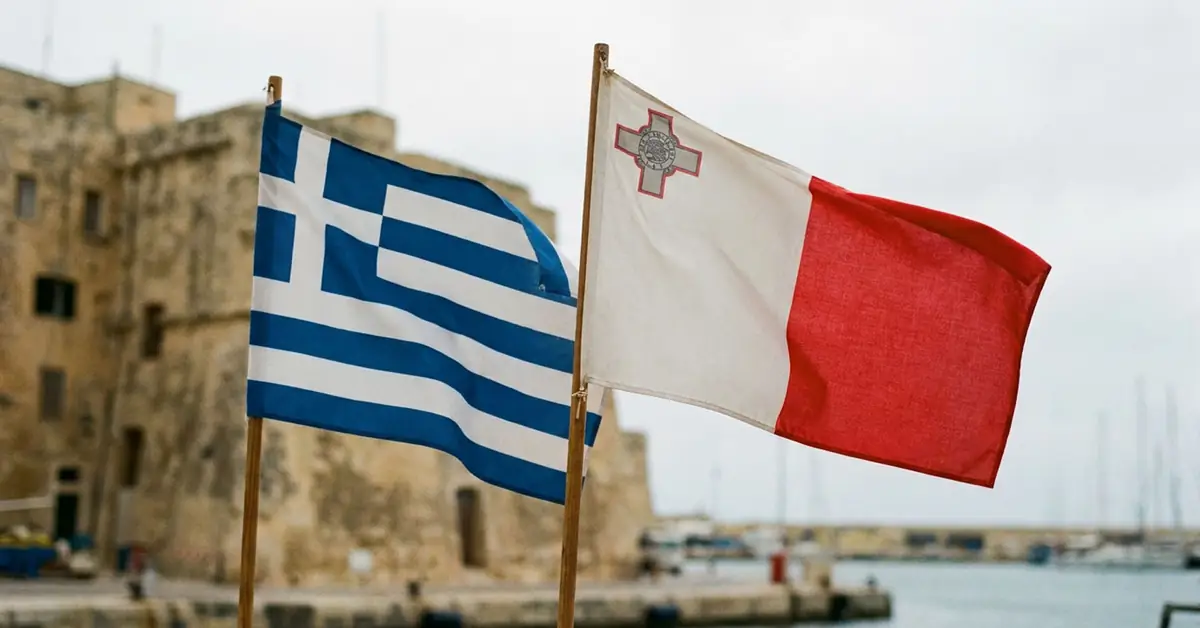
Greece Golden Visa vs Malta MPRP is a particularly popular comparison among mid-to-upper-budget investors (€400,000-€700,000), seeking sustainable EU residence with high legal stability. The two programmes represent two fundamentally different models: Greece issues a five-year residence permit that can be renewed indefinitely based on zoned property investment, while Malta grants permanent residence based on a combined package of a government contribution, property and an NGO donation.
This article compares the two programmes across six key criteria for mid-to-upper-budget investors: investment structure and actual total cost, asset requirements and due diligence, residence and Schengen rights, three-generation family policy, the path to citizenship, and the legal specifics of each programme. The content is based on the legal framework as of May 2026, following Greece’s reform under Law 5100/2024 and Malta MPRP’s Legal Notice 146/2025, in effect from 22 July 2025.
Message
Current investment structure
Greece — Zoned Property
Greece Golden Visa keeps property as its core route, with a three-tier structure based on geographic zoning following Law 5100/2024. According to the Greek Ministry of Migration and Asylum, the €800,000 threshold applies to Zone A, covering the Attica Region, the Thessaloniki Regional Unit, Mykonos, Santorini and 32 islands with a population over 3,100. The €400,000 threshold applies to Zone B, covering the rest of Greece. The €250,000 threshold is retained for two special options: converting commercial property to residential use, and restoring a heritage building.
The core feature of the Greek option is that the entire investment goes into a tangible asset owned by the investor. On exiting the programme or moving to citizenship, the investor can sell the property and recover 60-80% of its original value, depending on the market and the timing of the sale. This is an important philosophical difference from Malta’s “contribution plus investment” model.
Malta — a Combined Package with a Government Contribution
Malta MPRP (Malta Permanent Residence Programme) issued under Legal Notice 121/2021 and amended by Legal Notice 146/2025, officially administered by Residency Malta Agency . The MPRP requires investors to complete four mandatory components simultaneously; they cannot be separated.
The first component is a non-refundable Government Contribution of €37,000 for the main applicant. The second is an Administrative Fee of €60,000, paid in two instalments: €15,000 on application and €45,000 after receiving Approval in Principle. The third is a property investment with two options: purchasing property from €375,000, or renting property from €14,000 per year for a minimum of 5 years. The fourth is a €2,000 donation to a non-governmental organisation (NGO) registered in Malta.
Considering a residency programme? The Prosperous Living Investment team assesses your profile free of charge and advises on the pathway that fits your goals.
The Actual Total Cost of Greece Golden Visa vs Malta MPRP
| Cost item | Greece Zone B €400K | Malta Rental 5 Years | Malta Property Purchase |
|---|---|---|---|
| Real estate investment | €400,000 | €70,000 (5 years’ rent) | €375,000 |
| Government contribution | — | €37,000 | €37,000 |
| Government administrative fee | ~€2,000 | €60,000 | €60,000 |
| NGO donation | — | €2,000 | €2,000 |
| Notary fees + transfer tax | €16,000 | — | €18,750 |
| Legal fees | €10,000 | €20,000 | €20,000 |
| Actual total cost (principal) | ~€428,000 | ~€189,000 | ~€512,750 |
| Asset retained after 5 years | Property €280K-€320K | €0 | Property €375K-€450K |
| Net actual cost | €108K-€148K | €189K | €62K-€137K |
The comparison above shows that the reality is more complex than simply comparing the investment thresholds on paper. The Malta MPRP rental option has the highest net cost (€189,000, entirely non-recoverable) because none of the payments can be recovered. The Malta property-purchase option has a lower net cost if the Maltese property market holds its value or rises. Greece Zone B has a net cost similar to Malta’s purchase option but a simpler structure.
For investors with an actual budget of €450,000-€550,000, all three options are viable: Greece Zone B €400K, Malta rental €189K (keeping €260K in reserve), or Malta purchase €512K. The decision comes down to philosophy: for a tangible asset, favour Greece or Malta purchase; for a lower upfront cost, favour Malta rental.
Asset Requirements and Due Diligence
This is an important difference between the two programmes that many investors have not fully appreciated. Greece does not require proof of total net worth at the time of application — investors only need to demonstrate the lawful source of funds used for the property transaction. This is a considerably lighter requirement than the international standard.
The Malta MPRP requires investors to demonstrate a minimum net worth of €500,000, including €150,000 in liquid financial assets, or alternatively €650,000 in net worth including €75,000 in liquid financial assets. “Liquid financial assets” are strictly defined: they include only bank deposits, listed shares, bonds, and units in recognised investment funds. Real estate and business assets do not count.
Malta is also known for having the strictest due diligence (DD) process in the EU. According to figures published by the Residency Malta Agency, the average MPRP rejection rate is around 10% per year, mainly due to failed DD. DD covers multi-jurisdictional criminal background checks, business and financial history, litigation, international sanctions lists, and PEP (Politically Exposed Person) factors. Greece has a simpler DD process, focused mainly on judicial record and source of funds, with a rejection rate below 3%.
Residence and Schengen Rights
Both Greece and Malta are full members of the European Union and the Schengen Area, since 2007 (Malta) and 2000 (Greece). Holders of a Greece Golden Visa or Malta MPRP are entitled to move freely throughout the entire Schengen Area 27 countries for up to 90 days in any 180-day period, with no additional visa required.
| Benefits | Greece Golden Visa | Malta MPRP |
|---|---|---|
| Visa-free Schengen access | 90/180 days | 90/180 days |
| Residence in the issuing country | Yes | Yes |
| Residence in other EU countries | No | No |
| Presence requirement | 0 days | 14-21 days recommended |
| Validity | 5-year renewal | Permanent |
| Permitted to work | No | Yes (after PR) |
| Card renewal | Every 5 years | Every 5 years |
The Greece Golden Visa does not permit working in Greece in any form. To work, the investor must switch to a different permit type or wait until citizenship. The Malta MPRP legally permits working in Malta once PR has been obtained, but a work permit is still required in some sectors. This is an important practical difference for investors intending to run a business directly in the issuing country.
The Malta MPRP also grants permanent PR status, with the physical card renewed every 5 years (but with no re-assessment required). Greece renews indefinitely but requires the original investment to be maintained (selling the property means losing the Golden Visa). In practice the two models are equivalent in durability but differ legally.
Family Policy of Greece Golden Visa vs Malta MPRP
This is a key difference between the two programmes, with major implications for multi-generational Vietnamese families. Greece allows sponsorship of a spouse, children under 21 unconditionally, and the biological parents of both spouses with no requirement to prove financial dependency. This is already a broad policy compared with most EU programmes.
The Malta MPRP goes a step further with a three-generation family policy. Investors can sponsor, in a single application: a spouse, dependent children (no age limit, but must prove financial dependency and be unmarried), the biological parents of both spouses, and the biological grandparents of both spouses. This is one of very few EU residence-by-investment programmes that allows sponsorship of the grandparent generation.
| Criteria | Greece Golden Visa | Malta MPRP |
|---|---|---|
| Legal spouse | Yes | Yes |
| Common-law partner | Yes | Yes |
| Children under 21 | Yes (no conditions) | Yes (no conditions) |
| Children aged 21-25 | No | Yes (unmarried, dependent) |
| Children over 25 | No | Yes (unmarried, dependent, with proof) |
| Investor’s parents | Yes (no conditions) | Yes (proof of dependency) |
| Spouse’s parents | Yes (no conditions) | Yes (proof of dependency) |
| The investor’s grandparents | No | Yes (proof of dependency) |
| The spouse’s grandparents | No | Yes (proof of dependency) |
Although Malta allows more dependants to be included, each adult member (over 18, except the spouse) adds a further €7,500 dependant fee. A four-generation family (investor + spouse + 2 children + 2 parents + 2 grandparents = 8 people, of whom 6 are over 18 excluding the spouse) adds €37,500 on top of the base cost. Total MPRP cost for a large family can reach €550,000-€600,000.
The Greece Golden Visa does not increase the fee based on the number of family members. An investor including 8 dependants still pays only the base processing fee of €2,000. This is a major advantage of Greece for large traditional Vietnamese families, although grandparents cannot be included as they can under Malta.
The Path to Citizenship — Malta Is the Strictest in the EU
The naturalisation pathway is the clearest difference between the two programmes. Greece has a stable pathway of 7 years’ legal residence under Citizenship Law 3284/2004, together with a Greek B1 language test and a culture-and-history test, Greek citizenship which leads to an EU passport with freedom of movement across 27 EU countries.
Malta has one of the strictest naturalisation pathways in the EU for PR holders. Under the Malta Citizenship Act, Chapter 188, to apply for naturalisation an investor must meet two strict residence conditions at the same time: continuous residence in Malta for the 12 months immediately before applying (without exceeding the permitted time abroad), and at least 4 years’ residence in Malta within the preceding 6 years (a minimum of 5 years’ residence in total). This requirement means the investor must genuinely live in Malta continuously, not merely hold the paperwork.
For Vietnamese investors who intend to keep their main life in Vietnam, the Malta citizenship pathway is almost unworkable. Greece, with its 7 years of legal residence (with no minimum physical-presence requirement in the early years), is a far more accessible option. This is why investors who choose the Malta MPRP tend to treat it as a permanent residence destination (PR for life) rather than as a stepping stone to citizenship.
Malta also has its own citizenship-by-investment programme (Malta Citizenship by Naturalisation for Exceptional Services) with an investment from €750,000 upwards, but this is an entirely separate programme from the MPRP and is not covered in this article.
Processing time
Greece has a statutory processing time of 2 months, though in practice it takes 4-12 months depending on the region because of case backlogs. Greece has digitised the process since 2025, but caseloads remain high in Athens and Thessaloniki.
The Malta MPRP has an official processing time of 12-18 months from the date a complete application is submitted, making it one of the slowest programmes in the EU because of the region’s strictest due-diligence process. However, Malta offers a way to ease the time pressure: an investor can apply for a 1-year Temporary Residence Permit (TRP) immediately after filing, allowing lawful entry to Malta while the MPRP is being approved. The TRP requires payment of a €15,000 stage-1 administrative fee plus €100 per temporary card.
After receiving Approval in Principle, a Malta investor has 8 months to complete the remaining payments and be formally granted PR. Greece has no equivalent step — all payment must be completed before filing, and there is no formal temporary residence permit during the review period.
Legal Specifics and Risk
Both programmes have a stable legal framework but face pressure from the European Union over the transparency of residence-by-investment schemes. Greece has been through the Law 5100/2024 reform, raising the real-estate investment threshold, and continues to adjust it annually. Malta amended the MPRP through Legal Notice 146/2025 in July 2025, improving flexibility but also raising the dependant fee.
The biggest risk with the Malta MPRP is a due-diligence rejection rate of about 10%, much higher than Greece’s 3%. Investors should run a preliminary DD check before committing to the full cost. Some advisory services offer a preliminary DD check within 24-48 hours for €1,500-€3,000, reducing the risk of losing the initial €15,000 fee if the application is rejected outright.
The risk with Greece centres on the property asset: short-term letting (Airbnb) is prohibited, with a €50,000 fine, and use as a business headquarters is prohibited, with a €250,000 conversion option. See the article on taxes in Greece to understand the tax obligations that come with the Greece Golden Visa.
Who each programme suits
The Greece Golden Visa suits three groups. The first is investors with a budget of €250,000-€500,000 who prioritise a tangible property asset that can be resold after leaving the programme. The second is families with elderly parents who want to include them without having to prove financial dependency, and who do not need to include grandparents. The third is investors who have capital but not the €150,000 in liquid financial assets required to prove eligibility under the MPRP. See also the article on Greek Golden Visa Zone B €400,000 for the option suited to a mid-range budget.
The Malta MPRP suits three other groups. The first is three- or four-generation families who want to include grandparents, parents, spouse and children at the same time, and who can afford a total cost above €600,000. The second is investors who already hold substantial liquid financial assets (€500K+) and want permanent PR with no renewal. The third is investors who are betting on an actual future life in Malta (the EU’s only English-speaking jurisdiction, plus favourable tax treatment for entrepreneurs).
For Vietnamese investors with a budget under €500,000 and a three-generation family (spouse + children + parents), Greece is the only workable option, because the Malta MPRP incurs significant dependant fees and the total cost for an equivalent family is usually above €550,000.
Summary
The Greece Golden Visa and the Malta MPRP serve two investor segments that differ fundamentally in family structure and investment philosophy. The Greece Golden Visa suits a mid-range budget of €250,000-€500,000, prioritising a tangible asset and a standard two-generation family. The Malta MPRP suits a higher budget of €500,000-€700,000, three- to four-generation families including grandparents, and a wish for permanent PR from day one.
The final decision depends on three personal factors: the family structure to be included (whether grandparents are involved), investment philosophy (tangible asset versus contribution), and actual total budget. Both programmes offer full Schengen access and a workable citizenship pathway for investors who intend to actually reside in the EU. See the dedicated articles on each option to build a pathway suited to your family’s asset structure and specific goals.
Accompanying you on your journey in residency investment
The Prosperous Living Investment team advises on pathways, assesses profiles and manages investments transparently for every residency, citizenship and international property objective.
Free profile assessmentWhere life gets prosperous