

Cyprus vs Malta 2026: Cyprus PR 6.2 and Malta MPRP compared on investment, family and benefits

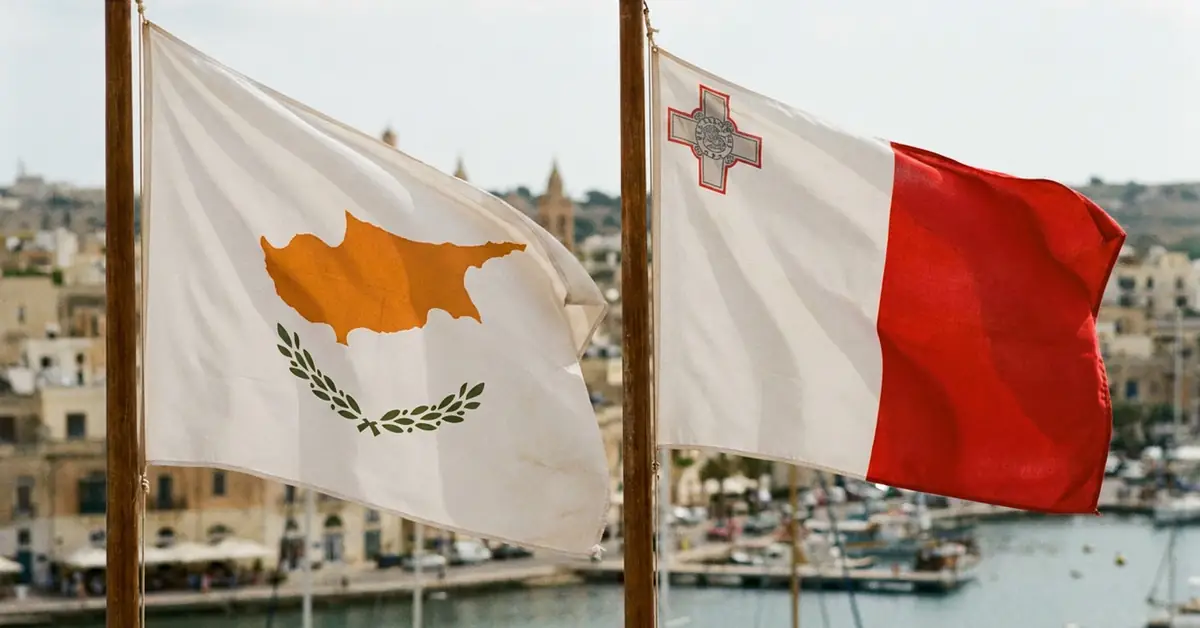
Cyprus vs Malta is the hardest decision among EU investment PR options for Vietnamese investors. Both Mediterranean island nations are members of the EU and the Eurozone, both grant family PR through investment, and both are seriously considered by many Vietnamese HNWIs. However, after Malta’s major reform under Legal Notice 146 of 2025 and the changes in the Republic of Cyprus in 2023–2026, the two programmes now differ very clearly in cost structure, family sponsorship scope and the path to citizenship.
This article analyses in detail 10 key factors between the Cyprus PR 6.2 fast track and the Malta Permanent Residence Programme (MPRP) updated for 2026, with a summary comparison table, the real cost structure, an assessment of the pros and cons of each programme, and recommendations tailored to each Vietnamese investor profile — from pure HNWIs to multi-generational extended families.
Message
An overview of the two programmes in the Cyprus vs Malta comparison
Before going into the detailed analysis, it is important to understand the legal nature and purpose of each programme. This is the foundation for correctly assessing each country’s policy philosophy and long-term risk.
PR Cyprus 6.2 fast-track
PR Cyprus 6.2 operates under Regulation 6(2) of the Aliens and Immigration Regulations of the Republic of Cyprus, running steadily since 2013. Its core feature: the programme grantspermanent (indefinite) residence— granted once, with no need to renew the status; only the physical card is renewed every 10 years. It requires an investment of €300,000 EUR excluding VAT in new property or in shares of a Cypriot company/fund.
Cyprus specifically requiressecured income of €50,000 EUR a year for the main applicantfrom sources outside Cyprus — a high barrier, but also a mechanism that protects the programme from AML risk.
Malta Permanent Residence Programme (MPRP)
Malta Permanent Residence Programme (MPRP)was introduced in 2021 to replace the old Malta Residence and Visa Programme (MRVP). It is apermanent PRprogramme with a residence card renewable every 5 years, administered by theResidency Malta Agencydirectly.
Following Legal Notice 146 of 2025 (in force from 22/07/2025) and the updates for 2026, the MPRP has 4 mandatory components:
– Property (purchase or rental) — minimum 5 years
– Government Administrative Fee — €60.000 EURO
– Government Contribution — €37,000 EUR (the same for purchase and rental)
– NGO Donation — €2.000 EURO
Unlike Cyprus, Malta requiresasset thresholds: minimum assets of €500,000 EUR (including €150,000 EUR in liquid assets) OR €650,000 EUR (including €75,000 EUR in liquid assets). This is a wealth requirement, not an income requirement — suitable for HNWIs with substantial assets but no regular income.
Considering a residency programme? The Prosperous Living Investment team assesses your profile free of charge and advises on the pathway that fits your goals.
Cost structure and investment thresholds
This is the first deciding factor for most investors in the Cyprus vs Malta comparison.
Cyprus PR 6.2: a simple structure
The Cyprus financial structure has only 2 major components:
- Property investment: €300,000 EUR excluding VAT (5%–19%) — the capital is retained in the asset
- Government fees: €500 EUR for MIP1 + €70 EUR per person for the ARC (very small)
- Lawyers’ fees: €3,000–€7,000 EUR depending on the family
Actual total cost (family of 4): ~€340,000–€370,000 EUR including VAT and service fees. Of this,€300K–€330K is held in the property— not money lost.
Malta MPRP: a multi-component structure
Malta has a more complex structure with several separate fees:
Rental Route:
– Property rental: €14,000 EUR a year × 5 years = €70,000 EUR (sunk cost)
– Government Administrative Fee: €60,000 EUR (sunk cost)
– Government Contribution: €37,000 EUR (sunk cost)
– NGO Donation: €2,000 EUR (sunk cost)
– Total sunk costs: €169,000 EUR over 5 years
Purchase Route:
– Property purchase: €375,000 EUR (retained in the asset)
– Government Administrative Fee: €60,000 EUR (sunk cost)
– Government Contribution: €37,000 EUR (sunk cost)
– NGO Donation: €2,000 EUR (sunk cost)
– Total initial cost: €474,000 EUR, of which€99,000 EUR is sunk cost
Additional fees: €7,500 EUR for each dependant over 18 (excluding the spouse), plus lawyers’ fees of €15,000–€30,000 EUR depending on complexity.
Real cost analysis
Comparing “sunk costs” — the part that cannot be recovered after the programme ends — is the most accurate way to assess them:
- Cyprus: ~€10,000–€20,000 EUR in service fees + transfer taxes
- Malta rental: €169,000 EUR over 5 years
- Malta purchase: €99,000 EUR over 5 years + the option to sell the property after 5 years
Cyprus is cheaper than Malta by about€80.000-€150.000 EUROover the same 5 years. However, Cyprus requires an income of €50K a year — a barrier Malta does not have.
Income and asset requirements
The core difference between the two programmes.
Cyprus: an income requirement (Income test)
Cyprus applies a mechanism of proving secured income from sources outside Cyprus:
- €50,000 EUR a year for the main applicant
- €15,000 EUR a year for a spouse
- €10,000 EUR a year for each dependent child
A family of 4 must prove a total income of €85,000 EUR a year. Income can come from salary, dividends, interest, pensions or rent — it must be stable and backed by tax records.
Malta: an asset requirement (Asset test)
Malta applies a mechanism of proving wealth instead of income:
- Minimum assets of €500,000 EUR (including €150,000 EUR in liquid assets — cash, shares, bonds)OR
- Minimum assets of €650,000 EUR (including €75,000 EUR in liquid assets)
Liquid assets must be maintained for the first 5 years, checked annually via Form MPRP5 (Official Compliance Form).
Impact on the choice
For Vietnamese investors:
– HNWIs with a regular cash flow of €100K+ EUR a year: both are viable
– HNWIs with substantial wealth but low cash flow(property, shares in unlisted companies): Malta is more suitable
– Retirees living on accumulated assets: Malta is more suitable (the asset test is easier than the income test)
– Business people with high salaries and regular dividends: Cyprus is more suitable (cheaper)
About 25–35% of Vietnamese investors who considered Cyprus switch to Malta when they cannot prove an income of €50K a year to the CRMD standard.
Scope of family sponsorship
The most important factor for Vietnamese families with a multi-generational structure.
Cyprus PR 6.2: a limited scope
After the 02/05/2023 reform, Cyprus narrowed the scope of sponsorship:
- Spouse: included
- Children under 18: included
- Children aged 18–25 (studying abroad, financially dependent): separate application + €10,000 EUR of additional income
- Parents and parents-in-law are NOT included(removed from 02/05/2023)
- Grandparents: not included
Many Vietnamese families who wanted to bring elderly parents along can no longer do so through the 6.2 programme — a major barrier compared with Malta.
Malta MPRP: 4 generations
Malta applies the broadest definition of family in the EU:
- Spouse/partner: included
- Children under 29 (unmarried, dependent): included —up to age 29, not 18 or 25
- Parents of the main applicant and of the spouse: included (not in full-time employment)
- Grandparents: included
A single application can sponsor the applicant + spouse + 2 children + 4 parents + 4 grandparents = 12 people in one application. An additional fee of €7,500 EUR applies per person >18 (excluding the spouse).
Practical analysis
For 3-generation Vietnamese families (grandparents + parents + children), Malta is the only viable option in the EU at a competitive entry price. Even with the additional €7,500 fee per person over 18, the total Malta cost for a family of 12 is still far lower than filing 3 separate Cyprus applications for 3 generations.
Process and processing time
Differences in process directly affect the investor’s timeline.
Cyprus PR 6.2: fast and streamlined
- Submit the MIP1 application in person at the CRMD in Nicosia (no licensed-agent lawyer required)
- Standard time: 2 months under Regulation 6(2)
- Actual time: 2–4 months for simple applications
- After approval: 1 year to enter the country and provide biometrics
- The PR card is issued within 2–4 weeks after biometrics
Malta MPRP: an expedited TRP
- Mandatorythrough an Authorised Registered Mandatory (ARM) — a lawyer licensed by the Residency Malta Agency
- A 5-step process: KYC → Submission → Due Diligence → Letter of Approval in Principle → Final approval
- Processing time: 6–9 months overall
- The plus side: A 1-year renewable Temporary Residence Permit (TRP) is issuedwithin 1 monthof applying — allowing entry and residence in Malta while final approval is pending
Process assessment
Cyprus wins on speed of final approval (2–4 months vs 6–9 months). Malta wins on immediacy — the 1-month TRP lets families move to Malta early. For families who want their children to start school in the new academic year, the Malta TRP is an important practical advantage.
The Schengen Area and travel rights
The top practical factor for international business people.
Cyprus: not yet in Schengen
Cyprus has been an EU member since 2004 buthas not yet joined the Schengen Area. PR holders do not automatically get visa-free travel within the Schengen area — they must apply for a separate Schengen visa for each trip.
The good news: Cyprus has met the technical standards and is in final negotiations with the EU. It is expected to join Schengen in 2026–2027.
Malta: full Schengen membership since 2007
Malta has been a full member of the Schengen Area since 21/12/2007. MPRP holders can travelvisa-free for 90 days in any 180-day periodacross all 27 Schengen countries — including France, Germany, Spain, Italy, the Netherlands, Austria, Belgium…
This is Malta’s biggest practical advantage over the Republic of Cyprus as of today, 2026.
The path to citizenship
The long-term goal of most investors is EU citizenship.
Cyprus: 8 years of residence
The 2023 reform: the required residence period is8 years of actual residence within the last 11 yearswith 1 continuous year immediately before applying for naturalisation. Additional requirements:
- Pass the Greek language exam (Greek B1) or English
- A test on the Constitution and history of the Republic of Cyprus
- Proof of economic and social integration
Pure 6.2 PR holders (investment only, no residence) cannot automatically move on to citizenship.
Malta: 5 years, with conditions
Malta applies a stricter mechanism:
- The MPRP does NOT lead automatically to citizenship— this is an important difference
- You must go through naturalisation under the Maltese Citizenship Act
- 5 continuous years of actual residence are required (4 of the last 6 years + the final year immediately before applying)
- Pass the Maltese or English language exam
- Prove social integration
Besides naturalisation, Malta hasCitizenship by Merit (CBM)— a direct citizenship programme through exceptional contributions, independent of the MPRP. CBM requires €600K–€750K and 12–36 months of residence.
Assessing the pathways
Although Malta has a shorter residence period (5 vs 8 years), it requires genuine residence — unsuitable for investors who keep their business base in Vietnam. The same goes for Cyprus 6.2 — pure PR does not lead to citizenship unless you genuinely move there.
Tax considerations and incentive regimes
Tax is often overlooked early on in the Cyprus vs Malta comparison, but it can make a big difference to long-term costs for HNWIs.
The Cyprus tax system
Cyprus has one of the most attractive tax systems in the EU for foreigners, especially after the 2026 Tax Reform:
- Corporate tax: 12.5% (rising to 15% from 01/01/2026 under OECD Pillar Two)
- Personal income tax: progressive 0–35%, with the first €19,500 EUR tax-free
- Non-Dom regime: a 17-year incentive — no tax on dividends, interest or investment returns from abroad
- Capital gains tax: applies only to Cypriot property and shares in property companies
- No inheritance tax: no inheritance or gift tax
Cyprus has the60-day rule, which is unique — 60+ days a year of residence is enough to become a Cyprus tax resident if you are not a tax resident of any other country.
The Malta tax system
According to information fromResidency Malta Agency, Malta has several distinctive tax regimes:
- Corporate tax: 35% nominal, but the full imputation system brings the effective rate down to 5% on distributed dividends
- Personal income tax: progressive 0-35%
- Resident Non-Domiciled regime: tax only on income remitted to Malta — suitable for people who do not bring all their assets into Malta
- Inheritance tax: none levied (an advantage equivalent to Cyprus)
- MPRP holders: no obligation to become a tax resident unless you reside 183+ days a year
Malta has a complex Imputation System — a Maltese tax specialist is needed to take full advantage of it.
Tax analysis for Vietnamese investors
The tax decision depends on your personal financial structure:
- Income of €100K–€500K EUR a year: Cyprus Non-Dom is usually better (simple, extensive exemptions)
- Business people running a Cypriot company: Cyprus 12.5%–15% is cheaper than Malta’s 5% effective (after imputation, Malta still needs larger cash flows to benefit)
- HNWIs with diverse passive income: Malta Resident Non-Dom (remittance basis) is more suitable if much of the income is kept outside Malta
- No intention of becoming a tax resident: both are fine, but Malta is easier
Investors should work with an international tax specialist to model their specific situation before deciding.
Actual residence requirements
The key question: how long must you live there to keep the status?
Cyprus PR 6.2
- Must enteronce every 2 yearson an ongoing basis
- Continuous absence of more than 2 years leads to cancellation of PR
- No minimum number of residence days per year
- Tax residency is not mandatory
Malta MPRP
- No actual residence requirementto keep the status
- 14–21 days a year recommended to maintain a “genuine link”
- Property and valid health insurance must be maintained
- You become a tax resident if you reside more than 183 days a year
Both allow investors to keep their main life in Vietnam, but Malta is more flexible on the number of visits.
The key question: how long must you live there to keep the status?
Cyprus PR 6.2
- Must enteronce every 2 yearson an ongoing basis
- Continuous absence of more than 2 years leads to cancellation of PR
- No minimum number of residence days per year
- Tax residency is not mandatory
Malta MPRP
- No actual residence requirementto keep the status
- 14–21 days a year recommended to maintain a “genuine link”
- Property and valid health insurance must be maintained
- You become a tax resident if you reside more than 183 days a year
Both allow investors to keep their main life in Vietnam, but Malta is more flexible on the number of visits.
Summary comparison table: Cyprus vs Malta
A summary table of the 10 key factors in the Cyprus vs Malta comparison, based on official data from theCivil Registry and Migration Department(Cyprus) and the Residency Malta Agency:
- Property investment: Cyprus €300K (purchase, asset retained) | Malta €375K purchase or €14K a year rental
- Sunk costs: Cyprus €10–20K | Malta €99K (purchase) or €169K (rental)
- Financial requirement: Cyprus income of €50K a year | Malta assets of €500K (including €150K liquid)
- Processing time: Cyprus 2–4 months | Malta 6–9 months (TRP in 1 month)
- Permit type: Cyprus permanent PR | Malta permanent PR (card renewable every 5 years)
- Family scope: Cyprus spouse + children <18/25 | Malta + parents + grandparents, 4 generations
- Schengen access: Cyprus not yet | Malta full
- Residence requirement: Cyprus once every 2 years | Malta not mandatory
- Citizenship: Cyprus 8/11 years + Greek/English | Malta 5-year naturalisation + Maltese/English
- Administration: Cyprus self-application possible | Malta mandatory through an ARM licensed agent
Recommendations by investor profile
Based on the 10 factors in the Cyprus vs Malta comparison, the right choice depends on the specific profile of the Vietnamese investor.
Choose Cyprus PR 6.2 if you
- Have a regular income of €50K+ EUR a year from Vietnam
- Want the fastest approval (4–6 months in total)
- Have a nuclear family (no dependent parents/grandparents)
- Want a permanent permit that never needs renewing
- Have assets of €300K–€500K and do not want to invest more
- Prefer to keep capital in property rather than donating to the government
- Are willing to wait for Cyprus to join Schengen in 2026–2027
Choose Malta MPRP (Rental Route) if you
- Do not have a regular income and mainly live on your assets
- Have wealth of €500K+ EUR but do not want to lock capital into property
- Have parents and grandparents you want to sponsor too (4 generations)
- Need Schengen access immediately
- Are comfortable with sunk costs of €169K over 5 years
- Prioritise a 1-month TRP to move your children to school in the EU early
Choose Malta MPRP (Purchase Route) if you
- Have wealth of €650K+ EUR and want to invest in Maltese property
- Are interested in Maltese property investment yields (4–7% a year)
- Intend to actually use the property (holidays, rental investment)
- Want to diversify property holdings outside Vietnam
- Have a complex multi-generational family structure
When to combine both
Some Vietnamese HNWIs with assets of €1.5M+ EUR choose todo both— Cyprus 6.2 for low-cost indefinite PR + Malta MPRP for Schengen access and sponsoring parents/grandparents. A total investment of about €700K–€1M EUR split across 2 countries diversifies policy risk and maximises family benefits.
Summary and next steps
The Cyprus vs Malta comparison has no absolute “best” choice — every decision depends on each investor’s financial profile, family structure and long-term goals. Cyprus wins on real cost, approval speed and simplicity of process. Malta wins on extended family scope (4 generations), immediate Schengen access and flexibility for HNWIs with wealth but no regular income.
Vietnamese investors consideringCyprus residency by investmentneed a realistic assessment of the secured income of €50,000 EUR a year — the barrier that rules out many applicants from the start. For extended families with elderly parents and grandparents who want to settle in the EU together, Malta MPRP is the only viable option, despite its significantly higher cost.
Finally, the most important practical difference between the two programmes is not the investment threshold but thepolicy philosophy: Cyprus sees PR as a first step in the integration process (rigorous but long-term oriented), while Malta sees the MPRP as a tool for attracting capital (expensive but flexible and family-friendly). For Vietnamese HNWIs weighing a third EU option, see theCyprus vs Greece comparisonof the Golden Visa for a complete view. Understanding this philosophy helps investors set the right expectations and choose the programme that fits their family’s real life.
Accompanying you on your journey in residency investment
The Prosperous Living Investment team advises on pathways, assesses profiles and manages investments transparently for every residency, citizenship and international property objective.
Free profile assessmentWhere life gets prosperous