


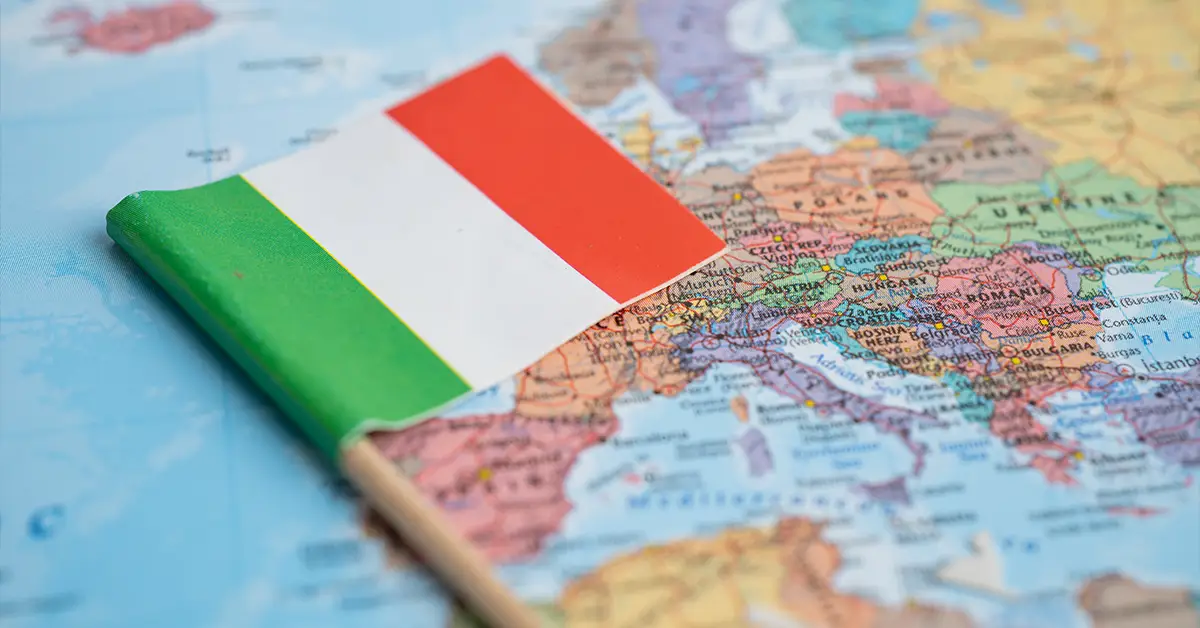
Italy’s international relations rest on three traditional pillars: European integration, the transatlantic alliance through NATO, and a central role in the Mediterranean. As a founding member of the European Union (EU) and NATO and a permanent member of the G7 and G20, Italy holds an important geopolitical position — a bridge between Europe, the Mediterranean and North Africa.
This article analyses Italy’s international relations with the EU, NATO, the G7 and G20, the United States, the Mediterranean and North Africa (through the Mattei Plan), Russia, China and emerging economies, as well as bilateral relations with Vietnam and the practical benefits for Vietnamese people.
Detailed articleItaly.
Message
Italy and the European Union (EU)
Italy was one of the six founding members of the European Economic Community (EEC) in 1957, the forerunner of today’s EU. The Treaty of Rome — which established the EEC — was signed in the capital on 25/03/1957. Italy has played a key role in all the bloc’s major developments, from the 1992 Maastricht Treaty that founded the EU to joining the eurozone in 1999 and the EU’s enlargement to Eastern Europe.
Within the EU, Italy is one of the largest beneficiaries of the Next Generation EU Recovery Fund, with a 194 billion euro package for its National Recovery and Resilience Plan (NRRP) for 2021–2026. Italy is also the third-largest net contributor to the EU budget after Germany and France. It has 76 seats in the European Parliament — the third-largest number after Germany and France.
Italy – EU relations under the Meloni government are more pragmatic than the earlier Euroscepticism of Fratelli d’Italia. According to the journal Contemporary Italian Politics (2025), Meloni maintains a pragmatic approach to Europe while keeping a firmly Atlanticist orientation. Italy has supported strategic EU initiatives such as ReArm Europe and the SAFE programme, and coordinates closely with Germany and France.
On 23/01/2026, Italy and Germany signed an Italy – Germany Action Plan in Rome at a meeting between Prime Minister Meloni and German Chancellor Friedrich Merz. The two sides committed to strengthening defence cooperation, boosting EU economic competitiveness and establishing an annual consultation mechanism between their foreign and defence ministers. This signals that Italy is moving from a “buffer” position towards a Berlin – Rome axis on Europe’s strategic issues.
Considering a residency programme? The Prosperous Living Investment team assesses your profile free of charge and advises on the pathway that fits your goals.
Italy in NATO and transatlantic security
Italy has been a founding member of NATO since 04/04/1949 and is one of six countries with a key geopolitical position for the alliance — controlling the southern Mediterranean flank. Italy currently hosts 5 major NATO bases, including Allied Joint Force Command Naples (JFC Naples), which commands NATO operations in Southern Europe, the Mediterranean, North Africa and the Middle East. Aviano (Friuli) is a major US and NATO air base in Europe.
Italy reached NATO’s defence spending target of 2% of GDP in 2025, after more than a decade of delay. According to the 2026 Public Finance Document, the Meloni government has committed to raising it gradually to 2.2% of GDP by Q1 2026, with further increases of 0.15% in 2026, 0.3% in 2027 and 0.5% in 2028. Italy has sent about 12 military aid packages worth more than 3 billion euros to Ukraine since 2022, including the SAMP/T air defence system and 220,000 artillery shells.
Italy keeps 1,200 troops in Latvia as part of NATO’s Enhanced Forward Presence and has trained 15,000 Ukrainian soldiers in Viterbo, especially in operating Leopard tanks. However, Italy has not sent combat troops to Ukraine, and Prime Minister Meloni ruled this out at a press conference in January 2026, citing NATO’s Article 5 commitment as a sufficient guarantee. The Italian armed forces also take part in the EU’s Operation Aspides protecting Red Sea shipping lanes — through which 12% of Italy’s imports pass.
NATO’s new target of 5% of GDP (3.5% for core defence and 1.5% for broader security) poses a major challenge for Italy. To reach 3.5% by 2035, Italy must spend at least an additional 165 billion euros — a politically and fiscally difficult task given public debt of 137.1% of GDP and differing views on defence within the ruling coalition. Deputy Prime Minister Salvini opposes an EU army and sending troops to Ukraine, while Deputy Prime Minister Tajani supports the creation of an EU army.
Italy and the G7, G20: its role among the economic powers
Italy is one of the seven members of the G7 — the forum of the world’s leading industrialised economies. Italy held the rotating G7 Presidency in 2024, hosting the G7 Summit at Borgo Egnazia (Puglia) in June 2024 on the themes of Ukraine, AI, infrastructure and Africa. Under the new schedule, Italy will again host a G7 Summit in June 2026 at Palazzo Chigi with 45 leaders representing 85% of global GDP.
In the G20, Italy is the only member from Southern Europe (with Spain holding permanent guest status). Italy held the G20 Presidency in 2021 during the recovery from the COVID-19 pandemic, hosting the Rome G20 Summit. Italy contributes actively to G20 initiatives on climate change, global health and the 15% global minimum corporate tax.
Italy also plays a key role in international financial institutions. It is the fourth-largest shareholder of the International Monetary Fund (IMF) among European countries and has a permanent representative seat on the Executive Boards of the IMF and the World Bank. Mario Draghi — former Prime Minister of Italy — served as President of the European Central Bank (2011–2019).
At the United Nations, Italy is one of the largest financial contributors to the regular budget and peacekeeping operations. Rome is home to three major UN agencies: the Food and Agriculture Organization (FAO), the International Fund for Agricultural Development (IFAD) and the World Food Programme (WFP). Italy had 1,116 personnel in 8 UN peacekeeping missions as of 2025, notably UNIFIL in Lebanon, where Italy commands the multinational force.
Relations with the United States and the West
The United States is Italy’s most important strategic ally outside the EU. Italy – US relations were established in 1861 and grew strongly after the Second World War thanks to the Marshall Plan and the US military presence in Italy. About 12,000 US troops are stationed at 5 main bases in Italy — Aviano, Vicenza, Naples, Sigonella and Camp Darby — making Italy the European country with the third-largest US military presence after Germany and the United Kingdom.
Bilateral economic relations are particularly important. The United States is Italy’s largest non-EU market, with 9% of total exports, especially fashion (12 billion euros in 2024), food and beverages, cars and machinery. However, the new 15% tariff on EU goods under the Trump administration is putting heavy pressure on Made in Italy exports, especially wine, olive oil and luxury goods.
Prime Minister Meloni has built a good personal relationship with President Donald Trump, positioning Italy as a bridge between Washington and Brussels. According to analysis by the German Marshall Fund of the United States, Meloni is trying to keep the door open to both sides — maintaining the Atlantic commitment while protecting European interests. The meeting in Washington in February 2026 and the G7 summit hosted by Italy in June 2026 will be major tests of this intermediary role.
Defence-industrial cooperation with the United States has expanded significantly. Italy has committed to buying more F-35 aircraft, bringing the total to 90, with deliveries of 15 a year until 2032. Italy’s Leonardo group cooperates with Lockheed Martin on the F-35 programme and assembles aircraft at Cameri (Piedmont). Italy also takes part in the GCAP programme with the UK and Japan to develop a sixth-generation fighter jet.
Relations with the Mediterranean and North Africa
The Mediterranean and North Africa are Italy’s top geopolitical priority. On 03/11/2023, the Meloni government announced the Mattei Plan — an Italy – Africa strategic plan named after Enrico Mattei (former head of the energy group ENI). The Mattei Plan was formally launched at the Italy – Africa Summit in January 2024 with 9 priority countries: Algeria, Egypt, Tunisia, Morocco, Libya, Côte d’Ivoire, Ethiopia, Mozambique and the Republic of the Congo.
The Mattei Plan is based on the principle of “equal partnership” instead of the traditional development aid model. Its five pillars of cooperation are: energy (especially natural gas and renewable energy), education and vocational training, sustainable agriculture, health, and water. Italy has committed to investing about 5.5 billion euros in the first phase (2024–2026) — much of it through ENI and Cassa Depositi e Prestiti. The strategic goal is to make Italy “Europe’s energy hub in the Mediterranean”.
Relations with North Africa are particularly important because of irregular migration and energy security. According to the Italian Ministry of the Interior, more than 80% of irregular migrants reach Italy via the Mediterranean route, mainly from Tunisia and Libya. Italy has signed bilateral agreements with the Tunisian government and the Libyan coast guard to control migration flows, while increasing investment in economic development in countries of origin.
Italy has strategic interests in Lebanon (UNIFIL), Libya (ENI oil and gas investments and counter-terrorism) and Israel – Palestine. According to Prime Minister Meloni’s remarks in January 2026, Italy is ready to take part in post-conflict security in Gaza and to train Palestinian security forces, positioning Italy as a “proactive European stakeholder” in the Middle East peace process.
Relations with Russia, China and emerging economies
Italy – Russia relations changed fundamentally after Russia’s invasion of Ukraine in 2022. Italy cancelled the South Stream pipeline and cut its dependence on Russian gas from 40% (2021) to below 5% (2025), replacing it with imports from Algeria, Azerbaijan, Norway and US LNG. Italy has frozen Russian assets worth 238 billion euros on its territory and fully applies the EU sanctions packages.
Italy – China relations have entered a more pragmatic phase. Italy was the only G7 country ever to join the Belt and Road Initiative (BRI), in 2019, but formally withdrew in December 2023 under the Meloni government. Italy has also excluded Huawei from its 5G networks and vetoed 12 Chinese investments across 27 strategic sectors. However, the two sides maintain large trade ties — the Beijing summit in November 2026 signed a green technology framework worth 15 billion euros.
Italy is stepping up relations with emerging economies in the Indo-Pacific. Italy is one of the strongest European supporters of the India – Middle East – Europe Economic Corridor (IMEC), a geopolitical initiative that counterbalances China’s BRI. Its strategic partnership with India was upgraded in 2024. Italy has also signed a Reciprocal Access Agreement with Japan, allowing troops to be stationed for 90 days in each country.
Vietnam – Italy relations: history, trade and cooperation
Vietnam – Italy diplomatic relations were established on 23/03/1973, making Italy one of the first Western countries to recognise a unified Vietnam. The two countries upgraded relations to a Strategic Partnership in 2013 during General Secretary Nguyễn Phú Trọng’s official visit to Italy. To date, Italy is one of only a few EU countries with a Strategic Partnership with Vietnam.
According to the Italian Ministry of Foreign Affairs and International Cooperation (Farnesina), Italy is currently Vietnam’s fourth-largest trading partner in the EU after Germany, the Netherlands and France, with bilateral trade of about USD 6.6 billion in 2024. Vietnam’s main exports to Italy are footwear, textiles and garments, seafood, coffee and electronics. Italy exports machinery, pharmaceuticals, chemicals, fashion and luxury goods to Vietnam.
The EU – Vietnam Free Trade Agreement (EVFTA), in force since August 2020, has removed most tariffs between the two sides, giving strong momentum to bilateral trade. The EU – Vietnam Investment Protection Agreement (EVIPA) was ratified by Italy in 2023, guaranteeing protection for investment in both directions. Vietnam has become the EU’s largest ASEAN export partner, opening opportunities for Italian businesses to expand into Southeast Asia.
Bilateral defence cooperation is being strengthened. According to reports, Italy has signed a defence cooperation package worth 2.8 billion euros with Vietnam, including 24 C-295 patrol aircraft. The two sides also cooperate actively in education — many Italian universities admit Vietnamese students through Erasmus+ scholarship programmes and direct partnerships with Vietnamese universities such as Hanoi University of Science and Technology and Vietnam National University Ho Chi Minh City.
For Vietnamese readers: practical benefits of Italy’s international relations
For Vietnamese people, Vietnam – Italy bilateral relations bring many practical benefits in trade, investment, study and travel. The EVFTA has removed most tariffs, helping Vietnamese businesses enter the Italian market at competitive cost. The Italian Embassy in Hanoi and the Italian Consulate General in Ho Chi Minh City support business, investment and student visas.
For Vietnamese students, educational ties between the two countries have opened up many scholarship programmes. Italian Government Scholarships are awarded annually by the Italian Ministry of Foreign Affairs specifically to non-EU nationals, with Vietnam usually receiving 5–10 places. EU Erasmus+ programmes also support student exchanges between Vietnam and Italian universities.
For Vietnamese investors and entrepreneurs, Italy is an attractive destination thanks to the Strategic Partnership, the EVFTA and the Italy Investor Visa. Investors with capital from 250,000 euros (innovative start-ups) to 2 million euros (government bonds) can obtain a long-term investor residence visa. Bilateral relations also make it easier for Vietnamese businesses to open representative offices in Italy to serve the EU market.
For Vietnamese people considering long-term settlement in Italy, the country’s multi-dimensional standing (a member of the EU, NATO and G7, and a strategic partner of Vietnam) offers many advantages. Italy is a gateway to the entire 29-country Schengen Area. An Italian visa allows free travel within the Schengen Area and is one of the most widely accepted visas.
After naturalisation, Vietnamese people with Italian citizenship enjoy the right to travel, work and live freely in all 27 EU countries and the EEA countries — holding one of the most powerful passports in the world, with visa-free access to more than 190 countries.
Accompanying you on your journey in residency investment
The Prosperous Living Investment team advises on pathways, assesses profiles and manages investments transparently for every residency, citizenship and international property objective.
Free profile assessmentWhere life gets prosperous