

US naturalisation

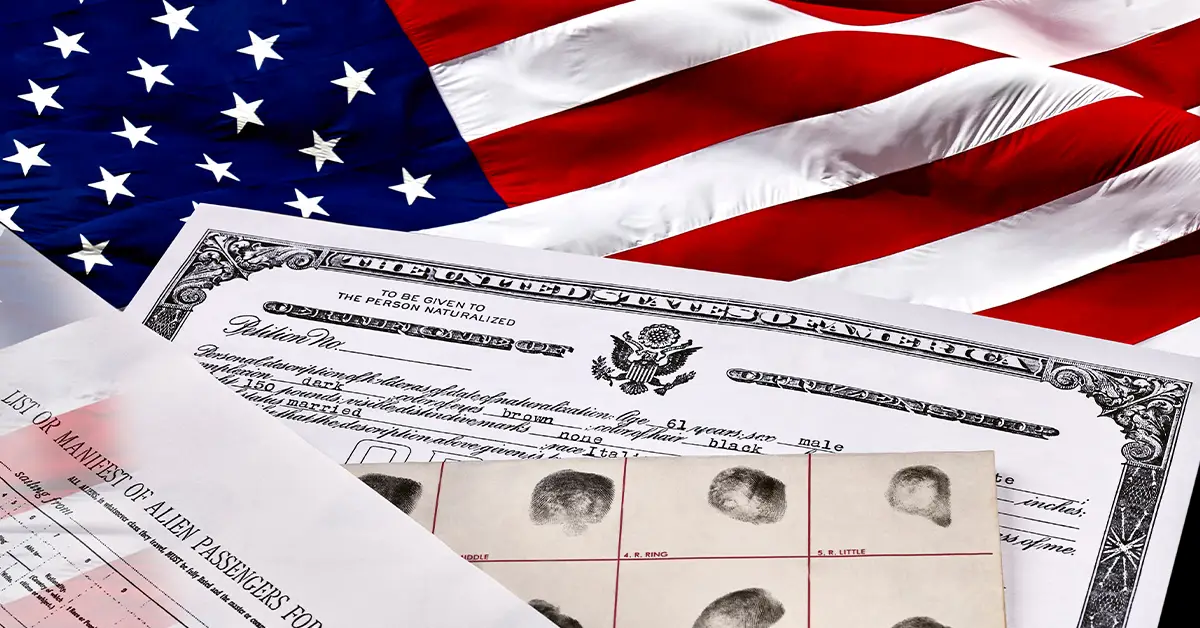
Naturalisation is the process by which an immigrant to the United States of America may become a US citizen. Only certain immigrants are eligible: those who have held agreen card(permanent residence) for 3-5 years or who meet various military service requirements.
Important update (August 2025):
United States Citizenship and Immigration Services (USCIS)has announced two major changes to the naturalisation process:
- Good moral character: officers will now consider both positive contributions (such as community involvement and tax compliance) and certain minor violations or questionable conduct when deciding whether an applicant meets this requirement. This means closer scrutiny and a broader assessment of each applicant’s background.
- Neighbourhood investigations: USCIS has restored in-person “neighbourhood investigations” for the first time in 34 years. Officers may contact an applicant’s neighbours, colleagues or employer to confirm eligibility. Submitting testimonial letters with the application may help avoid delays.
Message
Is naturalisation the same as citizenship?
Naturalisation and citizenship are related but not entirely the same.
Citizenship refers to the status of being recognised as a member of a country, either by descent or through other means.
Naturalisation is the process by which a non-citizen may become a citizen after meeting specific legal requirements, such as permanent residence, language proficiency and passing the citizenship test. So while naturalisation leads to citizenship, it is the process for obtaining citizenship rather than the status itself.
Becoming a US citizen comes with many advantages, and also means taking on new responsibilities.
Considering a residency programme? The Prosperous Living Investment team assesses your profile free of charge and advises on the pathway that fits your goals.
How long does it take to obtain US citizenship?
From the point of applying for citizenship to attending the Oath of Allegiance ceremony currently takes 5.5 months.
What is the fastest way to naturalise?
The fastest route to US citizenship is marriage to a US citizen. Where the applicant is a green card holder married to a US citizen, they may apply for naturalisation after only 3 years of permanent residence rather than the usual 5. Members of the US armed forces may also be eligible for expedited naturalisation, sometimes with the permanent residence requirements waived entirely.
The cost of naturalisation
How much does it cost to apply for citizenship?
The current government filing fee for a naturalisation (citizenship) application is USD 760.
Military applicants are exempt from the filing fee.
USCIS also offers a USD 50 discount where the applicant files the N-400 online rather than by post.
Eligibility for naturalisation
Eligibility for naturalisation usually depends on a number of factors:
- How long the applicant has held theirgreen cardfor
- How long the applicant has been physically present in the United States
- Whether the applicant has served in the US military (and if so, whether that service was in “peacetime” or “wartime” — see the Frequently Asked Questions below for an explanation of these terms)
The following table summarises the most common groups of individuals eligible to apply for US citizenship, and when they may apply, followed by a more detailed explanation below:
| Where the applicant is… | And has been physically present in the United States for at least…* | The applicant may apply for naturalisation… |
|---|---|---|
| A green card holder with no special circumstances | 30 months (2.5 years) | After 5 years |
| A green card holder married to a US citizen | 18 months (1.5 years) | After 3 years |
| The widow/widower of a US citizen who died while serving honourably in the military** | Not required | At any time |
| A green card holder with at least 1 year of peacetime military service | Not required | While still serving or within 6 months of an honourable discharge** |
| A green card holder with less than 1 year of peacetime military service | 30 months (2.5 years) | After 5 years |
| A green card holder with at least 1 year of peacetime military service who was honourably discharged more than 6 months ago** | 30 months (2.5 years) | After 5 years |
| A member of the military with any period of wartime service (with or without a green card) | Not required | At any time |
- *Continuous or non-continuous; any period of military service counts as physical presence in the United States.
- **A discharge designated “General Discharge-Under Honorable Conditions” is treated as an “honourable” discharge for naturalisation purposes.
Who this applies to:
- Where the applicant is a green card holder with no special circumstances, they may apply for US citizenship at least 5 years after obtaining the green card. The applicant must also have been physically present in the United States for at least 30 months (2.5 years) during those 5 years.
- Where the applicant has been married to a US citizen for at least 3 years and has lived with that spouse throughout that period, they may apply to become a US citizen at least 3 years after obtaining the green card. The applicant must also have been physically present in the United States for at least 18 months (1.5 years) during those 3 years, and the applicant’s spouse must have been a US citizen for at least 3 years.
- Where the applicant is the widow/widower of a US citizen who died while serving honourably in the US military (and was living with them at the time of death), the applicant may apply for US citizenship at any time — provided the applicant is a green card holder at the time of the citizenship interview. The applicant need not have held a green card for any particular number of years or have been physically present in the United States for any number of months before applying.
- Where the applicant has served in the US military for at least 1 year in peacetime, they may apply while still serving or within 6 months of an honourable discharge. The applicant need not have held a green card for any particular number of years or have been physically present in the United States for any number of months before applying to become a naturalised citizen.
- Where the applicant has served in the US military for less than 1 year in peacetime, they may apply for US citizenship 5 years after obtaining the green card (periods of honourable service within those 5 years may also count towards that required period). The applicant must also have been physically present in the United States for at least 30 months (or 2.5 years) during those 5 years.
- Where the applicant has served in the US military for at least 1 year in peacetime and is applying more than 6 months after an honourable discharge, they may apply to become a US citizen 5 years after obtaining the green card (periods of honourable service within those 5 years may also count towards that required period). The applicant must also have been physically present in the United States for at least 30 months (2.5 years) during those 5 years.
- Where the applicant has served in the US military during any period of wartime, they may apply at any time and need not be a green card holder. The applicant (or the applicant’s military spouse) need only have been physically present in the United States (including US territories) or on a US vessel when they enlisted, re-enlisted, extended their service or were inducted. The applicant need not have held a green card for any particular number of years (if at all) or have been physically present in the United States for any number of months before applying for citizenship.
Naturalisation requirements
As well as waiting 3 or 5 years after obtaining the green card (unless the applicant is applying for citizenship based on qualifying military service), the applicant must also meet the following requirements in order to proceed with the naturalisation process to become a US citizen:
- The applicant must be at least 18 years old.
- The applicant must have lived continuously in the United States as a green card holder for at least 5 years, or 3 years where married to a US citizen.
- The applicant must have been a resident of the state in which they intend to apply for citizenship for at least 3 months.
- The applicant must have “good moral character”, broadly defined as character meeting the standards of the average citizen in the community. More specifically, however, this means that the applicant has no certain types of offence — such as murder, illegal gambling, or deliberately lying to the US government in order to obtain an immigration benefit — on their record at any time before applying, and does not lie at the naturalisation interview. Whether the applicant meets this requirement is decided by the government case by case.
- The applicant must pass the two-part naturalisation test: the first part is the English test (covering reading, writing and speaking skills) and the second is the civics test (covering knowledge of US history and government).
- The applicant must be willing to serve in the US military or to perform civilian service for the United States if called upon.
- The applicant must have registered with the Selective Service System where male and having lived in the United States between the ages of 18 and 25.
How to apply for US citizenship
A brief overview of the naturalisation process is set out below.
Step 1: File the naturalisation application
The first step to becoming a US citizen is to file the Application for Naturalization (Form N-400) and pay the filing fee (unless the applicant is exempt — see above for details). The applicant may complete and send a paper application by post or complete the application online. Where filing online, the applicant must first create an online account with USCIS.
Where the applicant is applying based on military service, from abroad, or for a fee reduction or waiver, the application cannot be completed online. The applicant must send the application by post to the appropriate USCIS office.
The 90-day early filing rule
The applicant may file the N-400 with USCIS as early as 90 days before reaching the 3- or 5-year waiting period as a green card holder — provided all the other eligibility requirements are met. However, the applicant must still wait the full 3 or 5 years to become a US citizen. Filing early simply gets the applicant ahead in the application process.
Step 2: The biometrics appointment
The next step is to arrange a biometrics appointment — essentially fingerprinting — at the local USCIS office. As with the family-based green card process, USCIS takes fingerprints during naturalisation in order to carry out background checks.
The fingerprinting appointment usually takes place around a month after USCIS receives the US citizenship application.
Find out aboutUS biometrics.
Step 3: The citizenship interview and test
The interview
The citizenship interview is usually scheduled around 14 months after the application is filed. However, the exact time to process a naturalisation application depends largely on the local USCIS office handling the file, which is assigned by postcode.
At the citizenship interview, a USCIS officer verifies that all the information on the naturalisation application is accurate. The interview usually takes place at the nearest USCIS office. Where the applicant is applying from abroad, they attend the interview at a US embassy or consulate. Where serving in the military, the interview may be held at a military facility.
The test
The citizenship interview is also known as the citizenship “test” because, at the same time, the USCIS officer also administers the two-part naturalisation test (unless the applicant is eligible for an exemption): the first part, the English test, assesses the applicant’s written and spoken English skills. The second part, the civics test, assesses knowledge of US history and basic information on how the US government works.
But do not panic. These tests are fairly basic, and USCIS provides study materials to help with preparation. The applicant also has two opportunities to take the test for each application: once at the interview and again on a later date to retake any part not passed the first time.
Where the applicant passes the interview and the test, the USCIS officer approves the application at the end of the interview. In some cases, USCIS may request additional documents or schedule a second interview.
Where the applicant does not pass, USCIS sends a refusal letter explaining the reasons, but the applicant may appeal the decision within 30 days of receiving the letter or reapply. USCIS policy on refused applications, effective from 11/09/2018, emphasises the importance of completing the naturalisation application and meeting all the requirements accurately from the outset.
Step 4: The Oath of Allegiance
The applicant is nearly there. Once the application is approved, the applicant attends the Oath of Allegiance ceremony. It is essential that the applicant completes this step. The applicant is not yet a US citizen until they have taken the Oath of Allegiance.
After the citizenship interview, the applicant receives a notice by post with the date, time and location of the ceremony (usually a local courthouse or USCIS office). The time taken to schedule the ceremony varies by state.
The applicant is required to surrender their green card at check-in. Once the ceremony is over, the applicant receives a Certificate of Naturalization and begins life as a US citizen.
The benefits of naturalisation
Once the applicant formally receives theCertificate of Naturalizationand is a US citizen, the applicant has access to a number ofbenefitsthat were not previously available as a green card holder. This section covers a few of these.
- The right to vote: as a green card holder, the applicant may have voted in certain local municipalities, but with a Certificate of Naturalization the applicant can make an impact on the national stage by voting in federal elections.
- Eligibility to stand for office: to be eligible to stand in US elections, the applicant must be a citizen, meaning that with a Certificate of Naturalization the applicant may stand for office.
- No more immigration applications: going forward, the applicant no longer needs to go through the trouble of filing with USCIS. That means no more filing fees, no more renewing or replacing the green card, and no more reporting to the US government whenever they decide to move.
- New employment opportunities: under US law, only US citizens may be employed to work for the US government. Although pay levels vary, federal employees are generally paid more and have greater benefits than their private-sector counterparts.
- Greater access to government assistance programmes: as a green card holder, the applicant has limited — if any — access to federal programmes such as Social Security and Medicare. But with a Certificate of Naturalization, the applicant no longer faces these restrictions. In some cases, the applicant may even apply for federal college aid, which is reserved for US citizens.
- No more removal: like any US citizen, the applicant cannot be forcibly removed from the United States. This is true even where the applicant is convicted or arrested. A naturalised citizen may be removed only where they are first stripped of citizenship — which is very rare.For this to happen, the original application must have involved fraud in some way.
- The ability to sponsor relatives seeking to settle: with a Certificate of Naturalization, the applicant may sponsor any sibling, parent or adult child wishing to apply for lawful permanent residence in the United States.
- Automatic citizenship for children: once the applicant has naturalised, their children automatically acquire citizenship, even where born abroad. Where a child is born outside the United States, be sure to notify the US embassy or consulate.
- The strength of the US passport: as a US citizen, the applicant is issued a US passport, which brings a number of benefits. First, the applicant has visa-free access to more than 180 countries and territories around the world, and where abroad in an emergency, the applicant is able to contact the local US consulate or embassy. The applicant also has almost complete freedom to travel around the globe, as the US government imposes no restriction on the duration or frequency of trips abroad. (Note: it is always advisable to check the specific visa requirements for any country before arranging travel.)
Special considerations
Before beginning the journey towards US citizenship, it is important to understand the basic responsibilities of becoming an American citizen. Some of the most important duties include:
- The applicant may be required to renounce citizenship of other countries. Depending on the home country’s rules on dual citizenship (being a citizen of two countries at the same time), the applicant may need to renounce their current citizenship on becoming American. The United States permits dual citizenship, but requires US citizens to use a US passport when travelling into and out of the United States. Many countries — such as Australia, Canada and the United Kingdom — also allow the applicant to be a citizen of another country. However, India, Japan and certain other countries require the applicant to renounce citizenship of those countries on becoming American. It is best to check the home country’s policy on dual citizenship before applying for naturalisation where the applicant intends to retain citizenship of that country.
- The applicant may be called up to serve in the military. Compulsory military service enforced by a formal draft order was discontinued in 1973. However, where it is restored, the applicant may be called up. Any male who is a US citizen or green card holder and has lived in the United States between the ages of 18 and 25 must register with the Selective Service System.
- The applicant may need to serve on a jury. In the United States, jury duty in legal proceedings is mandatory. Where summoned, the applicant must attend, but may not necessarily serve. Only those selected by the judge and lawyers after being summoned actually serve on a jury. Serving members of the military, professional firefighters and police officers, and certain government officials serving full-time in their positions are exempt from federal jury duty. Individuals who have served on a federal jury in the past 2 years, are aged 71 or over, or are volunteer first responders may generally request to be excused from service, but policies vary by district court. State and local courts impose their own rules but generally also excuse individuals based on age, disability or their position in public office.
- The applicant must file US income tax returns for life — wherever they live. As a US citizen, even where they move abroad, the applicant must still file US income tax returns. However, provided certain requirements are met, the applicant is able to exclude from income up to an annual limit — currently more than USD 100,000 — permitted by the US government, meaning it is not taxed. Any income above that limit is usually taxed.
- The applicant’s criminal record is examined closely. Where the applicant has committed an offence that could make them removable — such as immigration fraud, drug misuse or domestic violence — it is particularly important to seek legal advice before applying for naturalisation.
Frequently asked questions about naturalisation
A naturalised citizen is a person born outside the United States who has acquired US citizenship. Only immigrants who have been lawful permanent residents for 3-5 years or who meet certain military service requirements are eligible.
Naturalisation is a process. Citizenship is a status. Naturalisation is the process by which an immigrant becomes a US citizen after meeting certain requirements, whereas citizenship applies to anyone who is a US citizen, whether born within or outside the United States.
Acquiring citizenship after obtaining a green card is the most common route for the vast majority of naturalisation applicants, although certain foreign-born service members or veterans may also be eligible.
“Peacetime” refers to any time. “Wartime” refers specifically to the following periods:
- The First World War (06/04/1917 – 11/11/1918)
- The Second World War (01/09/1939 – 31/12/1946)
- The Korean War (25/06/1950 – 01/07/1955)
- The Vietnam War (28/02/1961 – 15/10/1978)
- The Gulf War (02/08/1990 – 11/04/1991)
- The War on Terror (11/09/2001 – present)
Although peacetime naturalisation is always an option for any applicant with at least 1 year of military service, anyone eligible for wartime naturalisation will almost certainly choose that route instead.
Depending on the complexity of the case, or where the applicant simply wants greater peace of mind during the process, the expertise of an immigration lawyer for a citizenship application may be helpful. A lawyer can help the applicant navigate the naturalisation process with confidence and help respond to government requests.
Where the applicant is in the United States on a visa, they cannot apply for citizenship directly. They must first obtain a green card (permanent residence) and then meet the eligibility requirements for naturalisation, including the required period of permanent residence. Once these criteria are met, the applicant may apply for citizenship.
Where the applicant has been outside the United States for a long period while holding a green card, this may affect eligibility for naturalisation. Continuous residence in the United States is a requirement, and prolonged absences may break that continuous residence. The applicant may need to provide evidence of an intention to reside permanently in the United States in order to demonstrate continuous residence.
Yes, one of the requirements for naturalisation is to demonstrate basic knowledge of English. This includes the ability to read, write and speak English. However, there are exemptions for individuals above a certain age or with certain disabilities. The applicant needs to take a simple English test at the citizenship interview unless exempt.
Although rare, the applicant may lose US citizenship where they voluntarily renounce it or where they are found to have committed acts such as treason against the United States or to have acquired citizenship fraudulently. US citizenship is a permanent status unless revoked in specific legal circumstances.
Accompanying you on your journey in residency investment
The Prosperous Living Investment team advises on pathways, assesses profiles and manages investments transparently for every residency, citizenship and international property objective.
Free profile assessmentWhere life gets prosperous