


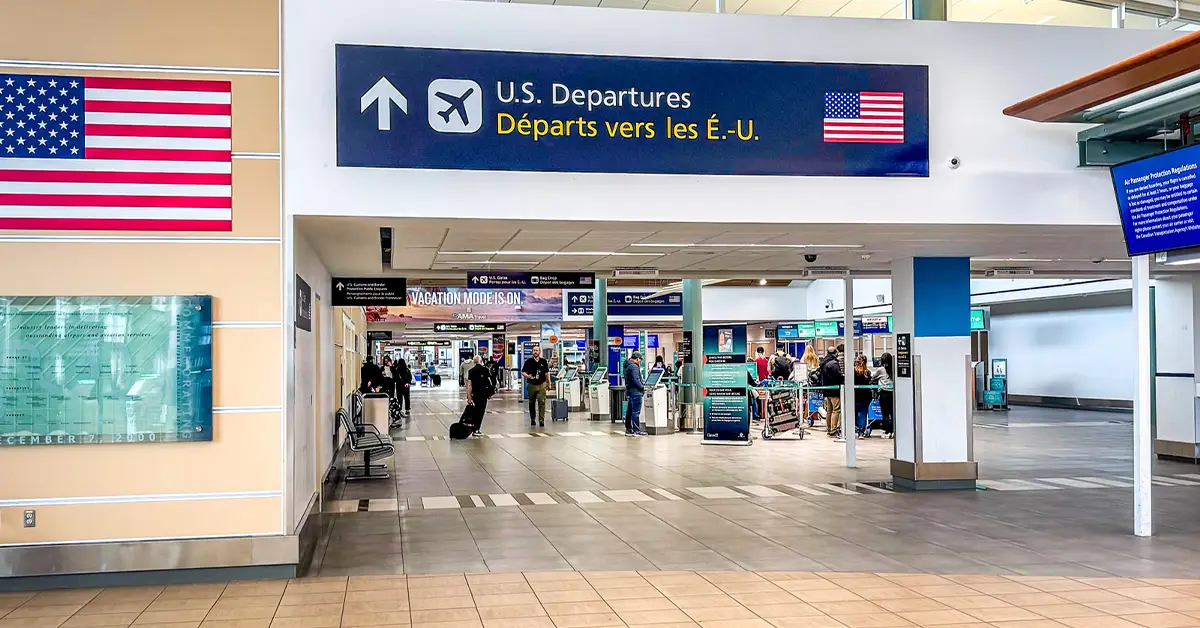
Form I-94, officially named the “Arrival/Departure Record”, is an important document issued by the United States Department of Homeland Security (DHS). It is an essential part of the entry process for visitors to the United States. Why this document matters:
- It proves the applicant entered the United States lawfully.
- It shows the date by which the applicant must leave the United States.
- It states how long the applicant may stay in the United States lawfully.
Fee increase alert:30/09/2025. The fee for Form I-94 rose from USD 6 to USD 24 under the One Big Beautiful Bill Act (OBBBA). Travellers entering the United States by land should budget for the higher fee.
Message
Where to find the “Admit Until Date”
The applicant’s stamped passport and electronic or paper I-94 record will show an “Admit Until Date”, stating how long the applicant is permitted to stay in the United States. The CBP officer stamping the passport may simply write “Duration of Status” or “D/S”, indicating that the applicant may stay in the United States for as long as the current visa remains valid.
Considering a residency programme? The Prosperous Living Investment team assesses your profile free of charge and advises on the pathway that fits your goals.
Who needs Form I-94?
Most non-citizens arriving in the United States need a Form I-94, including:
- Tourists: those coming for a holiday or to visit family and friends
- Students: those coming to study at United States educational institutions
- Temporary workers: individuals holding work visas for short-term jobs in the United States
- Business visitors: those coming to attend business meetings or conferences
- Those changing immigration status while in the United States
- Those extending their stay in the United States
- Non-citizens returning to the United States after a temporary absence
Applicants do not need an I-94 travel record where they are:
- United States citizens: citizens by birth or bynaturalisationof the United States
- Lawful permanent residents (holders of agreen card): those with the right to live and work permanently in the United States
- Immigrant visa holders: those entering the United States to live permanently
- Canadian citizens visiting or in transit: unless staying more than 6 months
- Using theVisa Waiver Program: these visitors receive a different form called the I-94W.
Details are on the government website athere.
Immigration terminology
- The Visa Waiver Program: a programme allowing citizens of certain countries to visit the United States for tourism or business for up to 90 days without a traditional visa.
- Border crossing cards: these cards work like visas for certain Mexican citizens, allowing them to visit the United States for short periods.
- Automatic visa revalidation: a special rule allowing holders of certain visas to make quick trips to Canada, Mexico or certain Caribbean islands without a new visa in order to re-enter the United States.
How to obtain an I-94 travel record
The process for obtaining a Form I-94 depends on how the applicant enters the United States:
By air or sea
Where the applicant arrives by air or sea:
- The applicant will automatically receive an electronic I-94. The system creates it when the applicant passes through customs at the airport or seaport.
- A Customs and Border Protection (CBP) officer will stamp the passport. This stamp shows the date of entry to the United States and the applicant’s immigration status.
- The officer will also write or stamp the date until which the applicant may stay in the United States. This is usually recorded as “D/S” (Duration of Status) for students and exchange visitors, or a specific date for other visitors.
By land (car, bus or on foot)
Land travellers are now issued electronic I-94s and no longer receive a paper I-94 receipt. CBP encourages travellers requiring an I-94 to use the CBP One™ mobile app or the CBP I-94 website to register for an I-94 before arriving at the United States land border. Where the applicant arrives by land:
- The applicant will receive an electronic I-94.
- The applicant may register before arrival using the CBP One™ mobile app or the I-94 website.
- Where the applicant is coming from a Visa Waiver Program country, approval from the Electronic System for Travel Authorization (ESTA) is needed before arrival. ESTA is pre-travel authorisation for visitors from participating Visa Waiver Program countries.
Important:
Whether electronic or paper, make sure to keep the I-94 safe. Applicants will need to surrender the paper copy when leaving the United States, so that the United States government can track their departure and know that the applicant left the country before their visa expired. In addition, applicants may need this form for things like obtaining a driving licence, finding work or changing immigration status.
Registering a new Form I-94 online
Applicants may register for a new I-94 online where entering by land or on certain ferries. Below is a detailed explanation of the process:
- Cost: the fee is USD 6 per person. This fee is non-refundable, even where entry is refused.
- Timeframe: applicants must arrive at the border within 7 days of registering online. Otherwise the registration expires and the applicant must register again.
- At the border:
- Applicants may need to provide biometrics (fingerprints or a facial scan).
- Applicants will have an interview with a CBP officer. They will ask about the purpose of the visit and may request additional information.
- Documents: bring the same documents as used in the online registration. This usually includes the passport and any relevant visas.
- Additional evidence: be ready to show evidence of:
- Where the applicant lives (such as utility bills or a tenancy agreement)
- Where the applicant works (such as a letter from their workplace)
- The applicant’s travel plans (such as hotel bookings or an invitation letter)
How to access and print an I-94
Applicants may view and print an I-94 in two ways:
The CBP One™ mobile app:
- Download the app on a smartphone
- Follow the instructions to retrieve the I-94
I-94 website:
- Go to the website
- Click “Get Most Recent I-94”
- Enter the personal details exactly as they appear on the passport
Applicants may request a paper I-94 at the border, but this may take extra time and is generally not recommended unless necessary.
Understanding your I-94 number
When CBP approves lawful entry and issues a Form I-94, a unique number is assigned to the record. This number is linked to one particular entry and reason for visiting the United States, so applicants will receive a different I-94 number each time they arrive in the country. This number, found on the paper I-94 card or the electronic record, may sometimes be requested by the state Department of Motor Vehicles (DMV), or an employer may need it for their records. Since May 2019, the I-94 number has had a new format:
- It has 11 characters
- The first 9 characters are numbers
- The 10th character is a letter
- The 11th character is a number
Where an applicant needs to replace a Form I-94, this may be done on the CBP website or by calling CBP on 1-877-CBP-5511 (1-877-227-5511) Monday to Friday from 8:30 am to 5:00 pm, Eastern Time.
Older I-94s with numbers only remain valid until their end date. The number is unique to that entry and helps identify the particular arrival record.
Leaving the United States
When leaving the United States, it is important to make sure the departure is recorded correctly:
- By air or sea: the system records the departure automatically based on the information the airline or ship provides.
- By land:
- Where the applicant has a paper I-94, surrender it to the border officer.
- Where the applicant has an electronic I-94, the departure may not be recorded automatically.
Keep evidence that the applicant left the country, such as:
- An entry stamp in the passport from Canada or Mexico
- Travel tickets
- Receipts from the country the applicant entered
Recording the departure properly is very important to maintaining a good immigration record and avoiding problems on future visits to the United States.
Checking travel history and status
Applicants may access their I-94 travel history on the CBP website. They will usually see the most recent 5 years of travel history, but may request the full history where needed.
Where an applicant extends their stay oradjust statusafter arriving in the United States — such as obtaining a green card — thenUnited States Citizenship and Immigration Services (USCIS)will issue a new I-94 or other document reflecting the new situation. In such cases, the new document will be the main way of showing the applicant’s lawful status.
Travel history
To view travel history, go to the I-94 website, click “view travel history” and enter the personal details. Here, applicants will see:
- United States travel history over the past 10 years
- When and where the applicant entered and left the United States
Note: not all land border crossings or short cruise trips may be shown.
Checking status
Use the “View Compliance” tab on the I-94 website or the CBP One™ app and enter the details. This will show:
- How many days the applicant may stay
- Whether the applicant has overstayed
- What to do next where there is a problem
Where there is an error on your I-94
Where the I-94 has inaccurate information:
For errors caused by CBP:
- Go to a CBP deferred inspection site
- Bring all the relevant documents (passport, visa, evidence of the correct information)
Where USCIS caused the error (for those who have an I-94 through a change of status):
- Use Form I-102 on the USCIS website
- There may be a fee for this correction
Where to obtain a copy of your I-94
How to replace a lost Form I-94
Where applicants cannot find the passport containing the entry stamp and visa or the I-94 travel record, they may request these records from USCIS, but the method to follow depends on when the applicant arrived in the United States:
- Where the applicant entered the United States before April 2013, they may request a replacement I-94 by filing Form I-102 (officially named the “Application for Replacement/Initial Nonimmigrant Arrival-Departure Document”). Applicants must send the completed form to USCIS by post and pay a filing fee of USD 560.
- Where the applicant entered the United States after April 2013, they may request a copy of the most recent I-94 and travel history for the past 5 years from CBP. There is no cost for this service.
Filing a FOIA request for an I-94 travel record
Although the options above are the fastest way to obtain the records, applicants may instead request the release of records under the Freedom of Information Act (FOIA). However, processing such a request may take up to 1 year.
There are 3 ways to file a FOIA request:
- Complete the online form. The United States Department of Homeland Security (DHS) provides an online submission form that will be forwarded to CBP once completed. Alternatively, applicants may make the same request to USCIS, but CBP generally handles such requests much faster.
- Complete the paper form. USCIS also provides a paper form (G-639) for this procedure, but it is generally not required and takes much longer than an online request through CBP. Where this option is chosen, applicants must follow the specific instructions on the form.
- Write to USCIS. Where preferred, applicants may also write their request and send it by post or fax to USCIS’s National Records Center.
Where the third option is chosen, applicants must file the request together with the following:
- Full name, address and telephone number
- A detailed description of the records the applicant is seeking (as specific as possible)
- A statement of willingness to pay any fees associated with the request
- A signature witnessed by a notary
Substitute documents for Form I-94
Where applicants cannot produce a travel record through one of the options above, DHS will assume that the applicant entered the United States unlawfully (formally called “without inspection”). In such cases, the applicant must instead submit both of the following:
- A notarised personal affidavit (written statement) fully explaining why the document is unavailable
- Any other evidence supporting the claim that the applicant entered the United States lawfully (for example, an airline ticket receipt, a boarding pass from the date the applicant travelled to the United States, or a copy of one of their parents’ passports showing the entry stamp and visa where the applicant arrived with them)
Where other evidence is also unavailable, applicants must submit at least 2 additional notarised personal affidavits from other people with personal knowledge of the applicant’s lawful entry to the United States.
All affidavits, including those from the applicant and from others, should explain the following in detail:
- When and where the applicant entered the United States
- What travel documents the applicant had, if any
- Whether the applicant allowed a United States immigration officer to inspect them and their travel documents
- Any questions the immigration officer asked the applicant
- Any other details the applicant can provide about entering the United States
Recent changes and updates
Electronic I-94s at land borders
- Who is affected: all non-citizens entering the United States across a land border.
- What has changed: CBP no longer issues paper Forms I-94 at land borders. All I-94s are now electronic.
- Impact: visitors must access the I-94 online or through the CBP One™ app.
- When: this change was fully rolled out in 2024.
Filing Form I-515A for students
- What has changed: F, M and J visa holders now file Form I-515A electronically instead of by post.
- How to do it: students now email the Form I-515A documents.
- When: this change took effect on 26/06/2024.
- Who is affected: international students and exchange visitors who receive a Form I-515A on entry.
Guidance for Ukrainian parolees
- What has changed: the Ukraine Security Supplemental Appropriations Act extended the period of stay for Ukrainian parolees.
- The new deadline: 30/09/2024 (previously 30/09/2023).
- Who is affected: Ukrainian citizens admitted to the United States under humanitarian parole.
Extension of the Form I-9 expiry date
- What has changed: the expiry date for Form I-9 (Employment Eligibility Verification) has been extended.
- The new expiry date: 31/05/2027.
- Impact: employers may continue using the current version of Form I-9 until the new expiry date.
- Who is affected: all employers and employees in the United States involved in the I-9 process.
CBP One™ app improvements
- What has changed: the CBP One™ app now offers more features for managing the I-94 process, including:
- The ability to register a provisional I-94 before travelling
- The option to view and print recent I-94 records
- Access to travel history
- Who is affected: all visitors eligible for an I-94.
I-94 website updates
- What has changed: the I-94 website now offers more self-service options, including:
- An improved travel history display
- An enhanced compliance checking tool
- Who is affected: all non-immigrant visitors to the United States.
Visa Waiver Program updates
- What has changed: the status of some countries in the Visa Waiver Program may have changed.
- Action required: before planning a trip, visitors should check the current list of Visa Waiver Program countries.
- Who is affected: citizens of countries participating in, or newly added to, the Visa Waiver Program.
Frequently asked questions about Form I-94
How do I find my I-94 travel record online?
Form I-94 is easily accessed using CBP’s online portal. Applicants will need to make sure they enter their details correctly — such as name and passport information — in order to log in.
Where applicants cannot find their I-94 travel record using the online system, check the official guidance on how to make sure the details are entered correctly and for further help where needed.
What if my I-94 travel record is inaccurate or incomplete?
Where there is an error in the I-94 travel record, applicants will need to contact USCIS to have the correction made. Applicants may schedule an in-person interview at their local USCIS office, or call the USCIS Contact Center on 1-800-375-5283 for further information.
Note that where the error occurred when the applicant first entered the United States, they will need to go to their local CBP deferred inspection site or port of entry to have it changed.
How do I print or download Form I-94?
It is worth keeping a hard copy of the I-94 travel record somewhere safe. To download or print a copy of the I-94 card, simply log in to CBP’s I-94 website and follow the on-screen instructions.
Can I combine paper and electronic I-94 travel records?
Electronic travel records are convenient in most cases, but things may become complicated where an applicant receives an electronic record after arriving in the United States by sea or air, but then leaves the country at a land border crossing. At land borders, departures are still tracked largely by paper I-94 travel records, so where the applicant has an electronic record, the departure may not be recorded automatically.
In such cases, applicants will want to make sure they have another way of proving that they left the country before their visa expired. One option is to request an entry stamp in the passport from the Canadian or Mexican authorities. Applicants may also keep transport tickets, receipts or payslips to show that they left the United States before the visa expired.
Accompanying you on your journey in residency investment
The Prosperous Living Investment team advises on pathways, assesses profiles and manages investments transparently for every residency, citizenship and international property objective.
Free profile assessmentWhere life gets prosperous