

The history of Singapore is the story of a small island nation that has gone through many turbulent eras, from an ancient fishing village to a trading port of the British Empire, an occupied territory in the Second World War and finally an independent country since 1965. This journey of more than a thousand years has shaped the multicultural, pragmatic and dynamic character of the island nation today.
This article summarises the key periods in Singapore’s history, from ancient Temasek to the present, based on official sources from the National Library Board, the Parliament of Singapore and heritage agencies. Understanding its history is key to explaining the island nation’s distinctive social, economic and political structure.
Detailed article onSingapore.
Message
Ancient and medieval Singapore as Temasek
The history of Singapore can be traced back to the 3rd century AD, when Chinese records first mentioned a place called Pu Luo Chung, believed to be a transliteration of the Malay name “Pulau Ujong” — the island at the end of the Malay Peninsula. However, it was not until the 11th century that Singapore clearly appeared in historical records under the name Temasek.
Temasek in Old Malay means “sea town”, reflecting the area’s role as a small seaport within Southeast Asia’s maritime empires. In the 13th and 14th centuries, Temasek was part of the Srivijaya Empire and later the Majapahit Empire, becoming an important stop on trade routes linking China, India and the Malay Archipelago.
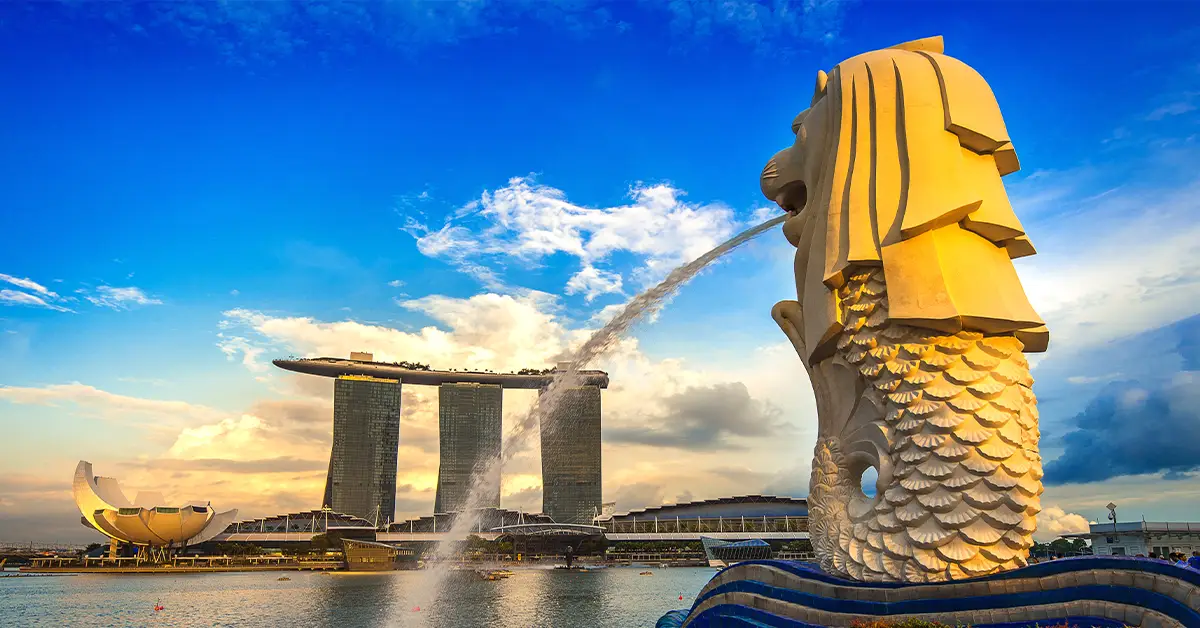
According to legend recorded in the “Sejarah Melayu” (Malay Annals), in the late 13th century a Srivijayan prince named Sang Nila Utama landed on the island and saw an animal he believed to be a lion. He named the place “Singapura”, meaning “Lion City” in Sanskrit. This is the origin of the modern name Singapore.
By the late 14th century, Singapore had been attacked and destroyed by forces from Java and Siam, leading to the decline of the kingdom of Temasek. For almost four centuries afterwards, the island became a small fishing village under various Malay sultanates, losing the role it once had as a trading centre.
Considering a residency programme? The Prosperous Living Investment team assesses your profile free of charge and advises on the pathway that fits your goals.
The British colonial period, 1819 – 1942
A major turning point in Singapore’s history came on 29 January 1819, when Sir Thomas Stamford Raffles — representing the British East India Company — landed on the island. Recognising Singapore’s strategic position at the junction of key shipping routes, Raffles signed a treaty with Sultan Hussein Shah and Temenggong Abdul Rahman to establish a free trading post on the island.
Free trade and tax-free policies attracted merchants from all over Asia to Singapore. The population grew from about 1,000 in 1819 to more than 11,000 just a decade later, and reached 80,000 by 1860. The island quickly became the busiest trading port in Southeast Asia.
In 1824, under the Anglo-Dutch Treaty, Singapore officially came under full British control. In 1826, the island was incorporated into the Straits Settlements together with Penang and Malacca. In 1867, the Straits Settlements became a Crown Colony of the British Empire, governed directly from London instead of through British India.
The opening of the Suez Canal in 1869 and the development of steamships strengthened Singapore’s position as a global transshipment port. By the early 20th century, the island was one of the busiest seaports in the world and a hub for rubber and tin exports from the Malay region.
During this period, Singapore’s population was markedly multi-ethnic, with Chinese immigrants from southern China, indigenous Malays, Indians and Europeans. The multicultural character of modern Singapore was formed precisely in this era, with communities living side by side and contributing to the island’s shared development.
Singapore’s history under Japanese occupation
A dark chapter in Singapore’s history began on 15 February 1942, when Japanese forces captured the island after a Malayan campaign lasting just 70 days. The fall of Singapore — considered the British Empire’s “impregnable fortress” — was one of the greatest military defeats in British history, with about 80,000 British, Australian and Indian soldiers taken prisoner.
During three and a half years of occupation, Japan renamed Singapore “Syonan-to”, meaning “Light of the South Island”. This period is associated with deep suffering for the population, including the Sook Ching massacre targeting the Chinese community, with an estimated 25,000 to 50,000 victims.
Life for civilians was extremely hard, with famine, runaway inflation and brutal repression by the Japanese military. The “banana money” currency issued by Japan quickly lost its value, causing a severe economic crisis. People had to grow their own vegetables and fruit on roadsides and in their yards to survive.
Singapore was liberated on 12 September 1945 after Japan’s surrender. British forces returned to take over the island, but the occupation had eroded people’s confidence in the colonial power’s ability to protect them, sowing the seeds of a strong movement for self-government in the following decade.
Self-government and merger with Malaysia, 1959 to 1965
After the war, nationalism in Singapore grew strongly. In 1948, Britain held the first Legislative Council election with a limited number of elected seats. Self-government was gradually expanded through the Rendel Constitution (1955) and rounds of negotiations in London.
On 03 June 1959, Singapore officially attained internal self-government, with the People’s Action Party (PAP) led by Lee Kuan Yew winning a landslide in the general election. Lee Kuan Yew became the first Prime Minister of self-governing Singapore at the age of 35, beginning a legacy of leadership that lasted more than three decades.
On 16 September 1963, Singapore joined the newly formed Federation of Malaysia, together with Malaya, North Borneo (Sabah) and Sarawak. The merger was an economic and political solution: the small island lacked a domestic market and had security concerns, while Malaya wanted to balance its ethnic makeup against Singapore’s Chinese community.
However, deep political, economic and ethnic differences between the PAP and the ruling Alliance in Kuala Lumpur led to escalating tensions. Racial riots in Singapore in 1964 worsened the situation. After nearly two years in the federation, Malaysian Prime Minister Tunku Abdul Rahman decided to expel Singapore from the federation.
On 09 August 1965, the Malaysian Parliament voted 126-0 to pass a constitutional amendment separating Singapore from the federation. At a historic press conference the same day, an emotional Lee Kuan Yew declared Singapore a sovereign, independent and democratic nation. According to archival records of theNational Library Board Singapore (NLB), this date is recognised as the island nation’s National Day.
The history of independent Singapore after 1965
Singapore entered the era of independence facing countless challenges. The small island had no natural resources, lacked fresh water, had no significant domestic market, suffered high unemployment and faced security threats from its neighbours. Many international analysts at the time doubted the country’s ability to survive.
In the early years, the government’s top priority was national security. After Britain announced it would withdraw its forces from Singapore by 1971, the island nation established the Singapore Armed Forces (SAF) and introduced compulsory National Service from 1967. This model was learned from Israel and Switzerland.
On the economic front, the Economic Development Board (EDB), established in 1961, pursued an export-oriented industrialisation strategy. Jurong Industrial Estate, built on former swampland, became a manufacturing hub. Multinational companies were invited to invest with tax incentives and a well-trained workforce.
The public housing programme run by the Housing and Development Board (HDB) housed most of the population within a few decades. By the 1980s, more than 80% of Singaporeans lived in HDB flats. It is one of the most successful public housing programmes in the world.
Singapore’s history from 1965 to the end of the 20th century saw a spectacular transformation. GDP per capita rose from about USD 500 in 1965 to tens of thousands of USD by 2000. The island nation became one of the “Four Asian Tigers” together with South Korea, Taiwan and Hong Kong.
Economic development under Lee Kuan Yew
Lee Kuan Yew served as Prime Minister from 1959 to 1990, the longest tenure in Singapore’s history. His vision and leadership style shaped every aspect of the modern island nation, from economic policy, diplomacy and language to urban planning.
Lee Kuan Yew’s leadership philosophy emphasised pragmatism, social discipline, a high-quality civil service and avoiding dependence on any major power. He placed special emphasis on education, making English the main language of instruction alongside the mother tongue, laying the foundation for the global competitiveness of later generations.
One of the boldest policies was the anti-corruption campaign. The Corrupt Practices Investigation Bureau (CPIB) was given broad powers and independence from the government. Civil service salaries were raised to match the private sector to reduce incentives for corruption. Singapore went from a society where corruption was widespread to one of the cleanest countries in the world.
Lee Kuan Yew handed over the premiership to Goh Chok Tong in 1990, followed by Lee Hsien Loong (Lee Kuan Yew’s son) in 2004. Lee Kuan Yew remained a senior adviser in government until 2011 and died in 2015. His funeral drew millions of people who queued to pay their respects, reflecting society’s deep affection for the man regarded as the “founding father” of modern Singapore.
Modern Singapore from 2000 to the present
Entering the 21st century, Singapore continued its strong transformation. The two integrated resorts, Marina Bay Sands and Resorts World Sentosa, opened in 2010 and made the island nation a world-class tourism and entertainment destination. 2010 also saw the highest GDP growth in the country’s history at 14.5%, surpassing the previous record of 13.8% in 1970.
The 2011 general election marked a turning point, as the PAP recorded its lowest vote share since independence (60.14%) and lost a Group Representation Constituency (GRC) to the opposition Workers’ Party for the first time. This signalled a gradual diversification of politics.
The COVID-19 pandemic of 2020-2022 was a major test in modern Singapore’s history. The island nation applied strict containment measures and rolled out a rapid vaccination programme. Although GDP contracted by about 3.9% in 2020 — the deepest recession since independence — the economy rebounded strongly in the following years.
On 15 May 2024, Lee Hsien Loong officially handed over the premiership to Lawrence Wong, ending nearly 60 years of leadership of Singapore by the first and second generations of the Lee family. Lawrence Wong became the fourth Prime Minister and the first born after the island nation’s independence, opening a new chapter in the nation’s history.
Summary
Singapore’s history is vivid proof that a people’s destiny can be changed through sound policy, visionary leadership and the unity of a multicultural society. From an island expelled from a federation and facing countless difficulties in 1965, Singapore has risen to become one of the most developed countries in the world in just six decades.
This journey was not the result of natural resources or geographic size but of strategic thinking, social discipline and the ability to adapt quickly to global change. Understanding the island nation’s history gives Vietnamese investors, entrepreneurs and individuals deeper insight into the mindset and ways of working of this country when cooperating or planning future investment and settlement.
Accompanying you on your journey in residency investment
The Prosperous Living Investment team advises on pathways, assesses profiles and manages investments transparently for every residency, citizenship and international property objective.
Free profile assessmentWhere life gets prosperous