


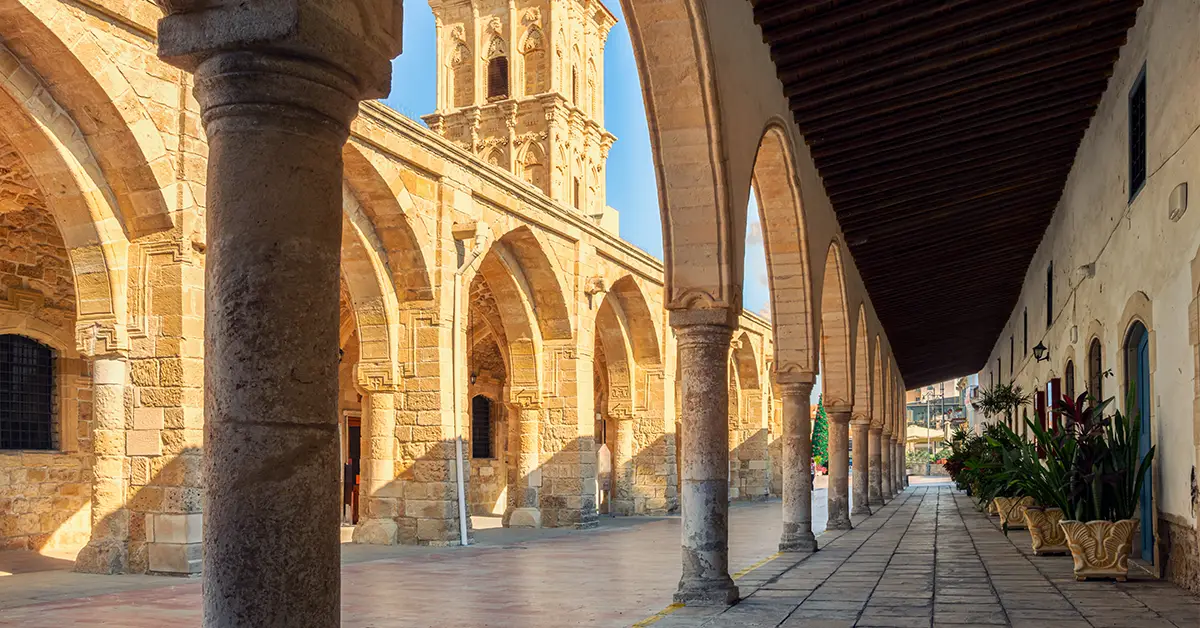
The history of Cyprus is a story spanning more than 13,000 years of an island at the crossroads of three continents: Europe, Asia and Africa. Its special location made Cyprus a meeting point of many great civilisations, from ancient Greece, Phoenicia, Egypt, Persia, Rome and Byzantium to the crusader kingdoms, Venice, the Ottoman Empire and Britain.
This article summarises the most important periods in the history of Cyprus, from the first traces of prehistoric settlement to its position as a modern member state of the European Union.
Detailed article onThe island nation of Cyprus.
Message
Prehistoric and ancient history of Cyprus
Archaeological traces at the Aetokremnos cave on the south coast show that humans were present on Cyprus from around 11,000 BC. The first permanent farming settlement appeared around 8,500 BC at Khirokitia, a UNESCO World Heritage Site since 1998. It is one of the best-preserved Neolithic settlements in the Eastern Mediterranean.
At the end of the second millennium BC, Mycenaeans from Greece arrived in Cyprus in several waves of settlement, bringing the Greek language, religion and architecture. This period shaped the island’s long-lasting Greek identity. In the Late Bronze Age, Cyprus was known as Alashiya and was an important copper-mining centre of the ancient world.
From the 8th century BC, the Phoenicians established trading posts along the island’s south coast. Cyprus then came successively under the rule of Assyria, Egypt and the Persian Empire. In 333 BC, Alexander the Great defeated the Persians and Cyprus became part of the Hellenistic world. After Alexander’s empire broke up, the island came under the Ptolemaic dynasty of Egypt.
In 58 BC, Cyprus was annexed by Rome and became a province of the empire. In Roman times, Paphos was chosen as the capital and developed into an important administrative and cultural centre. The archaeological site of Paphos, with exquisite mosaics from the 2nd to the 4th century AD, was inscribed as a UNESCO World Heritage Site in 1980. Cyprus was also the first land in the world to have a Christian governor, following the missionary journey of the apostles Paul and Barnabas in 45 AD.
Considering a residency programme? The Prosperous Living Investment team assesses your profile free of charge and advises on the pathway that fits your goals.
Byzantine and medieval Cyprus
After the Roman Empire split in 395 AD, Cyprus belonged to the Eastern Roman (Byzantine) Empire and remained so for nearly eight centuries. During this period Orthodox Christianity flourished in Cyprus, with the autocephalous Church of Cyprus established at the Council of Ephesus in 431. Many churches and monasteries were built in the Troodos mountains during this time, later inscribed as a UNESCO World Heritage Site in 1985.
From the 7th to the 10th century, Cyprus suffered many Arab raids, leading to a period of joint administration between Byzantium and the Islamic Caliphate. In 965, the Byzantine emperor Nikephoros II Phokas recaptured the island and restored full control. Cyprus remained an important Byzantine province until the late 12th century.
In 1191, King Richard the Lionheart of England conquered Cyprus during the Third Crusade. He then sold the island to the Knights Templar, and it later passed to Guy de Lusignan, the former King of Jerusalem. The Lusignan dynasty ruled Cyprus from 1192 to 1489, making the island a feudal crusader kingdom where French was spoken among the nobility. Many Gothic castles and churches were built during this period, especially in Famagusta and Nicosia.
In 1489, Cyprus was taken over by the Republic of Venice following the marriage of Caterina Cornaro, the last queen of the Lusignan dynasty. The Venetians built strong fortified walls around Nicosia and Famagusta, parts of which survive to this day. They also developed agriculture, especially sugar and wine production, making Cyprus an important commercial colony of Venice.
The Ottoman period, 1571-1878
In 1571, the Ottoman Empire under Sultan Selim II conquered Cyprus after a 13-month siege of Famagusta. The invasion ended 82 years of Venetian rule and began 307 years of Cyprus as a province of the Ottoman Empire. After taking the island, the Ottomans settled about 30,000 Turks there, laying the foundations of the modern Turkish Cypriot community.
In the Ottoman period, Cyprus was organised under the millet system, which allowed religious communities to manage their own internal affairs. The Orthodox Archbishop of Cyprus became the political and legal representative of the Greek Cypriot community, a role that would last into the 20th century. This system shaped a community-based social structure whose traces remain today.
Economic life under the Ottomans had many ups and downs, with heavy taxation and corruption by local officials sometimes leading to revolts. However, the Greek and Turkish Cypriot communities largely lived together peacefully, sharing many customs, foods and words. Cypriot Turkish and Cypriot Greek both developed distinct dialect features during this period.
The British colonial period, 1878-1960
In 1878, the Ottoman Empire handed over the administration of Cyprus to Britain under the Cyprus Convention, in return for British support for the Ottomans against Russia. In 1914, when the Ottoman Empire entered the First World War on Germany’s side, Britain formally annexed Cyprus and made it a crown colony in 1925.
Under British colonial rule, Cyprus was modernised in its infrastructure, legal system and education. English became the official language of administration. A legal system based on English common law was established, a legacy that still influences the modern Cypriot judiciary. The British also founded English-language schools and paved the way for a generation of Cypriot intellectuals to engage with Western ideas.
The movement for union with Greece (enosis) grew strongly in the first half of the 20th century, especially after the Second World War. In January 1950, the Church of Cyprus held an unofficial referendum on enosis, in which 96% of participating Greek Cypriots voted in favour. However, the Turkish Cypriot community opposed it and proposed partition of the island (taksim).
On 1 April 1955, EOKA, led by Colonel Georgios Grivas, launched an armed campaign against the British. The Cyprus Emergency lasted four years, with 371 British soldiers killed, hundreds of Cypriots dead and Archbishop Makarios exiled to the Seychelles. The Turkish Cypriot community formed the TMT organisation to protect its interests. Diplomatic and military pressure eventually forced the parties to the negotiating table.
The independent Republic of Cyprus, 1960-1974
In February 1959, negotiations in Zürich and London between Britain, Greece, Turkey and representatives of the two Cypriot communities led to an agreement to establish an independent Republic of Cyprus. Three founding treaties — the Treaty of Establishment, the Treaty of Guarantee and the Treaty of Alliance — were signed, with Britain retaining two Sovereign Base Areas at Akrotiri and Dhekelia.
The Republic of Cyprus officially came into being on 16 August 1960, with Archbishop Makarios III as its first president and Fazıl Küçük as vice-president representing the Turkish Cypriot community. The 1960 Constitution established a complex power-sharing system between the two communities, with Turkish Cypriots holding 30% of the seats in Parliament and a veto over certain important decisions.
Cyprus joined the United Nations on 20 September 1960 and the Commonwealth in 1961. However, the complex constitutional structure soon revealed its weaknesses. In November 1963, President Makarios proposed 13 constitutional amendments, which were rejected by the Turkish Cypriot community and Turkey. In December 1963, intercommunal violence broke out, leading the Turkish Cypriot representatives to withdraw from the government and parliament.
The United Nations Peacekeeping Force in Cyprus (UNFICYP) was deployed in March 1964 and remains in operation today. The Green Line separating the two communities was established at this time. Throughout the 1960s, talks between the two communities made no significant progress.
The events of 1974 and the division of the island
In the early 1970s, tensions between President Makarios and the Greek military junta grew steadily. EOKA-B was re-established by Grivas in 1971 with the aim of overthrowing Makarios and achieving enosis. On 15 July 1974, the Cypriot National Guard, commanded by Greek officers, staged a coup, overthrowing the Makarios government and installing Nikos Sampson as interim president.
Five days later, on 20 July 1974, Turkey launched an invasion of Cyprus under Article 4 of the 1960 Treaty of Guarantee, citing the need to protect the Turkish Cypriot community. Turkish forces seized 3% of the territory in the north in the first wave before a ceasefire was declared. The Greek military junta collapsed and Sampson resigned.
A second offensive took place from 14 to 16 August 1974, extending the area under Turkish control to 37% of the island. As a result, about 150,000 to 200,000 Greek Cypriots were forced to leave the north, while 50,000 to 60,000 Turkish Cypriots were moved from the south to the north in a temporary population exchange overseen by the United Nations.
In 1974 the Green Line was extended into a 180 km United Nations buffer zone, dividing even the capital Nicosia into two parts. It is the last divided capital in Europe. In 1983, the Turkish Cypriot community unilaterally declared the Turkish Republic of Northern Cyprus, which is recognised only by Turkey. The UN Security Council adopted Resolution 541 in 1983 declaring the move legally invalid.
Modern Cyprus and the path to EU membership
After 1974, the Republic of Cyprus focused on economic and social reconstruction. More than a third of the population became internally displaced, losing their homes and livelihoods. However, under successive governments, Cyprus recovered quickly thanks to open economic policies and investment in tourism, shipping and financial services. By the end of the 1980s, Cyprus’s GDP per capita had overtaken that of many European countries.
In July 1990, Cyprus applied to join the European Community. Formal accession negotiations began in 1998 and concluded in 2002. On 1 May 2004, Cyprus became a member of the European Union together with nine other countries in the largest enlargement in EU history. However, because the division remains unresolved, EU law applies only in the area under the effective control of the Republic of Cyprus.
In 2004, the UN’s Annan reunification plan was put to a referendum; it was supported by 65% of Turkish Cypriots but rejected by 76% of Greek Cypriots. Subsequent reunification talks, notably at Crans-Montana in 2017, also failed. The Cyprus problem remains one of the longest-running geopolitical disputes on the UN agenda.
Cyprus joined the eurozone on 1 January 2008, replacing the Cyprus pound used since British colonial times. In 2012-2013, the Cypriot banking system fell into a severe crisis due to its exposure to Greek debt. The government had to accept a €10 billion EURO bailout from the European Commission, the European Central Bank and the International Monetary Fund, with tough restructuring measures for the banking system. Cyprus made an impressive recovery after the crisis, regaining an investment-grade credit rating in 2018.
Cyprus in the 2020s
Entering the 2020s, Cyprus has continued to establish itself as one of the fastest-growing economies in the eurozone. In November 2020, the government ended the citizenship by investment programme after investigations found that nearly 53% of the passports issued did not comply with the rules. The permanent residency by investment programme became the main option for foreign investors.
In 2026, Cyprus holds the rotating Presidency of the Council of the European Union for the first half of the year, its second after the first in 2012. This is an important milestone marking the country’s maturity as an EU member. The legislative election expected on 24 May 2026 will shape the Cypriot political landscape for the second half of the decade.
The more than 13,000-year history of Cyprus is a testament to the adaptability and resilience of a small nation at the crossroads of great civilisations. From the Stone Age to modern EU membership, the island has witnessed many upheavals but has always preserved its cultural identity and strategic position.
Find out more on the government website athere.
Accompanying you on your journey in residency investment
The Prosperous Living Investment team advises on pathways, assesses profiles and manages investments transparently for every residency, citizenship and international property objective.
Free profile assessmentWhere life gets prosperous