

The Antigua and Barbuda passport

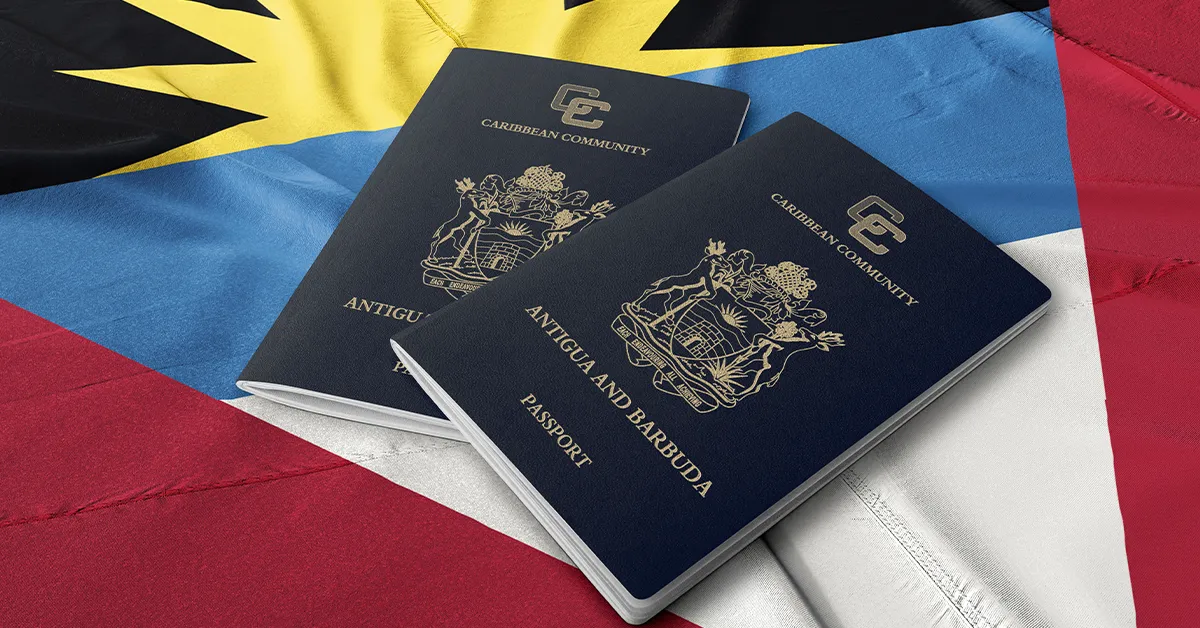
The Antigua and Barbuda passport is the official identity document issued by the Department of Immigration of Antigua and Barbuda to the country’s citizens, allowing them to travel internationally and serving as proof of citizenship. Before independence in 1981, people of Antigua and Barbuda were issued British territorial passports. As a member of the Commonwealth, CARICOM and the OECS, the passport is widely recognised internationally and offers strong global mobility.
According to the 2026 Henley Passport Index, the passport ranks 22nd globally, with visa-free or visa-on-arrival access to 154 countries and territories. It is one of the strongest Caribbean passports, notably with visa-free entry to the United Kingdom, the 27 European Schengen countries, Singapore, Hong Kong, South Korea and China. This article analyses in detail the types of passport, technical features, the application process and the rights that come with it.
Detailed article onthe country of Antigua and Barbuda.
Message
Legal framework
The passport is issued under the Immigration and Passport Act, 2014. The Act replaced earlier passport rules inherited from British colonial times and modernised the process in line with the international standards of the International Civil Aviation Organization (ICAO).
The Passport Office, part of the Prime Minister’s Ministry, is responsible for issuing passports. The office is located on Queen Elizabeth Highway, Saint John’s, and is open Monday to Friday during business hours. Citizens living abroad can apply for passports through the Embassies, High Commissions or Consulates of Antigua and Barbuda in countries where it has representation.
According to the official website of theAntigua and Barbuda Immigration Department, all passport applicants must attend the Passport Office in person to submit their application. The application must be certified by an authorised certifying official before submission.
Considering a residency programme? The Prosperous Living Investment team assesses your profile free of charge and advises on the pathway that fits your goals.
Types of passport
Antigua and Barbuda issues four different types of passport, serving specific groups and purposes:
- Adult Passports: issued to citizens of Antigua and Barbuda aged 16 and over, valid for 10 years
- Minor Passports: issued to citizens of Antigua and Barbuda under 16, valid for 5 years
- Diplomatic Passports: issued to Government Ministers and those authorised to represent the country in diplomatic and international affairs
- Official Passports: issued to government officials representing the interests of Antigua and Barbuda abroad
The ordinary passport is the most widely used type. Under a recent update to the Immigration and Passport Act, the validity of adult ordinary passports was extended from 5 years to 10 years — in line with developed countries and reducing renewal costs for citizens.
Technical and security features
The modern Antigua and Barbuda passport has a design consistent with other CARICOM passports. The cover is dark blue — symbolising Commonwealth membership. The front is embossed with the coat of arms of Antigua and Barbuda in gold, with the words “CARIBBEAN COMMUNITY” at the top, “ANTIGUA AND BARBUDA”, “PASSPORT” and the biometric chip symbol at the bottom.
The data page uses modern polycarbonate material that is rigid and hard to forge. It contains a portrait photo, personal details, the passport number and an electronic RFID chip storing biometric information. Since 2017, all newly issued passports have been biometric passports — meeting the ICAO 9303 standard for electronic passports.
Advanced security features include Optically Variable Ink (OVI), images visible under UV light, microprint, personalised laser engraving and other anti-counterfeiting elements. The RFID chip stores fingerprint data, an encrypted facial image and personal information — enabling automatic verification at border control e-gates.
The passport application process
Citizens of Antigua and Barbuda applying for a new passport or a renewal need to prepare basic documents: proof of citizenship (birth certificate, certificate of citizenship or old passport), 2 recent ICAO-standard photos, a completed and certified passport application form, and the passport application fee.
The application form can be downloaded from the Department of Immigration website or collected in person at the Passport Office. It must be completed in full and then certified by an authorised official — such as a senior police officer, a notary public, a registered minister of religion or a certified professional.
The standard passport fee is $300 USD per applicant. The fee is non-refundable and must be paid when the application is submitted. Normal processing takes 3 weeks. An expedited service is available for an additional fee. Once complete, the passport can be collected in person at the Passport Office or sent by courier to the applicant’s address.
Detailed article onthe process of registering for Antigua and Barbuda citizenship through CBI.
For CBI citizens
For people granted citizenship through the Citizenship by Investment programme, the process is slightly different. Once the CBI application is approved by the Citizenship by Investment Unit (CIU) and the Certificate of Naturalisation is issued, the passport is securely produced at the Antigua and Barbuda Passport Office. It can be collected in person in Antigua or sent to the applicant’s address by diplomatic courier.
CBI citizens still need to spend 5 days in Antigua and Barbuda within the first 5 years after receiving citizenship to keep their citizen status. This requirement has applied since 2024 to meet international standards for programme integrity. Details of the CBI programme are set out in the articleAntigua and Barbuda Citizenship by Investment.
Visa-free access
The Antigua and Barbuda passport offers extensive visa-free or visa-on-arrival entry rights. According to data updated on 15/04/2026 fromHenley Passport Index, the Antigua and Barbuda passport ranks 22nd globally, with free entry to 154 countries and territories.
Europe
Europe is the most attractive destination, with the 27 Schengen Area countries allowing Antiguan citizens visa-free entry for up to 90 days in any 180-day period. These countries include Germany, France, Italy, Spain, the Netherlands, Austria, Belgium, Greece, Portugal and many others. The United Kingdom allows visa-free entry for up to 6 months but has required an Electronic Travel Authorization (ETA) before arrival since 2025.
From late 2026, citizens of Antigua and Barbuda entering the Schengen Area will have to register with the European Travel Information and Authorization System (ETIAS) before departure, at a fee of 7 EUR per application. This policy applies to all nationals of Schengen visa-exempt countries and is not a measure targeting Antigua and Barbuda.
Asia
In Asia, citizens of Antigua and Barbuda enjoy significant entry rights: Singapore (90 days visa-free), Hong Kong (90 days visa-free), South Korea (90 days with a K-ETA), China (30 days visa-free — a special privilege), Qatar (90 days visa-free), the United Arab Emirates (UAE) and Malaysia. Japan requires an entry visa.
The Americas
In the Americas, citizens of Antigua and Barbuda can enter most Caribbean and Central and South American countries visa-free: Brazil (90 days), Chile (90 days), Argentina, El Salvador, Costa Rica, Guatemala, Panama, and the CARICOM islands for up to 6 months. However, the United States and Canada still require visas, and Mexico requires a visa unless the traveller holds a valid US, UK, Japanese or Schengen visa.
The United States — a special situation in 2026
Visa relations between Antigua and Barbuda and the United States went through major upheaval in late 2025. On 16/12/2025, President Donald Trump issued an executive order partially suspending visa issuance to citizens of Antigua and Barbuda from 01/01/2026, covering immigrant, B-1/B-2, F, M and J visas. Visas issued before 31/12/2025 remain valid under a preliminary agreement between the two sides.
From 21/01/2026, Antiguan citizens applying for new B1/B2 visas must post a bond of up to $15,000 USD. Ambassador Sir Ronald Sanders in Washington is actively negotiating with the US administration to resolve the situation. Holders of Antigua and Barbuda passports with valid B-1/B-2 visas can still enter the United States for up to 180 days a year for tourism, business and family visits.
Free movement within the OECS
One of the special rights of citizens of Antigua and Barbuda is freedom of movement within the Organisation of Eastern Caribbean States (OECS) without a passport. Under OECS rules, citizens of full members — Antigua and Barbuda, Dominica, Grenada, Saint Lucia, Saint Vincent and the Grenadines, Saint Kitts and Nevis and Montserrat — can travel between member states with just an ID card or a driving licence showing their place of birth.
This right is similar to freedom of movement between Schengen countries in the European Union — one of the privileges of the OECS’s deep integration. OECS citizens are also free to work, do business and live in other member states without visa procedures or complicated work permits. The CARICOM passport also facilitates travel across the wider CARICOM region.
US B-1/B-2 visa and CARICOM benefits
A notable benefit of the Antigua and Barbuda passport is the ability to apply for a US B-1/B-2 visa valid for up to 10 years — allowing holders to enter the United States multiple times during that period for tourism (B-2) and business (B-1) for up to 180 days per stay. However, visa relations with the United States have been changing significantly since late 2025.
An important note: unlike Grenada — the only Caribbean country with an E-2 treaty with the United States — Antigua and Barbudahas no E-2 treatyand therefore holders of Antigua and Barbuda passports cannot apply for the US E-2 Investor visa. This is an important distinction from some misleading marketing on the market. For Vietnamese investors interested in settling in the United States through investment, the Grenada passport is the only suitable option in the Caribbean.
Freedom of movement within CARICOM is broader than in the OECS, covering 15 member states. Citizens of Antigua and Barbuda can enter all CARICOM members visa-free for stays of up to 6 months. Some CARICOM countries also allow work under special conditions through the Skills Certificate.
The Antigua and Barbuda passport — a summary
The Antigua and Barbuda passport is one of the most valuable identity documents in the Caribbean, with strong global mobility, modern security technology and significant entry rights. Its 22nd-place global ranking on the Henley Passport Index, 154 visa-free destinations, 10-year validity for adults and the ability to apply for a US E-2 visa make it a highly valuable document for both native citizens and investors through the CBI programme.
However, recent developments — especially the Trump executive order of December 2025 and the $15,000 bond requirement for B1/B2 visas from January 2026 — challenge the sustainability of the rights that come with the passport. Reforming the CBI programme to international standards and constructive dialogue with major partners will be key to maintaining and expanding the passport’s benefits in the future.
Accompanying you on your journey in residency investment
The Prosperous Living Investment team advises on pathways, assesses profiles and manages investments transparently for every residency, citizenship and international property objective.
Free profile assessmentWhere life gets prosperous