


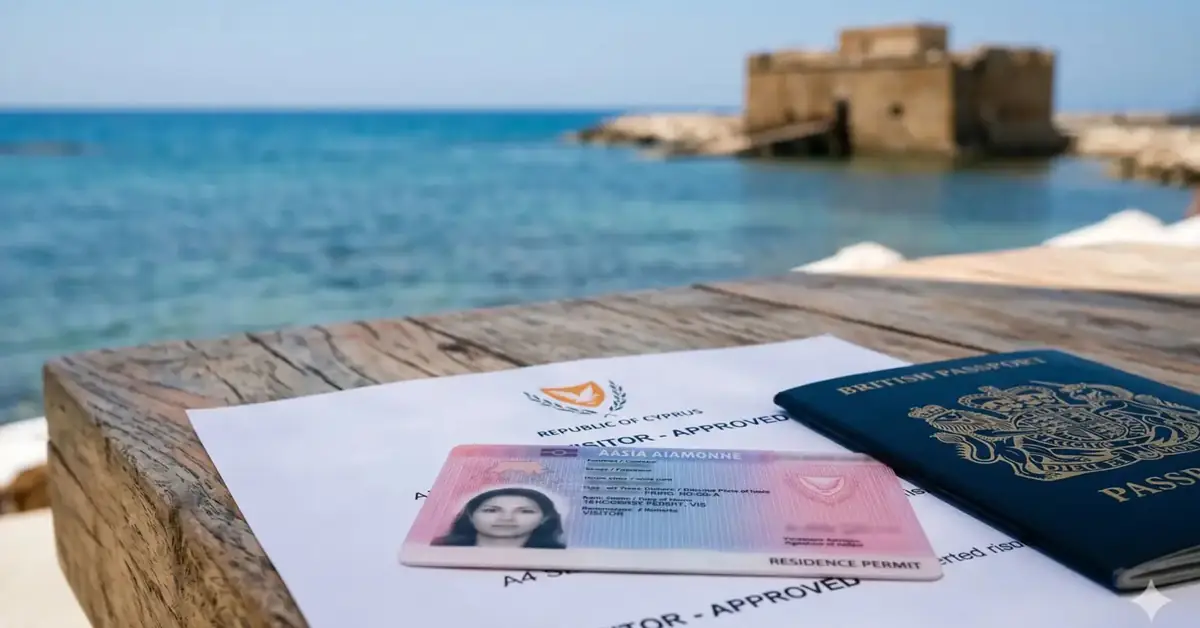
Pink Slip Cyprus is the unofficial name for the Temporary Residence Permit for third-country nationals who want to live in the Republic of Cyprus for more than 90 days without working. It is the widest and most accessible door for Vietnamese people who want to live long-term in the Republic of Cyprus but do not yet want (or do not yet qualify) to apply for PR under 6.2 or Category F. For freelancers/remote workers with higher incomes (€3,500 EUR a month), theCyprus Digital Nomad Visais an attractive alternative valid for 3 years.
This article covers in full the Pink Slip Cyprus requirements for 2026 according to the CRMD: the minimum income of €24,000 EUR a year and a €10,000 EUR bank deposit, the MVIS8 application form, the 4–8 month application process, the role of the Pink Slip on the path to PR and citizenship, and the common mistakes Vietnamese applicants make that get their applications rejected or cancelled midway.
Message
What Pink Slip Cyprus is
Before going into the conditions and process, the terminology needs clarifying — the Pink Slip goes by several names, which confuses newcomers.
Names and nature
Pink Slip Cyprus is a common term used by many Vietnamese people, referring to theTemporary Residence Permit (TRP)for non-EU nationals under the “Visitor” category. The Ministry of Interior of the Republic of Cyprus uses several official names:
- Temporary Residence Permit for Visitors(official name)
- TRC Card(Temporary Residence Card) — the name of the modern physical card
- Pink Card(old name, English)
- Pink Slip(old name, commonly used in Vietnamese)
The name “Pink Slip” comes from the traditional pink confirmation paper the CRMD issued before 2015. It has since been replaced by a modern plastic card, but the old name is still widely used in the expatriate community in the Republic of Cyprus.
How it differs from other permits
Pink Slip Cyprus is easily confused with other permits:
- Yellow Slip: Issued to EU/EEA/Swiss citizens — not a TRC but a Registration Certificate. It is valid indefinitely and allows work.
- Student Pink Slip: Issued to non-EU students studying in Cyprus, with its own rules. It requires an enrolment letter from the institution and does not require an income of €24,000 EUR.
- Work Permit: Issued to people with an employment contract with a Cypriot company. The employer must pass a “labour market test” or belong to the Business Facilitation Unit scheme.
- PR Cyprus 6.2: Permanent Residence — permanent, not temporary. It requires a €300,000 EUR property investment and an income of €50,000 EUR a year.
- PR Category F: Slow-track Permanent Residence — permanent, but with 5–6 years of processing.
- Digital Nomad Visa: A permit specifically for remote workers — it requires a higher income (€3,500 EUR a month) and a formal remote employment contract.
The core difference: the Pink Slip is atemporary(1 year, renewable), while 6.2 and Cat F arepermanent(permanent). The Pink Slip is the easiest to obtain but also the easiest to lose because of the 90-day absence rule.
Rights and limitations
The Pink Slip allows you to:
– Live legally in the Republic of Cyprus beyond 90 days without a Schengen-style visa
– Include a spouse and children under 18 (each with a separate application)
– Renew annually under the same conditions
– Accumulate residence time towards PR (5-year long-term resident) or citizenship (8-year naturalisation)
– Open a bank account, buy/rent property, study (for children) and receive medical treatment
– Become a Cyprus tax resident under the 60-day rule or the 183-day rule
The Pink Slip does NOT allow you to:
– Work or run a business in the Republic of Cyprus
– Travel visa-free within the Schengen Area (Cyprus is not yet part of Schengen)
– Be absent for more than 90 consecutive days (the permit is automatically cancelled)
– Apply for fast-track naturalisation — Pink Slip holders still need the full residence period
Important note:Remote workfor foreign companies is NOT considered working in Cyprus. Pink Slip holders can work online for Vietnamese businesses or businesses in any third country — a popular choice for freelancers and digital workers.
Considering a residency programme? The Prosperous Living Investment team assesses your profile free of charge and advises on the pathway that fits your goals.
Minimum income requirement
This is the most important condition in deciding who is eligible to apply for Pink Slip Cyprus.
Income levels by family structure
Under current CRMD practice (updated 2026):
- Main applicant: at least €24,000 EUR a year = €2,000 EUR a month
- Spouse: an additional 20% = €4,800 EUR a year
- Each child under 18: an additional 15% = €3,600 EUR a year
Real examples:
– A single person: €24,000 EUR a year
– A couple without children: €28,800 EUR a year
– A couple + 1 child: €32,400 EUR a year
– A couple + 2 children: €36,000 EUR a year
– A couple + 3 children: €39,600 EUR a year
Compared with PR 6.2, which requires €50K + €15K + €10K (€85,000 EUR a year for a family of 4), the Pink Slip is far more accessible — almost any middle-class Vietnamese family can meet it.
Accepted sources of income
Income must come from sources outside the Republic of Cyprus and be stable. Accepted sources:
- Salary from a foreign company (including remote work)
- Pensions
- Dividends from businesses in Vietnam or abroad
- Rental income from property in Vietnam
- Interest on deposits in foreign banks
- Returns on securities investments
- Copyright income and royalties
Exception: dividend income from a Cypriot company is accepted if accompanied by confirmation from the company’s accountant that the applicant receives no salary for their role in the company.
Proof of income
The CRMD requires specific documents proving income:
- Statements from a foreign bank account for the last 12 months
- Personal tax returns from the country of origin (Vietnam)
- An employment contract or confirmation letter from the employer
- A pension book (for retirees)
- Dividend statements from companies in which you hold shares
- Proof of rental income from property
All documents must be fully consularly legalised and translated into English by a certified translator.
Bank deposit and bank guarantee
Besides income, the Pink Slip requires proof of short-term financial capacity through two mechanisms.
Bank deposit €10.000 EURO
Applicants must open an account with a bank in the Republic of Cyprus (Bank of Cyprus, Hellenic Bank, Eurobank Cyprus, RCB Bank…) and transferat least €10,000 EURfrom a foreign bank into this account. Accompanying requirements:
- The money must come from a bank outside Cyprus — transfers within Cyprus are not accepted
- A SWIFT confirmation proving the funds were sent from abroad
- The money is not “locked” — it can be used for living expenses after the application is submitted
For a first application, the bank transfer can be replaced by cash brought in on entry — it must be declared at the airport and a confirmation obtained. However, a bank transfer is recommended because it is safer and creates a good paper trail for renewals.
For families, the deposit increases with the family structure:
– Main applicant: €10,000 EUR
– Spouse: an additional €5,000 EUR
– Each child: an additional €5,000 EUR
A family of 4 (a couple + 2 children) needs to transfer a total of €25,000 EUR into the Cypriot account.
Bank guarantee from a Cypriot bank
The second requirement is aBank Guaranteeissued by a Cypriot bank — guaranteeing repatriation costs if needed. The amount varies with the applicant’s nationality, from€350 EUR to €850 EUR per person.
For Vietnamese citizens, the bank guarantee is usually €500–€650 EUR per person. Some nationalities are exempt (UK, UAE, Switzerland, Singapore…), but Vietnam is not among them.
The bank guarantee is valid for 10 years and is not fully locked — the bank holds it as collateral. Once the applicant no longer needs it (leaving Cyprus, moving to PR, losing Pink Slip status), the bank guarantee is refunded minus some administrative fees.
Setting up a bank guarantee: 1–2 business days, with a bank processing fee of about €50–€100 EUR per person.
The Pink Slip Cyprus application file
The Pink Slip application file is more complex than many Vietnamese applicants initially think.
The MVIS8 form and main documents
The official form isMVIS8(updated from the old MVIS6/MVIS7 — some law firms still use the old names). Each family member submits a separate form, but in the same batch as the main applicant.
Attachments:
- The completed, hand-signed MVIS8 form
- A copy of a valid passport + all pages with entry stamps
- 2 passport-size photos taken within the last 6 months
- A rental or purchase contract for property in Cyprus (at least 1 year)
- Cypriot bank statements + the SWIFT confirmation of the €10,000 EUR transfer
- A bank guarantee letter from a Cypriot bank
- Proof of income of €24,000 EUR a year + legalised documents
- A health insurance certificate (Plan A or equivalent)
- A No. 2 Criminal Record Certificate from Vietnam (no more than 6 months old)
- Marriage certificate (if applicable) — consularly legalised
- Children’s birth certificates (if applicable) — consularly legalised
- Application fee: €70 EUR per person + €70 EUR for the ARC
Property rental contract
One of the most complicated documents for Vietnamese newcomers to Cyprus. Requirements:
- A rental contract of at least 1 year (12 months)
- It must be certified by the Muhtar (community leader) or a certifying officer
- If the contract value exceeds €5,000 EUR a year, it must be stamped at the Tax Office (costing 0.15% of the contract value)
- A copy of the landlord’s passport or ID card
For Vietnamese applicants unfamiliar with the process, buying a home worth €100,000–€200,000 EUR instead of renting can simplify the process and increase the chance of approval — because the CRMD regards property ownership as a sign of greater commitment.
Mandatory medical examination the first time
When applying for Pink Slip Cyprus for the first time, the applicant and each family member over 12 must have a medical examination in Cyprus with the tests required by theCivil Registry and Migration Department:
- Blood tests: HIV, hepatitis B, hepatitis C, syphilis
- Chest X-ray: tuberculosis screening
- A general examination signed by a specialist doctor in the Republic of Cyprus
Cost: about €100–€200 EUR per person at private clinics recognised by the CRMD. The first examination is valid for the first renewal — after that, no repeat examination is needed unless the CRMD specifically requests one in special cases (travel to or from countries with epidemics, suspicious symptoms).
Some popular clinics for Pink Slip examinations: Aretaeio Hospital (Nicosia), American Heart Institute (Nicosia), Iasis (Limassol), Evangelistria (Paphos). Book 1–2 weeks in advance via their websites or by phone.
Application process and processing time
The Pink Slip Cyprus process involves several steps coordinated across multiple agencies.
Steps
Step 1: Enter Cyprus with a Schengen-style visa or a valid tourist visa. The Pink Slip application must be submitted before the visa expires.
Step 2: Open a Cypriot bank account (Bank of Cyprus, Hellenic Bank or equivalent). This takes 1–3 weeks, with strict KYC for Vietnamese applicants.
Step 3: Transfer €10,000 EUR (× the number of family members) from a Vietnamese bank to the newly opened Cypriot account. Keep the SWIFT confirmation.
Step 4: Set up a bank guarantee with a Cypriot bank (1–2 business days).
Step 5: Find a property to rent or buy, sign the contract, have it certified by the Muhtar and stamped at the Tax Office.
Step 6: Have a medical examination in Cyprus with a specialist doctor.
Step 7: Take out valid health insurance (Plan A from Pitsas, EuroLife or equivalent).
Step 8: Book an appointment with the Immigration Unit of your district of residence (Nicosia, Limassol, Paphos, Larnaca, Famagusta) — usually available 2–3 weeks later.
Step 9: Go to the Immigration Unit and submit the application in person. Pay the fee of €70 EUR per person + €70 EUR for the ARC. Provide biometrics (fingerprints, photo, signature).
Step 10: Receive the receipt (form Γ.Λ. 301B) — this receipt serves as proof of residence in the Republic of Cyprus while you await the result.
Processing time
The CRMD forwards the file to the Ministry of Interior of the Republic of Cyprus for final review. Processing times in 2026:
- Average: 6 months
- Simple applications: 4 months
- Complex applications: 8 months
While waiting, the applicant lives fully legally in the Republic of Cyprus with the receipt. They can travel to and from Vietnam, provided they are not absent for more than 90 consecutive days.
Tracking the status
The CRMD has no online portal for the Pink Slip. To check the status, send an SMS to 1199 with the text:STATUS [application number]— costing 3.4 cents per SMS. The application number is on the Γ.Λ. 301B receipt.
When a decision is made, the CRMD sends a notice by post to the registered address. The applicant collects the plastic Pink Slip card from the Immigration Unit.
Annual renewal
Pink Slip Cyprus is valid for 1 year and must be renewed annually to keep the status.
Renewal process
Renewal applications are submitted 1–2 months before the card expires. The file is similar to the first application, but simpler:
- A new MVIS8 form
- Cypriot bank statements showing money coming in from abroad
- Updated proof of income of €24,000+ EUR a year
- A current rental contract or property title deed
- An updated health insurance certificate
- A fee of €70 EUR per person
A medical examination is not needed for renewal (except in special cases).
Updated criminal record requirement
Every 3 years, Pink Slip holders must provide an updated No. 2 Criminal Record Certificate from Vietnam — consularly legalised. This is mandatory; failing to submit it leads to the renewal being refused.
Absence risk
The Pink Slip is automatically cancelled if the holder is absent from the Republic of Cyprus continuously for90 days or more. This is a significant barrier for:
– Vietnamese business people who must return to Vietnam frequently
– Parents caring for relatives in Vietnam
– Remote workers who need to travel a lot for work
Recommendation: Pink Slip holders should enter Cyprus at least once every 60–75 days to keep a safe buffer. Keep careful records of entry/exit stamps as proof at renewal.
Its role on the path to PR and citizenship
Pink Slip Cyprus is not the final destination — it is a stepping stone to higher statuses.
The path to PR
After 5 years of continuous residence with a Pink Slip, applicants can apply for Long-Term Resident (LTR) status under the EU Long-Term Residence Directive 2003/109/EC. LTR is EU-level PR, with stronger rights than the Pink Slip:
– Indefinite residence
– The right to work in Cyprus
– The right to move to another EU country (after a further 5 years)
LTR conditions differ from the Pink Slip: more actual residence is required (a maximum absence of 6 months a year), Greek at A1 level, and basic social and political knowledge.
The path to citizenship
After 8 years of residence (7 of the last 10 years + 12 consecutive months), Pink Slip holders are eligible to apply for naturalisation under the Civil Registry Law. Additional requirements: Greek B1, 60% on the social and political knowledge test, good character and stable finances.
Note: time on a Pink Slip counts as residence for PR and citizenship purposes — an important difference from a student visa (which does NOT count).
Switching to investment PR
Pink Slip holders can switch to the PR 6.2 fast track at any time if they meet the investment requirement of €300,000 EUR + income of €50,000 EUR a year. The process:
- Submit a new MIP1 form while keeping the Pink Slip
- Once PR 6.2 is approved, cancel the Pink Slip and register for the PR card
- Time spent on the earlier Pink Slip still counts towards the path to citizenship later
This is the “hybrid” strategy many Vietnamese investors use: a Pink Slip to get legal status right away, then an upgrade to PR once they have prepared enough funds for 6.2.
Common mistakes and risks
After handling thousands of Pink Slip Cyprus cases, Cypriot lawyers have summarised some of the most common mistakes.
Unprovable source of funds
The CRMD cross-checks Cypriot bank statements against the SWIFT transfer from Vietnam and Vietnamese tax returns. If the €10,000 EUR transfer has no clear origin (for example, money borrowed from relatives and sent in a hurry), the application is rejected or processing is extended.
Absence of more than 90 days
This is the most common mistake among Vietnamese business people. Some return to Vietnam for Lunar New Year (Tết) and business commitments drag on → 100–120 consecutive days of absence. The Pink Slip is automatically cancelled without notice. On returning to Cyprus, they must reapply from scratch, losing 4–8 months.
Not updating the criminal record
Every 3 years is a mandatory cycle, but many applicants forget. When they only discover at the year-4 renewal that they need a new certificate, consular legalisation takes 4–6 weeks — the old Pink Slip may expire before the documents are ready.
Using the old MVIS6/MVIS7
The current official form is MVIS8. Some older law firms still use MVIS6 or MVIS7 — the CRMD returns the application and asks for it to be resubmitted on the new form. This costs 2–3 weeks.
Not declaring remote work
Applicants working remotely for Vietnamese companies must declare it on the MVIS8 form. The CRMD allows remote work but requires transparency. Failing to declare it may be treated as fraud when the CRMD discovers it through bank statements.
Believing “the Pink Slip replaces PR”
Some brokers advertise the Pink Slip as “cheap PR” or “a substitute for PR 6.2”. This is wrong. The Pink Slip is TEMPORARY — it must be renewed annually, can be cancelled because of absence and does not allow work. Investors intending to settle long-term in the Republic of Cyprus should see the Pink Slip as a 1–3 year stepping stone before upgrading to real PR.
Summary and next steps
Pink Slip Cyprus is the first and most flexible entry point for Vietnamese investors who want to live long-term in the Republic of Cyprus. With an income requirement of €24,000 EUR a year and a €10,000 EUR bank deposit, the Pink Slip is much easier to obtain than PR 6.2 (which requires €50K of income + a €300K investment). It suits retirees, remote freelancers and business people who want to lay foundations in Cyprus before committing to a large investment.
However, the Pink Slip is not PR — it must be renewed annually, carries the risk of cancellation after 90 days of absence, does not allow work in the Republic of Cyprus and gives no Schengen access. For long-term settlement, the Pink Slip should be seen as a1–3 year stepping stonebefore upgrading to PR under 6.2 or Cat F.
For investors consideringCyprus residency by investment, the Pink Slip has strategic value: accumulating residence time towards citizenship after 8 years, establishing Cyprus tax residency under the 60-day rule, and seeing everyday life in the Republic of Cyprus first-hand before deciding on a €300K EUR property investment. Planning correctly from the start — especially around continuous residence and keeping documents up to date — is what determines whether the status is kept for the long term.
Accompanying you on your journey in residency investment
The Prosperous Living Investment team advises on pathways, assesses profiles and manages investments transparently for every residency, citizenship and international property objective.
Free profile assessmentWhere life gets prosperous