

Form I-485 EB-5: adjustment of status for investors in the United States

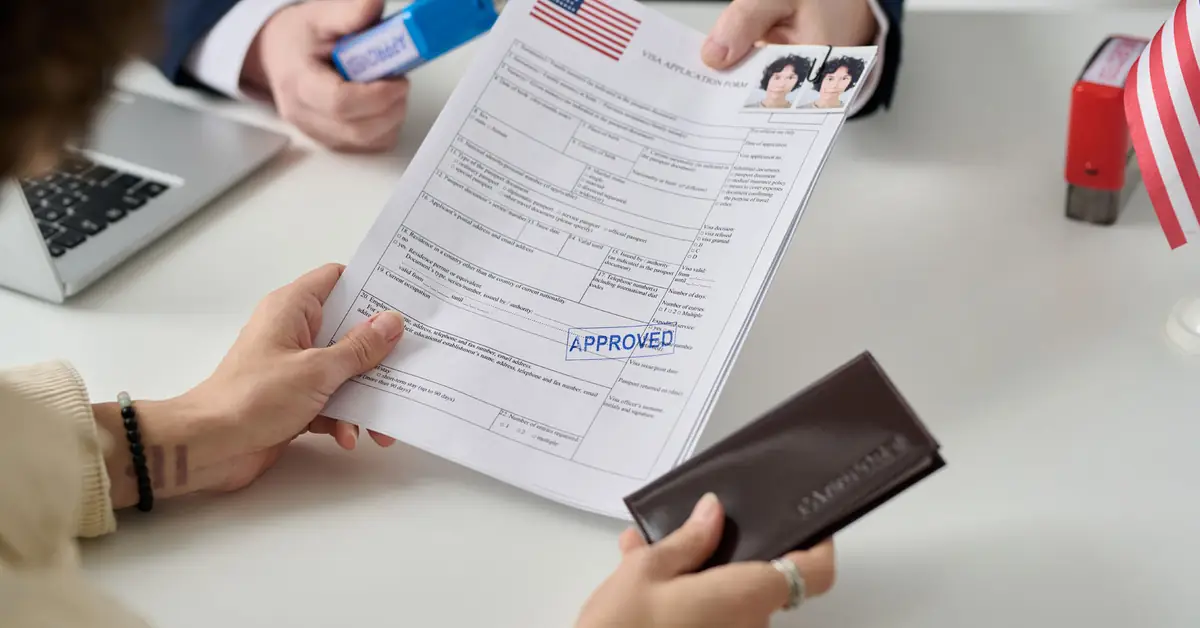
Form I-485 EB-5 is the application for Adjustment of Status (AOS) for investors living in the United States on a valid nonimmigrant visa who want to move to conditional permanent resident status through theVisa EB-5. Its full name, as set byU.S. Citizenship and Immigration Services (USCIS), is the Application to Register Permanent Residence or Adjust Status.
For Vietnamese investors living in the United States on H-1B, L-1, F-1, E-2, TN or other valid nonimmigrant visas, Form I-485 EB-5 opens the fastest route to a conditional green card without leaving the United States. After theEB-5 Reform and Integrity Act 2022 (RIA)took effect, Concurrent Filing allows the I-485 and I-526E to be filed together from day one, significantly shortening the total processing time.
Message
Who Form I-485 EB-5 is for
Form I-485 EB-5 only applies to investors who meet all three basic conditions. First, they are actually living in the United States on a valid nonimmigrant visa at the time of filing. Second, they have an I-526 or I-526E that has been filed or is pending. Third, the applicable EB-5 visa category must be current in the Visa Bulletin at the time of filing.
Investors in Vietnam or any other country cannot file this AOS application. According tothe official USCIS page on Form I-485, the alternative route is Consular Processing — an immigrant visa interview at the US Consulate General in Ho Chi Minh City, followed by entry into the United States on the issued immigrant visa.
According to actual data, a significant number of Vietnamese students studying in the United States on F-1 visas and highly skilled workers on H-1B visas use AOS to move to EB-5. The advantage of this route is that the investor keeps living and working in the United States throughout the process, without returning to Vietnam for a consular interview.
Considering a residency programme? The Prosperous Living Investment team assesses your profile free of charge and advises on the pathway that fits your goals.
Concurrent Filing — the standout feature of Form I-485 EB-5
Concurrent Filing is the mechanism of filing Form I-485 at the same time as the EB-5 Form I-526 or I-526E. It is one of the most important changes introduced by the RIA, and Vietnamese investors in the United States make full use of it.
Before the RIA, investors had to wait for the I-526 to be approved before filing the I-485. This sequential process usually took 3–5 years before reaching a conditional green card. After the RIA, according toUSCIS guidance on Concurrent Filing, investors can file concurrently if the Priority Date for their Reserved or Unreserved category is current.
The biggest advantage of this mechanism lies not in the final approval but in the interim benefits. Once the AOS application is accepted, the investor can concurrently file Form I-765 (Application for Employment Authorization) for work authorisation and Form I-131 (Application for Travel Document) for advance parole. These two documents are usually issued within 2–6 months, allowing the investor to work freely and travel internationally while the I-526E and I-485 are pending.
Conditions for using Concurrent Filing
Not every investor can take advantage of Concurrent Filing. The following four conditions must all be met.
First, the investor must be in the United States on a valid, unexpired nonimmigrant visa when filing the I-485. The most common eligible visas include H-1B, L-1A, L-1B, F-1, E-2, O-1 and TN. B-1/B-2 tourist visas are unsuitable because of the 30/60-day rule on immigrant intent.
Second, the Reserved or Unreserved category applicable to the petition must be current in the Visa Bulletin. According to the May 2026 Visa Bulletin, all three Reserved categories (Rural, High Unemployment, Infrastructure) are current for all countries, and Unreserved is current for Vietnam — favourable conditions for Concurrent Filing.
Third, F-1 students must comply with the US Department of State’s “90-day rule”. If an EB-5 petition is filed within 90 days of entering the United States on an F-1 visa, USCIS may treat this as misrepresentation of the original nonimmigrant intent, leading to denial. Students should wait at least 90 days before filing.
Fourth, no serious immigration violations in their history of residence in the United States — including no Notice to Appear, no removal order in effect and no overstay of more than 180 days.
Fees and payment methods
Under the updated USCIS rules following the Fee Rule of 01/04/2024, the fee structure for an AOS application consists of the following items.
Main filing fee: $1,440 USD per person for paper filing or $1,375 USD per person for online filing. This fee includes the $85 USD biometrics fee, so it does not need to be paid separately.
When using Concurrent Filing with an I-526E or I-526, investors usually file three supporting forms at the same time. The fee for each form applies separately:
- I-485: $1,440 USD per person (paper) or $1,375 USD per person (online).
- I-765 (Employment Authorization): $260 USD per person when filed with the I-485 (down from $520 USD if filed separately).
- I-131 (Travel Document): $630 USD per person, whether filed together or separately.
The total cost of the Concurrent Filing package (I-485 + I-765 + I-131) is $2,330 USD per person. For a family of 4, total fees can reach nearly $9,320 USD in USCIS fees alone, not counting the I-526E fee ($12,160 USD for the main petition) and medical examination fees.
USCIS requires electronic payment via Form G-1450 (credit/debit card) or G-1650 (ACH transfer from a US bank account). The ban on combined payments across forms has applied since 01/09/2022 — each form must have its own separate payment. One incorrect combined payment can cause the entire filing to be rejected.
Supporting evidence
The evidence package filed with the AOS application consists of four main groups of documents.
Group 1 — Evidence of lawful entry status
The investor must prove they entered the United States lawfully and maintained valid status up to the filing date. Documents include: copies of the passport information page and current visa, Form I-94 (Arrival/Departure Record) downloaded from the US Customs and Border Protection website, and any I-797 approval notices for changes of status (for example, an I-797 approving an H-1B).
Group 2 — Evidence of the underlying EB-5 petition
This includes a copy of the I-526 or I-526E (approved or pending), the I-797 receipt notice for the I-526/I-526E, and a copy of the current Priority Date in the Visa Bulletin for the month of filing. For investors through a Regional Center, include copies of the project’s I-956F documents.
Group 3 — Health and background evidence
Form I-693 (Report of Immigration Medical Examination and Vaccination Record) must be completed by a Civil Surgeon designated by USCIS. The medical record is sealed and filed with the I-485. For paper filing, Form I-693 must remain in its sealed envelope; for online filing, the envelope can be opened to upload it.
Background checks include evidence of no criminal record in the United States and in every country where the investor has lived for more than 6 months. Biometrics are taken after filing at an Application Support Center (ASC) near the investor’s residence.
Group 4 — Financial and family relationship evidence
This includes: US tax records for the most recent years of residence, bank account statements, proof of current employment, a marriage certificate (for spouses), children’s birth certificates, and Form I-864 or I-864W if applicable (Affidavit of Support).
Adjudication time
According to 2026 USCIS data, AOS adjudication times vary quite widely depending on the case and the local office’s workload. The range for 80% of cases is 8–38 months.
For Concurrent Filing cases with an I-526E, the actual timeline depends on whether the I-526E is adjudicated first. If the I-526E is approved quickly (especially in the Rural TEA category — 4–12 months), the I-485 is usually adjudicated within a few months afterwards. If the I-526E is still pending, the I-485 will wait for the I-526E to be approved first.
For Form I-765 (work authorisation), issuance usually takes 2–6 months from filing. This is one of the biggest benefits of Concurrent Filing — the investor receives an EAD many months before the I-485 is approved and can work freely in the United States even if their current H-1B/L-1 visa expires.
For Form I-131 (advance parole), issuance similarly takes 2–6 months. Note that Advance Parole cannot be used if the investor has left the United States before receiving the document — in that case, the I-485 may be considered abandoned.
The AOS interview and final decision
Once USCIS completes its review of the file and biometrics, some cases are called for an AOS interview at the local USCIS office. Not every EB-5 case requires an interview — the decision depends on the adjudicating officer and the complexity of the case.
The interview (if any) focuses on verifying personal information, residence history, the source of investment funds and the motive for the EB-5 investment. For families, the spouse and children are also asked to attend. Originals of all filed documents must be brought along.
Once the I-485 is approved, the investor and the whole family officially become conditional permanent residents of the United States. The physical green card is sent to the residential address within 4–6 weeks of approval. The I-485 approval date officially marks the start of the 2-year conditional green card period, which then leads to filingForm I-829 EB-5to remove the conditions.
Special notes for Vietnamese investors in the United States
Four important notes on using AOS for Vietnamese people living in the United States.
First, maintain a valid visa continuously throughout the process. Although a pending I-485 allows the investor to remain in the United States, this benefit only applies if the application was properly accepted. If the current visa expires before the I-485 is filed, the investor may fall out of lawful status.
Second, do not leave the United States before receiving Advance Parole. Leaving the United States while the I-485 is pending without an approved I-131 will cause USCIS to treat the I-485 as abandoned. Investors must wait for the I-131 to be issued before any business trip or visit home to Vietnam.
Third, use the EAD to change jobs if needed. After receiving the EAD from the I-765, the investor no longer depends on the employer sponsoring their H-1B or L-1 visa — they can work freely, freelance or run their own business. This is a significant advantage for anyone who wants to change career direction.
Fourth, follow the I-526E’s progress in parallel. Because the I-485 EB-5 depends on the outcome of the I-526E, investors need to follow the I-526E adjudication closely and respond promptly to any RFE/NOID from USCIS. A denied I-526E will lead to the I-485 being denied.
Form I-485 EB-5 is an important legal tool that shortens the EB-5 roadmap to 3–4 years overall for investors already in the United States. For Vietnamese families with members studying, working or doing business in the United States, combining Concurrent Filing with the Reserved Rural category opens up the fastest possible route to a green card under the current EB-5 programme.
Accompanying you on your journey in residency investment
The Prosperous Living Investment team advises on pathways, assesses profiles and manages investments transparently for every residency, citizenship and international property objective.
Free profile assessmentWhere life gets prosperous