

IELTS


Canada’s skilled worker immigration programmes require candidates to demonstrate their language ability in English or French.
For English, candidates may choose one of three tests: the International English Language Testing System (IELTS),Canadian English Language Proficiency Index Program (CELPIP)orPearson Test of English (PTE).
IELTS is the language test most candidates choose in order to meet the language requirement for a Canadian immigration pathway.
Contents
Overview
- Abbreviation: IELTS
- Type:A standardised test (available on computer or on paper). There are two versions: Academic and General Training. The IELTS test partners also offer IELTS Life Skills, a listening and speaking test used for UK Visas and Immigration.
- Administered by:The British Council, IDP Education and Cambridge Assessment English.
- Abilities tested:Listening, reading, writing and speaking in English.
- Purpose:To assess the English proficiency of non-native speakers.
- Year introduced: 1980.
- Duration:Total: 2 hours 45 minutes.
- Listening: 40 minutes (including 10 minutes of transfer time in the paper-based test)
- Reading: 60 minutes
- Writing: 60 minutes
- Speaking: 10-15 minutes.
- Score range:From 0 to 9, in increments of 0.5.
- Validity of scores:24 months.
- Frequency:Up to 4 times a month. Up to 48 times a year.
- Coverage:More than 4,000 test centres in over 140 countries.
- Language:English.
- Annual number of test takers:More than 3,500,000 (2018).
- Prerequisites:No formal prerequisites. Intended for non-native speakers of English.
- Fee:Approximately $250 USD.
- Used by:More than 12,000 universities, agencies and other organisations in over 140 countries.
- Website: ielts.org
Considering a residency programme? The Prosperous Living Investment team assesses your profile free of charge and advises on the pathway that fits your goals.
History
The English Language Testing Service (ELTS) was the original name of IELTS, launched in 1980 by Cambridge English Language Assessment (then known as UCLES) and the British Council.
It had an innovative format, reflecting changes in language learning and teaching, including the growth of communicative language learning and English for specific purposes. Test tasks were designed to reflect real-world use of the English language.
During the 1980s the number of test takers was very low (4,000 in 1981, rising to 10,000 in 1985) and there were practical difficulties in administering the test. As a result, the IELTS revision project was set up to oversee a redesign of the test.
To secure international involvement in the redesign, the International Development Program of Australian Universities and Colleges (IDP), now known as IDP: IELTS Australia, joined Cambridge English Language Assessment and the British Council to form the international IELTS partnership, which remains responsible for delivering the test today. This international partnership is reflected in the test’s new name, the International English Language Testing System (IELTS).
IELTS came into operation in 1989. Test takers sat two non-specialised modules, listening and speaking, and two specialised modules, reading and writing. The number of test takers grew by around 15% a year, and by 1995 there were 43,000 test takers at 210 test centres worldwide.
IELTS was revised again in 1995, with three main changes:
- There was a single Academic reading module and a single Academic writing module (previously there had been a choice between three field-specific reading and writing modules).
- The thematic link between the reading and writing tasks was removed, to avoid confusion in assessing reading and writing ability.
- The General Training reading and writing modules were brought into line with the Academic reading and writing modules (same duration, same response length, same score reporting).
Further revisions were made in 2001 (the speaking test was revised) and in 2005 (new assessment criteria for the Writing test).
Feature
IELTS Academic and IELTS General Training are designed to cover the full range of ability, from non-user or modest user through to expert user.
The Academic version is intended for test takers who wish to study at university level in an English-speaking country or to seek professional registration.
The General Training version is intended for test takers who wish to work, train, study at secondary school, or migrate to an English-speaking country.
The difference between the Academic and General Training versions lies in the content, context and purpose of the tasks. All other features, such as timing, the length of written responses and score reporting, are identical.
Both IELTS Academic and General Training include the following features:
- IELTS tests listening, reading, writing and speaking ability in English.
- The speaking test is a key component of IELTS. It takes the form of a one-to-one interview with an examiner, conducted either in person or by video conference. The examiner assesses the test taker as they speak. The speaking session is also recorded for monitoring purposes and for re-marking should the score awarded be appealed.
- A variety of accents and writing styles are used in the test material in order to minimise linguistic bias. The accents in the listening section are typically 80% British, Australian and New Zealand, and 20% other accents (mainly American).
- IELTS is developed by specialists at Cambridge English Language Assessment with contributions from item writers around the world. Working groups are based in the United States, the UK, Australia, New Zealand, Canada and other English-speaking countries.
- A band score is given for each ability (listening, reading, writing and speaking). These scores are averaged to determine each test taker’s overall band score.

Test types
There are two versions of the IELTS test:
- Academic
- General Training
In addition, the IELTS test partners offer a separate test, known as IELTS Life Skills:
- IELTS Academic is intended for those who wish to enrol at universities and other higher education institutions, as well as professionals such as doctors, engineers and nurses who wish to study or practise in an English-speaking country. It is primarily for those seeking a study permit rather than immigration.
- IELTS General Training is intended for those planning to undertake non-academic training, gain work experience, or immigrate.
- IELTS Life Skills is for those who need to prove their English listening and speaking skills at level A1 or B1 of the Common European Framework of Reference for Languages (CEFR), and it can be used to apply for a family of a settled person visa, indefinite leave to remain, or citizenship in the UK.
Test structure
| Section | Duration | Notes |
|---|---|---|
| Nghe | 30 minutes | Includes 10 minutes to transfer answers (in the paper-based test). |
| Reading | 60 minutes | |
| Writing | 60 minutes | |
| Speaking | 10–15 minutes | Divided into Part 1, Part 2 (CUE card) and Part 3. |
| Total test time | 2 hours 45 minutes |
- Note 1:The listening, reading and writing sections are completed in a single session. The speaking test may be taken on the same day, or up to seven days before or after the other tests.
- Note 2:All test takers sit the same listening and speaking tests, while the reading and writing tests differ depending on whether the test taker is taking the Academic or the General Training version.
- Note 3:The 10 minutes of transfer time applies to the paper-based test option. With the computer-based option, candidates are given two minutes (at the end of the test) to review their answers.
Nghe
This section consists of four recordings, each with 10 questions. It lasts around 40 minutes (on paper) or 32 minutes (on computer): 30 minutes for the test, plus 10 minutes to transfer answers to the answer sheet (on paper) or two minutes to review answers (on computer).
- Recordings 1 and 2 deal with everyday social situations.
- Recording 1: a conversation between two people (for example, a conversation about travel arrangements).
- Recording 2: a monologue (for example, a talk about local amenities).
- Recordings 3 and 4 deal with education and training situations.
- Recording 3: a conversation between two main speakers (for example, a discussion between two university students, possibly guided by a tutor).
- Recording 4: a monologue on an academic subject.
Each recording begins with a short introduction telling the test taker about the situation and the speakers. They then have time to look through the questions. The questions follow the order of the information in the recording, so the answer to the first question comes before the answer to the second, and so on. The first three recordings have a break halfway through, allowing test takers to look at the remaining questions. Each recording is played only once.
At the end of the test, candidates are given 10 minutes to transfer their answers to the answer sheet (in the paper-based test) or two minutes (at the end of the test, naturally) to review their answers (in the computer-based test). Test takers lose marks for spelling and grammar errors.
Reading
The reading test has three sections, with passages totalling around 2,150 – 3,250 words. There is a range of question types, such as multiple choice, short answer, identifying information, identifying the writer’s views, labelling diagrams, completing a summary using words from the text, matching information, headings and features in the text, and sentence completion. Test takers should write their answers carefully, as they lose marks for spelling and grammar errors.
Passages in IELTS Academic:
- Three reading passages, taken from books, magazines, newspapers and online resources written for a non-specialist audience. All the topics are of general interest to students at undergraduate or postgraduate level.
Passages in IELTS General Training:
- Section 1: contains two or three short texts, or several shorter texts, on everyday topics.For example: timetables or notices – the kind of material a person needs to understand when living in an English-speaking country.
- Section 2: contains two texts relating to work.For example: job descriptions, contracts, training materials.
- Section 3: contains one long text on a topic of general interest. The text is usually descriptive, and longer and more complex than those in Sections 1 and 2. It is taken from a newspaper, magazine, book or online resource.

Writing
IELTS Academic
- Task 1: the test taker describes a graph, table, diagram, map, process, pie chart or illustration in their own words.
- Task 2: the test taker discusses a point of view, argument or problem. Depending on the task, test takers may be asked to propose a solution to a problem, present and justify an opinion, compare and contrast evidence, opinions and implications, or evaluate and challenge ideas, evidence or arguments.
IELTS General Traning
- Task 1: the test taker writes a letter responding to a given everyday situation.For example: writing to an accommodation officer about a problem with accommodation, writing to a new employer about time management, or writing to a local newspaper about plans to develop the local airport.
- Task 2: the test taker writes an essay on a topic of general interest.For example: whether smoking should be banned in public places, whether children’s leisure activities should be educational, or how to address environmental problems.
Speaking
The speaking test is a face-to-face interview between the test taker and an examiner.
The speaking test has three parts.
- Part 1: introduction and interview (4 – 5 minutes):Test takers may be asked about their home, family, work, studies and interests, why they are taking the IELTS test, and other general topics such as clothing, free time, computers and the internet.
- Part 2: long turn (3 – 4 minutes):The test taker is given a task card on a particular topic. They have one minute to prepare to speak on it. The task card sets out the points to be covered in the talk and one aspect of the topic that must be explained. The test taker is then expected to speak on the topic for one to two minutes, after which the examiner may ask one or two questions.
- Part 3: discussion (4 – 5 minutes):The third part is a discussion between the examiner and the test taker, generally based on questions relating to the topic they spoke about in Part 2. These questions usually come in two groups of four or five.
Scoring system
Test takers receive a band score for each test component: listening, reading, writing and speaking. The individual scores are then averaged and rounded to produce the overall band score.
There is no pass or fail. IELTS is marked on a 9-band scale, with each band corresponding to a particular level of English. The overall band score is reported to the nearest half band.
The following rounding rule applies: if the average of the four abilities ends in 0.25, it is rounded up to the next half band; if it ends in 0.75, it is rounded up to the next whole band.
The 9-band scale is described as follows:
| Band | Level | Description |
|---|---|---|
| 9 | Expert user | Has full operational command of the language: appropriate, accurate, fluent and with complete understanding. The individual has full operational command of English. Their use of English is appropriate, accurate and fluent, and shows complete understanding. |
| 8 | Very good user | Has fully operational command of the language, with only occasional unsystematic inaccuracies and inappropriate usage. Misunderstandings may occur in unfamiliar situations. Handles complex, detailed argument well. |
| 7 | Good user | Has operational command of the language, though with occasional inaccuracies, inappropriate usage and misunderstandings in some situations. Generally handles complex language well and understands detailed reasoning. |
| 6 | Competent user | Has generally effective command of the language, despite some inaccuracies, inappropriate usage and misunderstandings. Can use and understand fairly complex language, particularly in familiar situations. |
| 5 | Modest user | Has partial command of the language, coping with overall meaning in most situations, though likely to make many mistakes. Should be able to handle basic communication in their own field. |
| 4 | Limited user | Basic competence is limited to familiar situations. Frequently has problems with understanding and expression. Is not able to use complex language. |
| 3 | Extremely limited user | Conveys and understands only general meaning in very familiar situations. Frequent breakdowns in communication occur. |
| 2 | Intermittent user | No real communication is possible except for the most basic information, using isolated words or short formulae in familiar situations and to meet immediate needs. Has great difficulty understanding spoken and written English. |
| 1 | Non-user | Essentially has no ability to use the language beyond possibly a few isolated words. |
| 0 | Did not attempt the test | No assessable information provided. |
Results
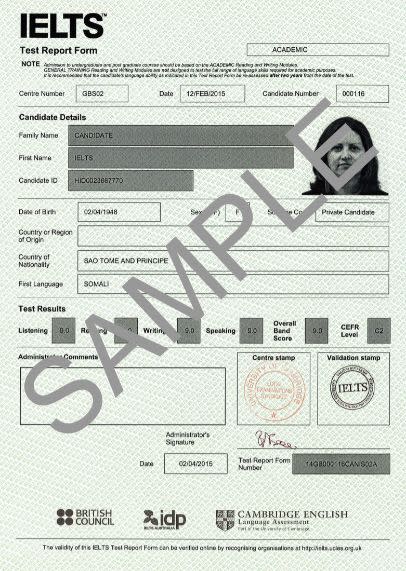
For the computer-based test, results are released within 3 – 5 days. For the paper-based test, the Test Report Form is sent to the test taker 13 days after the test.
The score report shows:
- The overall band score (from 1 – 9).
- The band score (from 1 – 9) for each section of the test (listening, reading, writing and speaking)
- The test taker’s estimated CEFR level in English.
- Whether the version completed was IELTS Academic or General Training.
- The test date and the date the certificate was signed.
- The Test Report Form number (15 – 18 characters, combining digits and capital letters)
- The test taker’s photograph, sex (male/female), nationality, candidate number, surname and given name, first language and date of birth.
Test takers receive one copy of the Test Report Form, except for those applying toImmigration, Refugees and Citizenship Canada (IRCC)orUK Visas and Immigration (UKVI)who receive two copies.
The Test Report Form is valid for two years.
Test locations and dates
Test takers can sit the IELTS test in more than 140 countries and at over 4,000 locations.
Up to 48 test dates are available each year. Each test centre runs the test up to four times a month, depending on local demand. The Academic version is available on all 48 dates each year, while the General Training version is available on 24 dates.
There used to be a minimum waiting period of 90 days before a person was allowed to retake the test. This restriction has since been lifted, and there is now no limit on candidates retaking the test.
Academic level required
More than half (51%) of test takers sit IELTS in order to enter university in a foreign country. The minimum IELTS score required varies by institution and by course.
As a general rule, leading universities in the United States require higher IELTS scores (typically 7.0). Most universities accept scores of 6 – 7 as adequate for undergraduate study in English. Detailed information on the organisations that accept IELTS and the scores they require can be found on the IELTS Global Recognition System website.
IELTS for immigration purposes
A number of Commonwealth countries use IELTS scores as evidence of the English proficiency of prospective immigrants.
Australia
Australian immigration authorities have used IELTS to assess the English proficiency of prospective immigrants since May 1998, when the test replaced the Access test previously used.
Different visa types carry different IELTS score requirements.
| Department of Immigration English proficiency level | Minimum IELTS score (March 2019) | Visa type |
|---|---|---|
| Functional English | 4.5 in each ability | Permanent and temporary skilled visas (to avoid paying the English language charge) |
| Vocational English | 5.0 in each ability | Subclass 457 visas, and ENS and RSMS visas through the Temporary Residence Transition stream for those who have held a 457 visa with the employer for two years |
| Competent English | 6.0 in each ability | ENS and RSMS visas through the Direct Entry stream, and Skilled Migration (6.0 is the minimum threshold, but attracts no points) |
| Proficient English | 7.0 in each ability | Points-tested Skilled visas (to receive 10 points) |
| Superior English | 8.0 in each ability | Points-tested Skilled visas (to receive 20 points) |
New Zealand
New Zealand has used the IELTS test since 1995. Different visa types and applicant categories carry different IELTS score requirements.
| Visa type | Minimum IELTS score where the applicant does not demonstrate the minimum standard by other means (May 2015) |
|---|---|
| Skilled Migrant | Principal applicant: 6.5. Common-law partner and children aged 16 or over: 5.0 |
| Business categories (Investor, Entrepreneur, Long Term Business Visa, Employees of Relocating Businesses) | Principal applicant: 5.0. Common-law partner and children aged 16 or over: in some cases the partner and children need not meet the minimum English level at the time of application, but may provide evidence at a later stage. |
Initially, applicants who did not achieve the required score could instead pay a fee of NZD 20,000, which could be refunded in full or in part if the immigrant passed the test within a set period (three to twelve months) after arriving in the country. Some years later this policy was changed: the fee was reduced and, rather than being refundable, was treated as “pre-purchased” English tuition after arrival.

Canada
Detailed article onIELTS General Training for Canadian immigration.
Immigration, Refugees and Citizenship Canada (IRCC) uses IELTS or TEF as evidence of the ability to communicate in English or French. CELPIP test scores are an alternative to IELTS.
Canadian Language Benchmark (CLB)is the national standard used in Canada to describe, measure and recognise the English proficiency of prospective immigrants. The table below shows the IELTS scores required for each CLB level:
| Canadian Language Benchmark (CLB) | Reading | Writing | Nghe | Speaking |
|---|---|---|---|---|
| 10 | 8,0 | 7,5 | 8,5 | 7,5 |
| 9 | 7,0 | 7,0 | 8,0 | 7,0 |
| 8 | 6,5 | 6,5 | 7,5 | 6,5 |
| 7 | 6,0 | 6,0 | 6,0 | 6,0 |
| 6 | 5,0 | 5,5 | 5,5 | 5,5 |
| 5 | 4,0 | 5,0 | 5,0 | 5,0 |
| 4 | 3,5 | 4,0 | 4,5 | 4,0 |
Submitting IELTS scores is also one of several ways of demonstrating official language proficiency when applying for Canadian citizenship (the minimum requirement is CLB 4).
The UK
On 6 April 2015, UK Visas and Immigration (UKVI) changed the English language requirements for visa and immigration applications in the UK.
IELTS assesses all four language abilities and is accepted by UK Visas and Immigration (UKVI) at levels B1 to C2 of the Common European Framework of Reference for Languages (CEFR).
A new test, IELTS Life Skills, assesses listening and speaking skills at CEFR levels A1 and B1. IELTS Life Skills can be used to meet the English language requirement for certain visa applications, including a family of a settled person visa, indefinite leave to remain and citizenship.
For visa and immigration purposes, IELTS and IELTS Life Skills must be taken at test centres approved by UKVI.
| Visa | Minimum CEFR level required (May 2015) | Minimum IELTS score overall and in each ability (May 2015) |
|---|---|---|
| Tier 1 (General) visa | C1 | 7.0 overall, and in each of the four abilities |
| Tier 1 (Exceptional Talent) visa | B1 | 4.0 overall, and in each of the four abilities |
| Tier 1 (Entrepreneur) visa | B1 | 4.0 overall, and in each of the four abilities |
| Tier 1 (Graduate Entrepreneur) visa | B1 | 4.0 overall, and in each of the four abilities |
| Tier 2 (General) visa | B1 | 4.0 overall, and in each of the four abilities |
| Tier 2 (Sportsperson) visa | A1 | 4.0 overall, and in each of the four abilities |
| Tier 2 (Minister of Religion) visa | B2 | 5.5 overall, and in each of the four abilities |
| Tier 4 (General) student visa – below degree level | B1 | 4.0 overall, and in each of the four abilities |
| Tier 4 (General) student visa – degree level and above, including certain pre-sessional courses | B2 | 5.5 overall, and in each of the four abilities |
| “Family of a settled person” visa | A1 | IELTS Life Skills at level A1 – Pass, or IELTS – 4.0 in Listening and Speaking |
| Indefinite leave to remain (to settle) or citizenship | B1 | IELTS Life Skills at level B1 – Pass, or IELTS – 4.0 in Listening and Speaking |
For visa purposes, the test is designed to meet the specific administrative requirements set by UKVI. These Test Report Forms differ slightly, in order to show that the test taker sat the test at an IELTS UKVI session. The actual test content is the same – the same material, examiners, format, level of difficulty and marking.
Accompanying you on your journey in residency investment
The Prosperous Living Investment team advises on pathways, assesses profiles and manages investments transparently for every residency, citizenship and international property objective.
Free profile assessmentWhere life gets prosperous