

CELPIP


The Canadian English Language Proficiency Index Program (CELPIP) is an English language assessment tool measuring listening, reading, writing and speaking skills.
Contents
Overview
The test is administered by Paragon Testing Enterprises, a subsidiary of the University of British Columbia (UBC). Paragon is the only company in Canada offering English tests designated byImmigration, Refugees and Citizenship Canada (IRCC). The test is available in two versions: CELPIP General and CELPIP General LS.

- CELPIP General is suitable for those who need to demonstrate their English skills when applying for permanent residence in Canada under the immigration programmes managed by the Express Entry system:
- The Federal Skilled Worker Program (FSWP)
- The Canadian Experience Class (CEC)
- The Start-up Visa in Canada
- Provincial Nominee Program (PNP)
- Or other employment programmes.
- CELPIP General LS is suitable for those who need to demonstrate listening and speaking proficiency in order to apply for Canadian citizenship. The CELPIP General LS test is accepted by IRCC as one of the two designated English tests for Canadian citizenship.
Official website:https://www.celpip.ca/
Considering a residency programme? The Prosperous Living Investment team assesses your profile free of charge and advises on the pathway that fits your goals.
History
CELPIP was developed at the University of British Columbia (UBC) and has existed since at least 2002.
In June 2015, following its acquisition of the Canadian Academic English Language (CAEL) assessment, Paragon Testing Enterprises discontinued the CELPIP Academic test.
Test versions
CELPIP General
The CELPIP-General test assesses general English proficiency. It is accepted as evidence of English proficiency for applicants for Canadian permanent residence and by the Association of Saskatchewan Realtors (ASR).

CELPIP General LS
The CELPIP General LS test assesses general English proficiency. It is accepted by Immigration, Refugees and Citizenship Canada (IRCC) as a measure of listening and speaking proficiency for applicants for Canadian citizenship.
In June 2015, Immigration, Refugees and Citizenship Canada (IRCC) implemented the remaining changes to the Citizenship Act. One significant change was that applicants aged 14 to 64 must now meet basic language requirements for listening and speaking in English or French. For minors aged 14 to 17, registrations for the CELPIP General LS test are accepted.

Test structure
CELPIP General
The test is taken entirely on computer and consists of four sections: listening, reading, writing and speaking. The listening section has eight parts, but only seven are included in the test. Test takers are not told which part is omitted.
Unscored items in the reading and listening sections are used for test development. These unscored items may appear anywhere in the section, and test takers will not know which items are not scored.
The total time for the four sections is 180 minutes.
| Number of questions | Component parts |
|---|---|
| Nghe (47 minutes) | |
| 2 | Practice test |
| 8 | Part 1: Listening to solve a problem |
| 5 | Part 2: Listening to a daily life conversation |
| 6 | Part 3: Listening for information |
| 5 | Part 4: Listening to a news item |
| 8 | Part 5: Listening to a discussion |
| 6 | Part 6: Listening to viewpoints |
| 5–8 | Part 7: Unscored items |
| Reading (60 minutes) | |
| 11 | Part 1: Reading correspondence |
| 8 | Part 2: Reading to apply a diagram |
| 9 | Part 3: Reading for information |
| 10 | Part 4: Reading for viewpoints |
| 8–11 | Part 7: Unscored items |
| Writing (53 minutes) | |
| 1 | Task 1: Writing an email |
| 1 | Task 2: Responding to survey questions |
| Speaking (20 minutes) | |
| 1 | Practice test |
| 1 | Task 1: Giving advice |
| 1 | Task 2: Talking about a personal experience |
| 1 | Task 3: Describing a scene |
| 1 | Task 4: Making predictions |
| 1 | Task 5: Comparing and persuading |
| 1 | Task 6: Dealing with a difficult situation |
| 1 | Task 7: Expressing opinions |
| 1 | Task 8: Describing an unusual situation |
CELPIP General LS
The test is taken on computer and consists of two sections: listening and speaking. The listening section has eight listening parts, but only seven are included in the test. Test takers are not told which part is omitted.
The total time for the two sections is 67 minutes.
| Number of questions | Component parts |
|---|---|
| Listening (47 minutes) | |
| 2 | Part 1: Identifying similar meaning |
| 8 | Part 2: Answering questions |
| 5 | Part 3: Listening to solve a problem |
| 6 | Part 4: Listening to a daily life conversation |
| 5 | Part 5: Listening for information |
| 8 | Part 6: Listening to a news item |
| 6 | Part 7: Listening to a discussion |
| 5–8 | Part 8: Listening to viewpoints |
| Speaking (20 minutes) | |
| 1 | Task 0: Practice task |
| 1 | Task 1: Giving advice |
| 1 | Task 2: Talking about a personal experience |
| 1 | Task 3: Describing a scene |
| 1 | Task 4: Making predictions |
| 1 | Task 5: Comparing and persuading |
| 1 | Task 6: Dealing with a difficult situation |
| 1 | Task 7: Expressing opinions |
| 1 | Task 8: Describing an unusual situation |
Scoring system
Scores are released online eight working days after the test taker’s test date. Two hard copies of the official score report are then sent by Canada Post.
Estimated scores are released in the test taker’s account three working days after their test date. Estimated scores are available, for an additional fee, for both the CELPIP General test and the CELPIP General LS test. A hard copy of the official score report is sent by Canada Post.
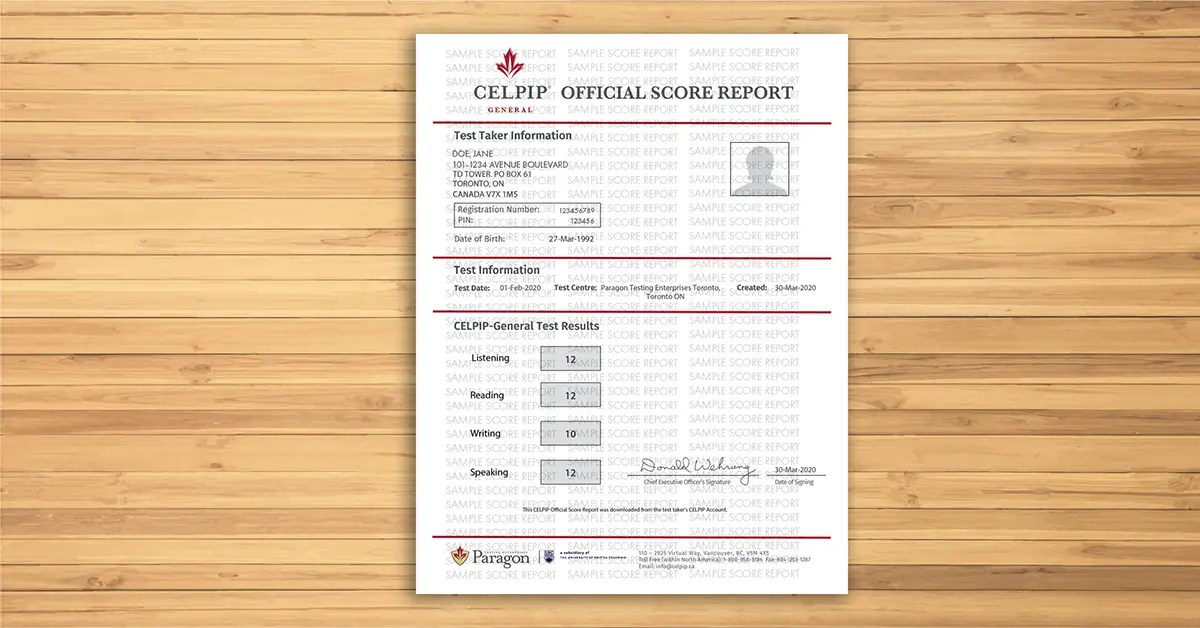
The format and marking of the CELPIP General test and the CELPIP General LS test are referenced against theCanadian Language Benchmark (CLB). The proficiency levels and their CLB equivalents are set out below:
| Points | Description | CLB |
|---|---|---|
| 12 | Advanced proficiency in workplace and community contexts | 12 |
| 11 | Advanced proficiency in workplace and community contexts | 11 |
| 10 | Highly effective proficiency in workplace and community contexts | 10 |
| 9 | Effective proficiency in workplace and community contexts | 9 |
| 8 | Good proficiency in workplace and community contexts | 8 |
| 7 | Adequate proficiency in workplace and community contexts | 7 |
| 6 | Developing proficiency in workplace and community contexts | 6 |
| 5 | Emerging proficiency in workplace and community contexts | 5 |
| 4 | Proficiency adequate for everyday life activities | 4 |
| 3 | Some proficiency in limited contexts | 3 |
| M | Minimal proficiency, or insufficient information to assess | 0, 1, 2 |
Unlike IELTS, there is no half-band system. Scores are reported in whole-point increments only.
Where to take it
The CELPIP test is available at more than 140 locations across Canada and internationally.
Find out where to take it athere.
How to prepare
Test takers can prepare by taking the free sample tests available through the online portal. Paragon also gives all prospective candidates the opportunity to sit a sample test in a real test centre environment.
Among other resources, Paragon produces a wide range of study materials for each version of the test and also runs online Speaking Pro sessions.
Frequently asked questions (FAQ) about CELPIP for Canadian immigration
Candidates applying to a Canadian skilled worker immigration programme must take one of the following tests: CELPIP,IELTS General Trainingor PTE Core, in order to demonstrate their English proficiency.
A great many preparation materials and courses are available to help candidates get ready for the CELPIP test. They can, for example, take CELPIP’s free sample tests on the CELPIP website.
Of the two tests, only CELPIP is accepted for Canadian immigration. Those wishing to study in Canada may prefer to take CAEL.
Candidates can find CELPIP test locations on the website athere.
The cost depends on the location, but is generally around $300 CAD.
CELPIP takes around three hours to complete in a single session:
- Speaking: 15–20 minutes
- Listening: 47–55 minutes
- Reading: 55–60 minutes
- Writing: 53–60 minutes
CELPIP test scores are available online 4–5 days after the candidate’s test.
Candidates may request a re-evaluation of some or all components of the CELPIP test within six months of taking it. A re-evaluation fee applies. The re-evaluation fee for a component is refunded if the candidate’s CELPIP level changes after the re-evaluation. CELPIP notes that re-evaluating the Listening and Reading components is less likely to change the score, as these are marked by computer.
Candidates may also retake the test at any time. A new fee applies.
No. CELPIP is designed to give a comprehensive assessment of a candidate’s English proficiency at a given point in time. For the results to be accurate, all sections must be completed within the same session.
CELPIP results are valid for two years. CELPIP results issued within 24 months of the application date therefore remain valid throughout the processing of the application.
CELPIP scores correspond to theCanadian Language Benchmark (CLB)levels. A CELPIP score of 10, for example, corresponds to CLB 10. A CELPIP score of 7 corresponds to CLB 7.
It is taken on computer only.
The score required to be eligible to immigrate to Canada depends on the skilled worker programme the candidate applies under.
The minimum level set by Immigration, Refugees and Citizenship Canada (IRCC) is CLB 4. Some programmes require CLB 4.
Other programmes have higher language requirements. Requirements generally range from CLB 5 to CLB 7.
For some programmes, the higher the CLB level, the more points the candidate receives. For others, candidates need only show that they meet the minimum level as part of the requirements for permanent residence.
Canada’s immigration language testing rules are set by Immigration, Refugees and Citizenship Canada (IRCC). They are not set by language testing organisations such as IELTS or CELPIP. Tests such as CELPIP are designed to assess a candidate’s general English proficiency, while tests taken to study in Canada assess their ability to follow an educational programme.
Both tests are accepted for Canadian immigration and both assess English skills objectively. Ultimately, candidates should choose the test they feel most comfortable with.
Accompanying you on your journey in residency investment
The Prosperous Living Investment team advises on pathways, assesses profiles and manages investments transparently for every residency, citizenship and international property objective.
Free profile assessmentWhere life gets prosperous