


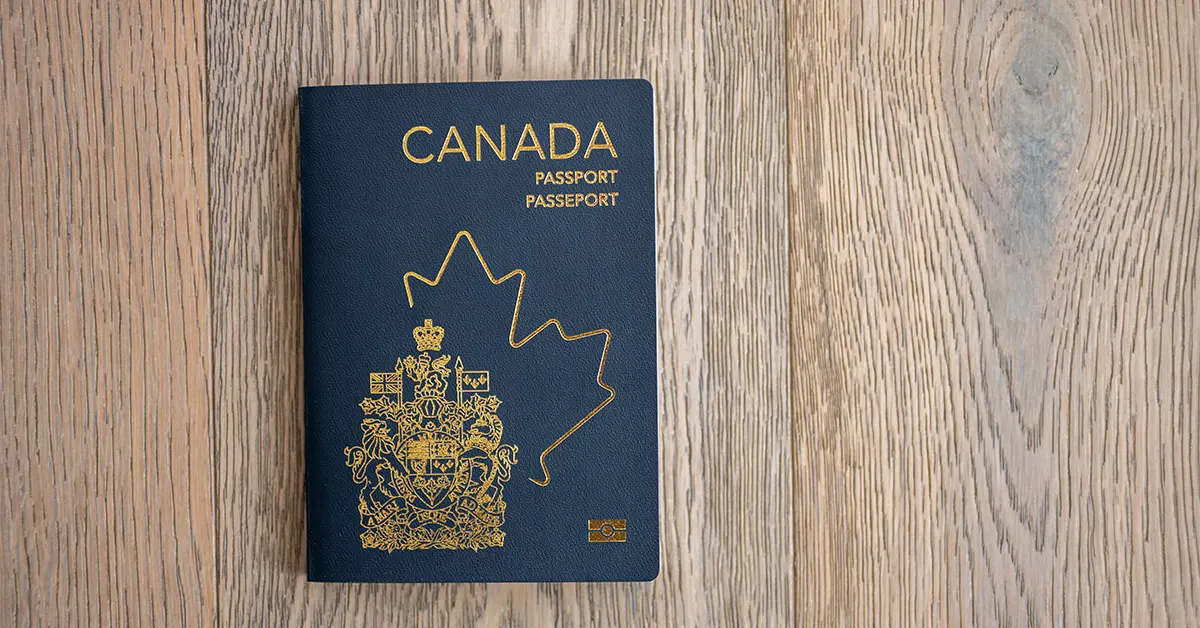
The Canadian passport (English: Canadian passport; French: passeport canadien) is the passport issued to Canadian citizens. It allows the holder to enter or re-enter Canada freely; to travel to and from other countries subject to their visa requirements; assists in obtaining help from Canadian consular officials abroad where needed; and requests protection for the holder while abroad.
Detailed article on theCanadian citizenship, and the rights and responsibilities of citizens.
Contents
Overview
All Canadian passports are issued through the passport programme ofImmigration, Refugees and Citizenship Canada (IRCC). Passports are normally valid for 5 or 10 years for those aged 16 and over, and for five years for children under 16.
In 2022, 70% of Canadian citizens held a passport, with more than 24.6 million passports in circulation. Although held by individual citizens, all Canadian passports remain in law the property of the Crown and must be returned to the Passport programme on request.
Canada is a member of theFive Nations Passport Group, an international forum for co-operation between the passport authorities of Canada, Australia, New Zealand, the United Kingdom and the United States, to “share best practice and discuss innovations relating to the development of passport policy, products and practice”.
Canada began issuing biometric passports to Canadian citizens on 1 July 2013. Historically, the Canadian passport has been a target for forgers and other forms of misuse.
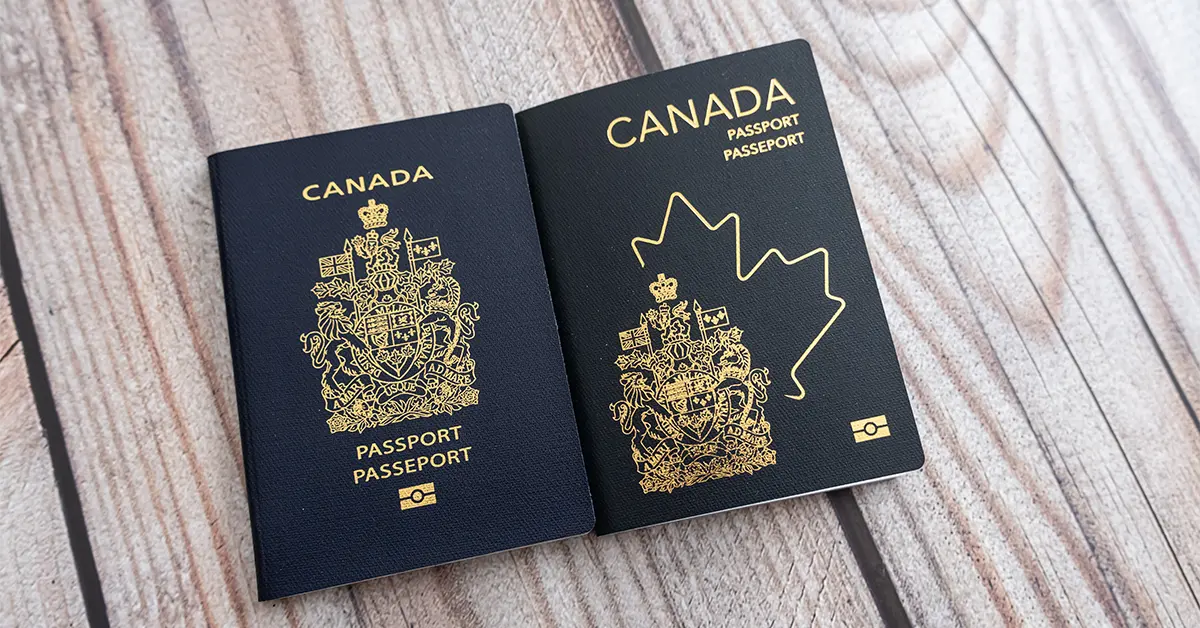
The most recent passport was released on 18 June 2023. It drew considerable objection over the removal of historic national symbols and images.
As at 2024, theCanadian passport ranks 7th in the worldfor the number of destinations the holder can access without a prior visa (according to the Henley Passport Index).
Considering a residency programme? The Prosperous Living Investment team assesses your profile free of charge and advises on the pathway that fits your goals.
Appearance
The ordinary passport is dark navy, with the Royal Arms of Canada and the Canadian maple leaf embossed in the lower left corner. The words “PASSPORT•PASSEPORT” appear above the arms, with the word “CANADA” at the top. The international e-passport symbol sits in the lower right corner.
The bilingual cover reflects the fact that the textual sections of the Canadian passport are printed in both English and French, Canada’s two official languages. The new standard passport has 38 pages, with 33 pages for entry/exit stamps and visas, compared with 29 stampable pages in the 2013–2023 series. The Canadian passport measures 8.89 cm (3.5in) x 12.7 cm (5in) when closed.
New security features, similar to those on banknotes, have been added in increasing numbers since 2001. Microprinting, holograms, images visible under UV light, watermarks and other details have been introduced, particularly on the photograph page.
In addition, the photograph is now printed digitally directly onto the paper (in both standard and UV-reactive ink); previously, an actual photograph was laminated inside the document.
The data page
- The passport holder’s photograph
- Type: PP
- Issuing Country/Pays émetteur: listed as “CAN” for “Canada”
- Passport No./Nº de passeport: 1 letter, 6 digits and 2 letters
- Surname/Nom
- Given names/Prénoms
- Nationality/Nationalité: Canadian nationality is shown as “Canadian/Canadienne” in both English and French
- Date of birth/Date de naissance
- Sex/Sexe: “F” for female, “M” for male, “X” for another gender
- Place of birth/Lieu de naissance: gives the city name and the three-letter country code, even where the holder was born in Canada.
- Note:The province is requested on the application form, where applicable, but is not shown in the passport.
- Date of issue/Date de délivrance
- Date of expiry/Date d’expiration
- Authority/Autorité
The information page ends with the Machine Readable Zone.
Signature
From 2002 to May 2015, all Canadian passports had two signature elements: one on the data page, where the scanned signature was printed alongside the other personal details, and a blank signature box on page 3. On receiving the passport, those over 16 also had to sign the signature box in ink.
Since May 2015, the passport holder’s scanned signature has not been printed on the data page. Adult applicants must, however, still sign page 3 of the passport booklet on receiving it.
Sex
On 24 August 2017, the Canadian government announced that it would introduce procedures for Canadian citizens wishing to record their sex as X (unspecified) in a Canadian passport, one of the 3 sex designations permitted for machine-readable passports alongside M (male) and F (female) under International Civil Aviation Organization rules.
This was an interim measure until IRCC was able to print passports with the X designation. From 31 August 2017, IRCC issued passports with an observation-page note indicating that the holder should be identified as X rather than by the sex designation printed on the data page. Since 11 July 2019, the X designation has been printed on the data page, although travellers are warned that other countries may require a male or female designation.
The passport note
A passport contains a note from the issuing authority addressed to the authorities of all other countries, identifying the holder as a national of that country and requesting that they be allowed to pass and be treated in accordance with international norms. The textual sections of the Canadian passport are printed in English and French, Canada’s official languages. The note in the Canadian passport reads, in English:
The Minister of Foreign Affairs of Canada, in the name of His Majesty the King, requests all those whom it may concern to allow the bearer to pass freely, without delay or hindrance, and to afford the bearer such assistance and protection as may be necessary.
And in French:
The Minister of Foreign Affairs of Canada, in the name of His Majesty the King, requests the authorities concerned to allow the bearer to pass freely, without delay or hindrance, and to afford the bearer such assistance and protection as may be needed.
Passports issued before May 2023 in the name of the late Queen remain valid until they expire.
Place of birth
The place of birth is recorded in the following format: CITY NAME UTO, where “UTO” is the ISO 3166-1 alpha-3 three-letter country code of the country of birth. The first-level administrative division of the place of birth, such as a Canadian province (or a US state), is not mentioned in the place of birth field. A Canadian citizen born in Richmond, British Columbia; Richmond, Quebec; or Richmond, Nova Scotia will therefore have the same place of birth entry, RICHMOND CAN; Canadian citizens born in Portland, Maine or Portland, Oregon will both have PORTLAND USA. Exceptions to this format are listed below.
Passport applicants may request in writing that IRCC omit the place of birth (city and country) — or the country of birth — from the data page, by completing form PPTC 077. Applicants must indicate that they understand omitting this information may cause difficulty at international ports of entry or when applying for visas.
Benefits of a Canadian passport
Detailed article on theThe benefits of holding a Canadian passport.
For many, a Canadian passport represents the final achievement in the journey of immigrating to Canada, a firm affirmation of citizenship in a new country.
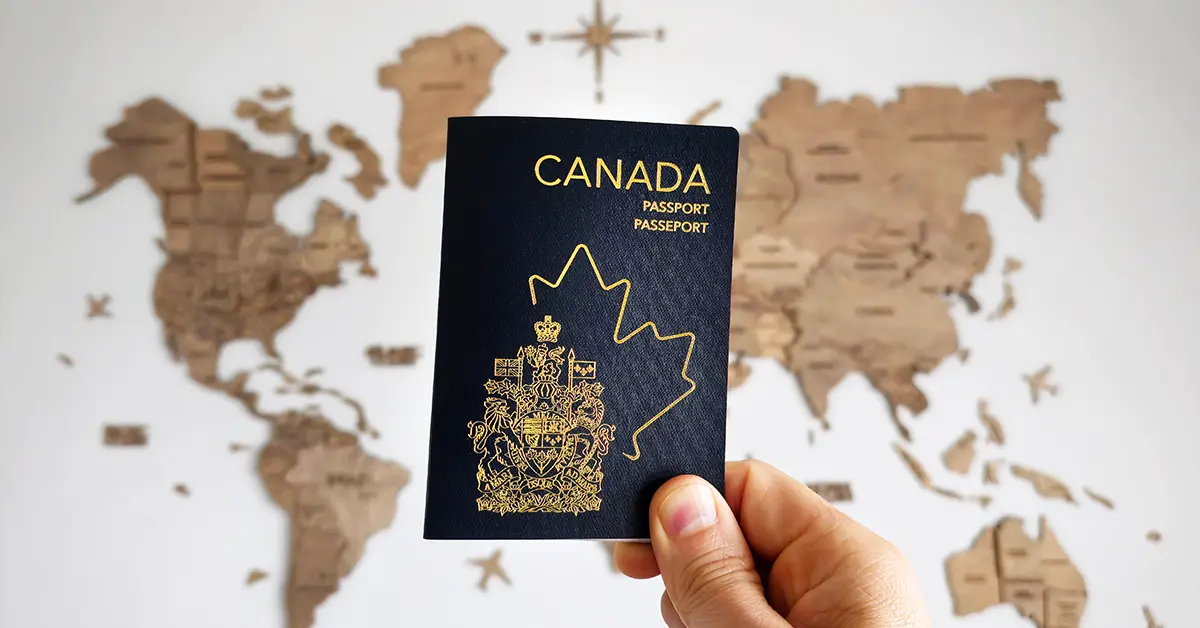
The benefits of a Canadian passport go well beyond citizenship and symbolic achievement. Canadian passport holders enjoy extensive visa-free access to other countries, substantial rights both inside and outside Canada, better employment opportunities, and much else besides.
Freedom of movement and greater visa-free travel
Canadian citizens and passport holders move freely into and out of Canada without a visa or permit, and are not subject to the physical presence requirement that applies to permanent residents.
Beyond freedom of movement, Canadian passport holders benefit from holding one of the most widely recognised passports in the world.
According to Henley & Partners, an investment migration advisory firm, the Canadian passport is among the strongest in the world, offering visa-free travel to more than 180 different countries worldwide, including:
- The United States (6 months per visit)
- Mexico (6 months per visit)
- The United Kingdom (6 months per visit)
- The Schengen Area and associated countries (90 days per visit)
- Australia and New Zealand (90 days)
- Brazil (90 days)
- The United Arab Emirates (30 days)
- The Kingdom of Saudi Arabia (90 days)
- South Korea (6 months)
- Japan (90 days)
- Singapore (30 days)
- Pakistan (30 days, extendable to 90 days)
- Bangladesh (30 days)
- South Africa (90 days)
- Nigeria (90 days)
- More than 100 other countries.
Canadian permanent residents do not enjoy these freedoms of movement.
Irrevocable status and the right to pass on citizenship
Canadian passport holders hold irrevocable permanent status in Canada. This contrasts with permanent residents, whose status may be revoked and who faceother obligations applying to permanent residents.
Canadian passport holders may rely on this permanent status — unless they choose to renounce it — and may pass citizenship on to children born after they become naturalised Canadian citizens.
Passport holders are also not required to maintain contact with Immigration, Refugees and Citizenship Canada (IRCC), unlike permanent residents (who must, for example, keep the residential address registered with IRCC up to date).
In addition,Canada allows citizens to hold dual citizenshipwith other countries, meaning new citizens need not renounce their existing citizenship if they do not wish to (assuming their country of origin also allows dual citizenship).
Additional benefits
Canadian citizens and passport holders also enjoy smaller benefits. For example, those who have completed the citizenship test and the citizenship ceremony receive free admission to all sites managed by Parks Canada throughout their first year. This includes national parks (such as the renowned Banff and Jasper), national historic sites and national marine conservation areas.
New Canadian citizens even receive free admission for 1 year to participating museums, science centres, art galleries and parks across Canada. The policy applies to the new citizen and up to 4 children per visit.
Applying for a Canadian passport
New Canadian citizens (holdingCanadian citizenship) must wait until after the citizenship ceremony to apply for a Canadian passport. IRCC issues a citizenship certificate, which they can use for the passport application.
Those who are already Canadian citizens may use a Canadian provincial or territorial birth certificate to apply for a passport. Note that the citizenship certificate and the birth certificate are the only two documents Passport Canada accepts as proof of Canadian citizenship.
When submitting a new adult Canadian passport application, applicants must attach specific forms and information to complete the process successfully. Additional urgent requirements may apply to their situation, and there are special considerations for dual citizens.
A passport application may be refused for a false declaration, even where this occurs by mistake.
Read about applying for a Canadian passport in detail athere.
Accompanying you on your journey in residency investment
The Prosperous Living Investment team advises on pathways, assesses profiles and manages investments transparently for every residency, citizenship and international property objective.
Free profile assessmentWhere life gets prosperous