

Work permits through the CCFTA

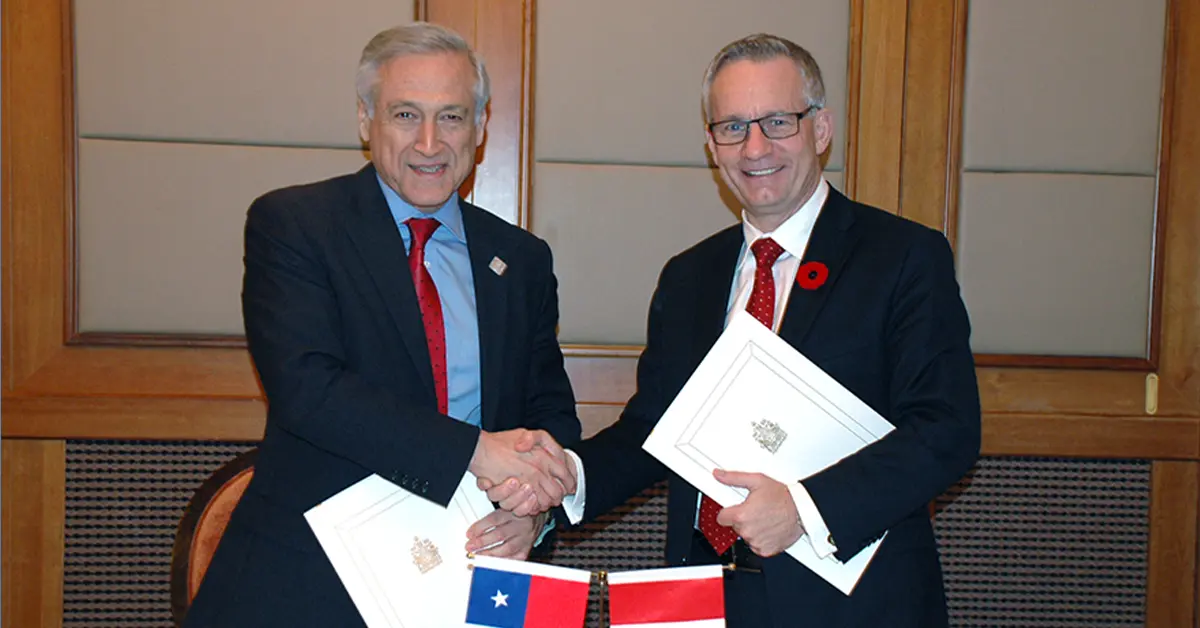
The Canada-Chile Free Trade Agreement (CCFTA) is an international agreement between Canada and Chile, and every work permit application is therefore assessed under the Immigration and Refugee Protection Regulations (IRPR). This part of the regulations falls within the International Mobility Program (IMP).
The CCFTA originally came into force on 5 July 1997. The modernised Canada-Chile Free Trade Agreement has been in force since 5 February 2019.
Contents
Overview
The Canada-Chile Free Trade Agreement (CCFTA) facilitates temporary entry for citizens or permanent residents of Chile who are engaged in trade in goods, the supply of services or investment activities.
The CCFTA:
- Does not facilitate entry for permanent residence.
- Does not affect the general requirements relating to passports and identity documents, medical examinations, safety and security.
- Does not exempt workers from meeting the licensing or certification requirements attached to the practice of an occupation.
- Does not extend special privileges to spouses and family members. The entry of family members is governed by the Immigration and Refugee Protection Act and Regulations.
Considering a residency programme? The Prosperous Living Investment team assesses your profile free of charge and advises on the pathway that fits your goals.
Temporary entry categories
The CCFTA facilitates temporary entry in the following categories:
Business travel
A Chilean business visitor seeking entry to Canada is eligible for assessment under the CCFTA provisions, as well as under the general rules applying to all foreign workers.
Business visitors take part in international business activities relating to research and design; growth, production and manufacture; marketing; sales; distribution; after-sales service; and general service, without a work permit. These activities reflect the components of the business cycle.
Traders
A trader under the CCFTA must carry on substantial trade in goods or services between Canada and Chile.
The trader must work in a supervisory or executive position, or a position involving essential skills.
Investors
An investor who has committed, or is in the process of committing, a substantial amount of capital in Canada.
The investor must work in a supervisory or executive position, or a position involving essential skills.
Professionals or technicians
Professionals or technicians under the CCFTA are workers entering to supply pre-arranged professional services — either as salaried employees of a Canadian enterprise through a contract between the worker and the Canadian employer, or through a contract between the business person’s Chilean employer and a Canadian enterprise.
Theoccupations covered by the CCFTA. Professionals enter to supply services in the field in which they were trained.
Intra-company transferees (ICT)
The intra-company transferee (ICT) stream under the CCFTA is open only to job titles at managerial or executive level (TEER 0 or 1), or positions involving specialised knowledge, where the person is transferred to a Canadian enterprise with a qualifying relationship as parent, branch, subsidiary or affiliate, in order to supply services in the same position.
Where to apply
Business visitors are exempt from the work permit requirement and may therefore apply at a port of entry, provided the applicant already holds a validTemporary Resident Visa (TRV)or a validElectronic Travel Authorisation (eTA)allowing them to travel to Canada. Applicants must apply for and obtain the temporary resident visa or electronic travel authorisation before arriving in Canada.
Foreign nationals who are exempt from the temporary resident visa requirement may apply for a work permit at a port of entry, as may foreign nationals who meet the requirements of R198. For more information, see:Temporary Foreign Worker Program (TFWP)andInternational Mobility Program (IMP): who may apply at a port of entry.
Foreign nationals may apply for a work permit from within Canada if they meet the conditions set out in the Immigration and Refugee Protection Regulations (IRPR).

Extending a work permit issued under the CCFTA
The free trade agreement (FTA) allows a work permit originally issued under the agreement to be extended. The work permit may be extended at the discretion of the officer assessing the application, provided the applicant has submitted all the documentary evidence required in support of the request.
To extend an FTA work permit under this agreement, the employer must submit a new offer of employment and the applicant must meet the usual work permit extension requirements.
In considering the period requested by the employer, the officer should review the application and the offer of employment to be satisfied that the requirements and purpose of entry under the agreement continue to be met. Extension applications should be submitted online. An application made at a port of entry or at an IRCC office outside Canada is treated as a new work permit application.
Documents accepted in support of an extension include:
- A letter from the supplying enterprise explaining the extension of the service contract.
- An updated business plan.
- An offer for a new contract.
- A feasibility study and marketing plan.
Requirements
To determine whether an applicant is eligible, the government immigration officer will consider the following factors:
- The applicant’s intentions:
- What is the applicant doing in Canada?
- How long has the applicant been here?
- How long a period is being requested?
- The reasons given by the applicant for the extension:
- Are the plans well thought through, or merely incidental?
- Has the applicant been granted an extension before?
- The applicant’s situation in their home country:
- In what way has the person left behind family, employment or other responsibilities and obligations?
- How have those responsibilities been dealt with?
- Is a long stay in Canada reasonable and workable?
- The original intention of the application:
- What was the original purpose of the business trip to Canada?
- Has the original purpose of the business trip been fulfilled?
- If the original purpose has not been fulfilled, was the original period sufficient to fulfil it?
- The licence or documents required for the applicant to practise their occupation in Canada, where the occupation is regulated at provincial or territorial level:
- For example, in most provinces and territories electricians and plumbers are regulated occupations and documents are required in order to practise.
Temporary entry
Temporary entry under a free trade agreement is entry without the intention of settling permanently. This definition is consistent with immigration law. It is applied flexibly to individual circumstances and recognises that the concept of temporary entry cannot rest on a fixed time limit alone.
The definition does not allow temporary entry without limit. The provisions of the agreement cannot be used as a mechanism to circumvent the procedures applying to permanent employment, nor as a means of establishing permanent residence.
Repeated extensions will not routinely be approved, even where a long appointment was specified on arrival in Canada. The longer the temporary stay, the greater the onus on the foreign national, particularly when requesting an extension of status, to satisfy the officer of their temporary intent.
A foreign national may be authorised to work temporarily in a permanent position that is, for some reason, temporarily vacant.
Read more about work permits through the CCFTA on the government website athere.
Accompanying you on your journey in residency investment
The Prosperous Living Investment team advises on pathways, assesses profiles and manages investments transparently for every residency, citizenship and international property objective.
Free profile assessmentWhere life gets prosperous