



International students may bring their family to Canada to live with them. Canada’s generous immigration policy allows certain family members of international students to come to Canada to work and/or study.
Contents
Definition of a family member
For the purposes of this page, a family member means a spouse, common-law partner, fiancé(e) or dependent child — those whom an international student may bring to Canada to live with them.
Considering a residency programme? The Prosperous Living Investment team assesses your profile free of charge and advises on the pathway that fits your goals.
The visitor visa
Citizens of certain countries and territories need aTemporary Resident Visa (TRV)to enter Canada as a visitor. The visa cannot be applied for at a Canadian port of entry and, in some cases, a medical examination may be required. This can add considerably to the applicant’s processing time.
Citizens of certain countries do not need a TRV but, since 10 November 2016, most visa-exempt travellers need anElectronic Travel Authorisation (eTA). The main exception is US citizens, who need neither a TRV nor an eTA.
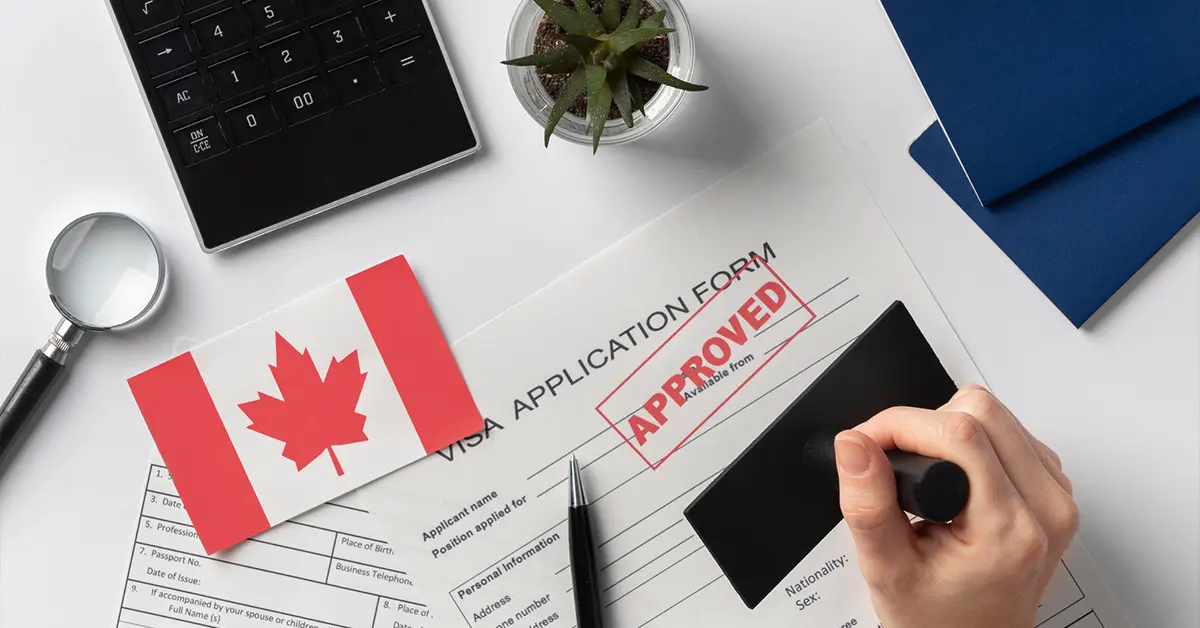
A work permit for a spouse
IRCC has changed the conditions under which the spouses of international students qualify for an open work permit.
An open work permitThis allows the holder to work for any employer in Canada, and requires neither a job offer nor anLabour Market Impact Assessment (LMIA).
Note that this open work permit may exclude certain occupations (such as work in schools or hospitals) unless a medical examination is provided. An open work permit for the spouse of an international student is normally valid for the same period as the student’s study permit.
If the spouse or common-law partner of an international student already holds an open work permit under this stream and wishes to extend their work permit under it, they must meet all the same eligibility criteria as those who applied for a work permit before 19 March 2024.
If the application is submitted after 19 March 2024, the following conditions must be met for the spouse of an international student to qualify for an open work permit:
The international student must be studying:
- A master’s* or doctoral programme at a university or polytechnic institution
- IRCC announced that it would introduce an eligible programme-length criterion for the spouses of master’s students in late 2024. Under this change, only the spouses of master’s students on programmes lasting 16 months or more will qualify for an open work permit.
- One of the following professional degree programmes at a university:
- Doctor of Dental Surgery (DDS, DMD)
- Bachelor of Laws or Juris Doctor (LLB, JD, BCL)
- Doctor of Medicine (MD)
- Doctor of Optometry (OD)
- Doctor of Pharmacy (PharmD, BS, BSc, BPharm)
- Doctor of Veterinary Medicine (DVM)
- Bachelor of Science in Nursing (BScN, BSN, BNSc)
- Bachelor of Education (B.Ed.)
- Bachelor of Engineering (B.Eng., BE, BASc)
- The spouse of an international student must provide one of the following documents with their application:
- A valid letter of acceptance fromDesignated Learning Institution in Canada (DLI).
- A letter of enrolment from the DLI.
- A transcript from the current programme.
- The international student must be able to provide evidence of the relationship to IRCC.
Where the open work permit application was submitted before 19 March, all of the following conditions must be met:
- The international student holds a valid study permit.
- Is eligible for a post-graduation work permit (PGWP).
- Is a full-time student at one of the following types of DLI:
- A public post-secondary institution, such as a college or university, or a CEGEP in Quebec.
- A private college-level institution in Quebec.
- A Canadian private institution lawfully able to confer degrees under provincial law (for example, a bachelor’s, master’s or doctoral degree).
The application process for a spousal work permit
Canadian visa offices abroad can usually process a work permit application at the same time as a study permit application. In such cases, in addition to the study permit processing fee, the applicant must also include the work permit processing fee.
Alternatively, a spouse or common-law partner may come to Canada as a visitor and then apply for a work permit after arriving. For citizens of countries that do not require a TRV, this work permit application may be made at a Canadian port of entry. In certain cases, citizens of visa-requiring countries may also consider applying at a port of entry.

Minor children and study permit rules
Where the international student, or their spouse or common-law partner, is already in Canada, the international student’s minor children may study without a study permit at kindergarten, primary or secondary level. Once a child reaches the age of majority in their province, however, they must apply for a study permit to continue studying in Canada. This application may be completed from within Canada. Please see the table below for further information.
When applying from outside Canada, the international student will need to apply for a study permit for their child at a Canadian visa office abroad.
Applying at the same time
Where an international student is planning to bring their family to Canada during their studies, and the applicants will arrive at the same time, the international student may consider completing a single application for the whole family. Where the international student has several different types of permit application (for example, the student’s study permit and a spouse’s or common-law partner’s work permit), the international student will need additional documents and must include the additional fees (such as the extra fee for the work permit).
Extensions
Where an international student wishes to extend or change their conditions while in Canada, they will need to complete a separate application. Be sure to check the expiry date on the study permit and to apply at least 30 days before that date if the international student wishes to extend their stay.

Do children need a study permit?
Children accompanying an adult who is in Canada on a work or study permit may study in Canada without a study permit at kindergarten, primary and secondary level.
| If the child is… | Documents required | Is a study permit required? |
|---|---|---|
| A Canadian citizen | A passport, citizenship card or birth certificate | No |
| A Canadian permanent resident | A Record of Landing (IMM-1000), Confirmation of Permanent Residence (IMM-5292) or a Permanent Resident Card | No |
| A foreign national accompanying a parent with visitor status | A stamp in the child’s passport, or in the passport of the parent on which the child is listed as a son/daughter | Yes |
| Alone, or with a parent who is a temporary resident holding a study or work permit | The child’s passport, or the child listed on a parent’s passport. The child may hold a visitor record. The parent holds a study or work permit. (See the note below) | No |
| An asylum claimant, whether or not accompanied by a parent | An Eligibility Determination Letter fromImmigration, Refugees and Citizenship Canada (IRCC). The child’s passport, or the child listed on a parent’s passport, or any available travel or identity document. There may also be expired IRCC documents. | No |
| In Canada without status | The child’s passport, or the child listed on a parent’s passport, or any available travel or identity document. There may also be expired IRCC documents. | No |
Note:A child may hold a visitor record or a study permit on entering Canada. The child is permitted to study without a study permit if they hold only a visitor record or a Canadian entry stamp in their passport.
Can I bring my parents while I hold a study permit?
While holding a study permit, an international student may invite their parents to visit under aTemporary Resident Visa (TRV)orElectronic Travel Authorisation (eTA)allowing the parents to come to Canada.
Accompanying you on your journey in residency investment
The Prosperous Living Investment team advises on pathways, assesses profiles and manages investments transparently for every residency, citizenship and international property objective.
Free profile assessmentWhere life gets prosperous