
Saint Kitts and Nevis

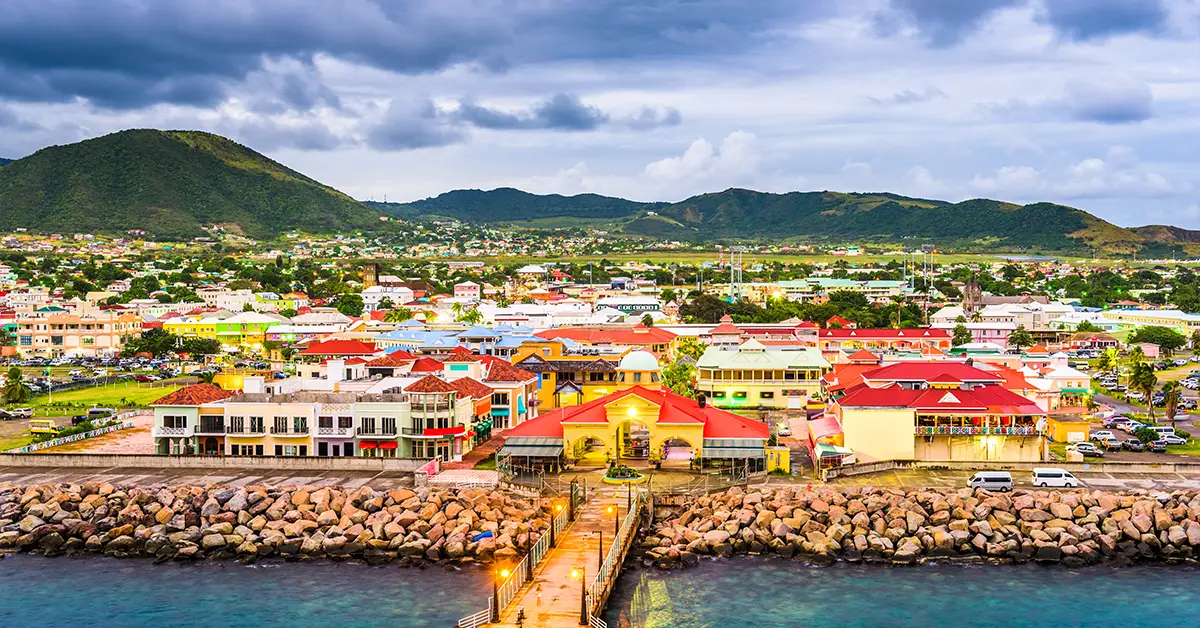
Saint Kitts and Nevis is a twin-island nation in the Leeward Islands of the Caribbean, known as the smallest sovereign state in the Western Hemisphere in both area and population. With 261 km² and a population of around 48,000 to 53,000, the federation is also the smallest sovereign federation in the world, officially named the Federation of Saint Christopher and Nevis.
Despite its modest size, the country holds a distinctive international position thanks to the world’s oldest citizenship by investment (CBI) programme — established in 1984 — together with a stable political system on the constitutional monarchy model within the Commonwealth. The economy is service-oriented, with tourism, offshore finance and citizenship by investment as its three main pillars.
Message
Geographical position and natural features
The federation lies in the eastern Caribbean, within the Leeward Islands group of the Lesser Antilles. The two main islands are around 3 km apart, separated by the shallow strait called The Narrows, creating the distinctive geography of a twin-island federation.
Saint Kitts is the larger island, elongated in shape, while Nevis is nearly round and smaller. Both islands are volcanic in origin with markedly hilly and mountainous terrain. The highest point is Mount Liamuiga on Saint Kitts, at 1,156 metres — once an active volcano but long dormant.
Besides the two main islands, the country also has two smaller islands. It has no direct neighbours, being surrounded by the Caribbean Sea. The distance from the capital Basseterre to New York is around 2,820 km and to Miami around 2,350 km — convenient for tourism and trade with North America.
The climate is tropical maritime, with average annual temperatures ranging from 24 to 28 degrees Celsius. The rainy season runs from May to November, coinciding with the Caribbean hurricane season. Tropical rainforest covers most of the mountainous interior, creating varied natural scenery for the tourism industry.
Considering a residency programme? The Prosperous Living Investment team assesses your profile free of charge and advises on the pathway that fits your goals.
Population and culture
On 2026 estimates, the population ranges from 47,000 to 53,000 depending on the source. Population density is around 164 to 180 per km² — ranked 64th in the world, fairly high for such a small area. Most of the population lives on Saint Kitts.
The ethnic composition is mainly of African origin, around 75% of the population — descendants of West African slaves brought during the colonial period. The other ethnic groups comprise Afro-European (12.3%), mulatto (5.3%), East Indian and Afro-East Indian (5%), together with South Asian and other groups.
The official language is English — a legacy of British colonial rule. In addition, local people use Saint Kitts Creole English in everyday conversation. The main religion is Christianity, mostly Protestant, with smaller numbers of Roman Catholics and Hindus.
The median age of the population is 36.5, reflecting a mature society entering a period of ageing. The urbanisation rate is around 39.78%, with Basseterre the largest urban centre at around 15,500 people.
The formation of Saint Kitts and Nevis
Theo The CIA World Factbook, this is one of the first islands in the Caribbean to be settled by Europeans. Saint Kitts was where both the English and the French established their first Caribbean colonies, which is why it is known as the “Mother Colony of the West Indies”.
The first European to set foot on the island was Christopher Columbus in 1493. The name “Saint Christopher” was given in honour of his patron saint, later shortened to “Saint Kitts”. The English established the first permanent colony in 1623, followed by the French in 1625. These two colonial powers shared and contested control for nearly 200 years.
After several conflicts and the treaties of Paris, the country formally became a British colony in 1783. The colonial economy rested mainly on sugar cane production, worked by African slave labour — creating the present ethnic composition.
The country gained independence from Britain on 19/09/1983 — one of the last Caribbean countries to do so. Although independent, the federation maintains its relationship with the British Crown by recognising King Charles III as titular head of state, reflecting the continuity of its British colonial heritage.
The political system and government
Saint Kitts and Nevis operates as a federal constitutional monarchy within the Commonwealth. King Charles III is the titular head of state, represented locally by the Governor-General. Real executive power rests with the Prime Minister and Cabinet.
The political system is a unicameral parliament, comprising the National Assembly with directly elected members. The two major political parties alternating in power are the Saint Kitts and Nevis Labour Party and the People’s Action Movement. The most recent election was held in 2022, making Terrance Drew the current Prime Minister.
A distinctive feature is that Nevis has considerable autonomy within the federation, with its own Nevis Island Assembly and its own Premier of Nevis. This structure reflects the relative independence of the two islands before unification. The Constitution gives Nevis the right to hold a referendum on seceding from the federation — a right invoked in 1998 but which did not reach the required threshold.
The country is an active member of several international organisations, comprising the United Nations, the Organization of American States (OAS), the Caribbean Community (CARICOM) and the Organisation of Eastern Caribbean States (OECS). OECS membership gives citizens freedom of movement and the right to work in the member states.
The economy and main sectors
On data from theInternational Monetary Fund (IMF), the country’s economy ranks 187th in the world by nominal GDP, with total GDP of around USD 1 billion and GDP per capita of around USD 22,470. The IMF forecasts GDP growth of 2.2% in 2026, up from 1.5% in 2025.
Tourism is the most important pillar, contributing considerably to GDP and employment. The sector has grown strongly thanks to the beaches, the volcanic landscape, UNESCO heritage such as Brimstone Hill Fortress, and the cruise market from the United States. The port of Basseterre is the main gateway for cruise passengers.
The CBI programme is the second most important source of revenue. The money from investor contributions goes into the Sustainable Island State Contribution (SISC) fund, serving the development of seven pillars comprising renewable energy, health, education, sustainable agriculture, tourism, infrastructure and economic diversification.
Agriculture was once the economic foundation with sugar cane as the mainstay, but the sector shrank considerably after the government closed the sugar industry in 2005. Agriculture now focuses on fruit and vegetables, livestock and crop diversification. Offshore financial services are also growing, particularly on Nevis with its company and trust structures.
The official currency is the Eastern Caribbean Dollar (XCD), pegged to the USD at 1 USD = 2.70 XCD — providing monetary stability for international trade. The banking system is assessed as stable by the IMF, with a strong capital position and a falling non-performing loan ratio.
Development indicators and quality of life
On the UN’s Human Development Index (HDI), the country scores 0.838 (2022 figures), ranking 51st of 193 countries. This falls within the high development group — an impressive achievement given the country’s size.
Income per head is USD 22,470, placing the federation in the high-income group under the World Bank classification. However, the IMF still classifies it as developing because of the small scale of the economy and its dependence on tourism.
The public health system has received considerable government investment, comprising the Joseph N. France General Hospital in Basseterre and Alexandra Hospital on Nevis. Education is compulsory and free from ages 5 to 16. The University of the West Indies has a campus on Saint Kitts, alongside Ross University School of Medicine, well known in international medical training.
International relations and the passport
The country maintains diplomatic relations with most Western countries and is an active Commonwealth member. It has no standing army, relying on the Saint Kitts and Nevis Defence Force together with the police for security.
The passport is among the strongest Caribbean passports in the world. Citizens have visa-free entry or visa on arrival to around 150 to 157 countries as at 2026, comprising the whole Schengen area, Britain, Ireland, Singapore and Hong Kong.
A favourable tax policy is another notable advantage. The federation levies no worldwide personal income tax, no inheritance tax, no wealth tax and no capital gains tax. This is a tax structure international investors lawfully use to optimise their financial planning.
In March 2026, the government signed a memorandum of cooperation with Nigeria to develop international film production on the islands. Filming is expected to begin in June 2026, widening revenue beyond tourism and CBI — showing the government’s efforts to diversify the economy.
Settlement and investment in Saint Kitts and Nevis
A detailed article onSaint Kitts and Nevis citizenship by investment.
The most common way for international investors to become citizens is through the CBI programme, with a minimum investment from USD 250,000. The programme grants citizenship for life, requires no physical residence and permits dual nationality — suiting Vietnamese investors who want to keep their original citizenship.
The current investment routes comprise SISC with a minimum of USD 250,000, developer property from USD 325,000, private property from USD 600,000, and the Public Benefit Option from USD 250,000. Each route has its own advantages and drawbacks, suiting different financial objectives.
Summary
Saint Kitts and Nevis is a small country with a distinctive position on the global investment migration map. With a long colonial history, a stable British-style political system, a diverse economy resting on tourism, CBI and financial services, together with the world’s oldest CBI programme, the country offers a worthwhile opportunity for international investors.
The combination of Caribbean natural scenery, a favourable tax environment, a strong passport and flexible procedures makes it a destination of interest to many Vietnamese investors. With continuous reforms from 2023 to 2026 strengthening its international standing, this is a good time to study the investment routes carefully and plan a long-term migration for the family.
Accompanying you on your journey in residency investment
The Prosperous Living Investment team advises on pathways, assesses profiles and manages investments transparently for every residency, citizenship and international property objective.
Free profile assessmentWhere life gets prosperous