



An Invitation to Apply, abbreviated to ITA, is an automatically generated letter sent to candidates eligible for permanent residence under an immigration programme within the Express Entry system. Canada usually issues ITAs about every 2 weeks.
Contents
Overview
An Invitation to Apply (ITA) is issued to candidates in the pool thatExpress Entry khi Immigration, Refugees and Citizenship Canada (IRCC)selects to submit an application for permanent residence. ITAs are issued in ranking order when IRCC holds an Express Entry draw, in which only candidates who have expressed their interest in immigrating to Canada are considered.
An ITA should not be confused with the initial eligibility to enter the Express Entry pool, nor is it a job offer from a Canadian employer or a provincial nomination certificate. It is an automatically generated letter sent to the candidate’s Express Entry account.
An ITA invites the candidate to apply under a specific immigration class, namely:
- The Federal Skilled Worker Program (FSWP)
- The Federal Skilled Trades Program (FSTP)
- The Canadian Experience Class (CEC)
- Provincial Nominee Program (PNP)
Considering a residency programme? The Prosperous Living Investment team assesses your profile free of charge and advises on the pathway that fits your goals.
Receiving an ITA
Only candidates who meet the minimum requirements of one of the federal economic immigration programmes may enter the Express Entry pool. They are then ranked under theComprehensive Ranking System (CRS), based on the following factors:
- Human capital factors
- Factors relating to the spouse or common-law partner (if applicable)
- Skill transferability factors
- Additional factors: a provincial nomination certificate, a qualifying job offer, Canadian study experience, having a sibling in Canada or French language ability
The CRS has a maximum total of1,200 points.
The Government of Canada holds an Express Entry draw by setting the minimum CRS score for that draw and issuing ITAs to candidates who meet or exceed that score. On receiving an ITA, the candidate may apply for permanent residence within the prescribed period.
A candidate cannot apply under an immigration class other than the one specified in their ITA, even if they appear to be eligible for several classes.
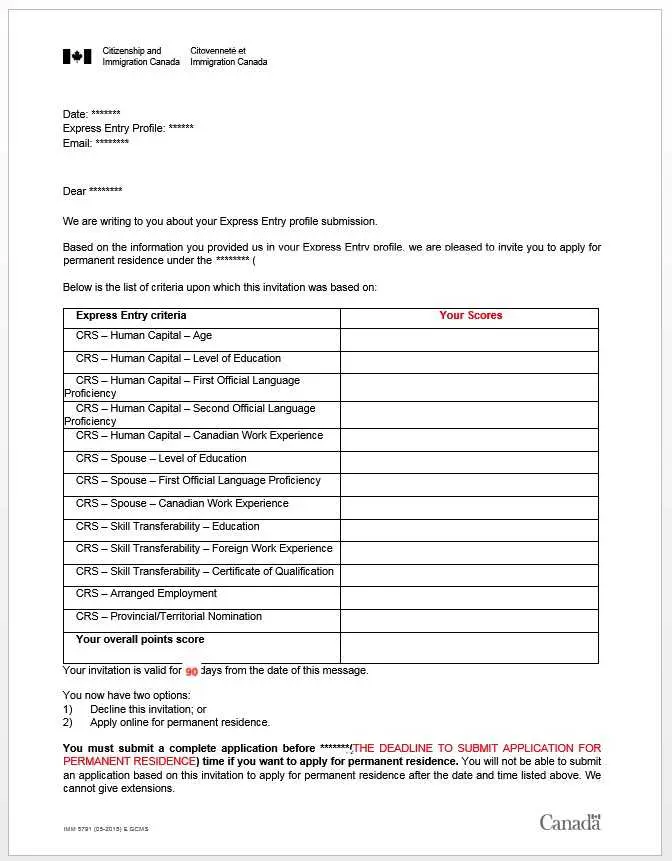
The ITA also includes the candidate’s Comprehensive Ranking System (CRS) score breakdown at the time the invitation was issued, showing the points awarded for each criterion as follows:
| Express Entry criterion | Your points |
|---|---|
| CRS – Human capital – Age | ### |
| CRS – Human capital – Level of education | ### |
| CRS – Human capital – First official language proficiency | ### |
| CRS – Human capital – Second official language proficiency | ### |
| CRS – Human capital – Canadian work experience | ### |
| CRS – Spouse – Level of education | ### |
| CRS – Spouse – First official language proficiency | ### |
| CRS – Spouse – Canadian work experience | ### |
| CRS – Skill transferability – Level of education | ### |
| CRS – Skill transferability – Foreign work experience | ### |
| CRS – Skill transferability – Certificate of qualification | ### |
| CRS – Arranged employment | ### |
| CRS – Provincial or territorial nomination | ### |
| Your total CRS score | ### |
Required documents
All candidates who receive an Invitation to Apply (ITA) must now submit the following supporting documents with their application, together with the government processing fee:
- A valid passport
- Birth certificate
- Language test results
- Documents proving work experience
- Police clearance certificate
- Medical examination report
- Photographs of the principal applicant and family members
Depending on the programme under which the candidate received the Invitation to Apply (ITA) and the information in the Express Entry profile, the following documents may be required:
- A Canadian educational credential or anEducational Credential Assessment (ECA)
- A letter confirming level of education
- Official transcripts for post-secondary courses
- Secondary school diploma
- An original letter from the Canadian employer confirming a valid job offer
- Proof of family relationships in Canada
- Proof of funds for settlement
- Legal documents evidencing a change of name or date of birth
- Marriage certificate
- A statutory declaration of common-law union and documents proving at least 12 months of cohabitation
- Divorce or annulment certificate
- Death certificate of a former spouse or common-law partner
- Children’s birth certificates
- Adoption papers
- Proof of full custody of children
- Other travel documents (not a passport)
- A copy of a certificate of qualification in a skilled trade issued by a provincial or territorial authority in Canada
- Copies of employment contracts and/or payslips
- Documents relating to income tax filings

Misrepresentation
If information provided by a prospective candidate is found to be false, this is known as misrepresentation and, depending on its seriousness, may lead to penalties. The rules on misrepresentation are intended to ensure that candidates provide complete, honest and accurate information throughout the Canadian immigration application process, and to protect the integrity of Canada’s immigration programmes.
A candidate found to have provided false information while in the Express Entry pool may be barred from reapplying for 5 years. Providing accurate and complete information is therefore extremely important.
A candidate may be found inadmissible to Canada for misrepresentation if they directly or indirectly provide false information or withhold material information that could lead to an error in the assessment of their application. The candidate is responsible for ensuring that the application is truthful and that the supporting documents are genuine. Misrepresentation may be acted upon even where it was not deliberate on the candidate’s part.
Examples of misrepresentation include:
- A candidate asks a relative or friend to gather information in support of their application. If the information provided by that representative is false and the candidate is unaware of the inaccuracy, the candidate remains responsible for ensuring that the application is truthful and the supporting documents genuine. The candidate may therefore be refused immigration for submitting false documents or information, even where they did not personally falsify the evidence.
- An individual declares that they have never been convicted of a criminal offence, but the police clearance check shows a prior conviction. This is a case of direct misrepresentation.
The scope of misrepresentation is not limited to the cases described above. Where inaccuracy is suspected, the candidate may be given an opportunity to address the concerns raised about their application.
Accepting an ITA
The information in the original Express Entry profile is retained for 60 days after the candidate receives an Invitation to Apply (ITA). Candidates have this window in which to submit a complete and accurate application together with all supporting documents.
Because the processing window is limited, candidates are advised to begin gathering documents and to make sure every required paper is valid before the ITA arrives. If a candidate does not submit the application before the 60-day deadline, the ITA lapses and they must return to the Express Entry pool to await consideration again.
Once all required documents have been uploaded and the application is complete, the candidate is given the option to submit. That option appears only after every section has been filled in. Submitting a complete application is treated as acceptance of the ITA. After submission, the system automatically issues an Acknowledgement of Receipt (AOR).
Immigration, Refugees and Citizenship Canada (IRCC) then reviews the application and determines whether it is complete and valid. IRCC aims to process applications within 6 months of the date the candidate submits.

ITA expiry
If the candidate does not submit within the prescribed period, the ITA is removed. Candidates who neither decline the ITA nor apply within 60 days will see their ITA expire. If they still wish to immigrate to Canada through Express Entry, they must create a new Express Entry profile and be accepted into the pool in order to be considered in subsequent draws. To re-enter the pool, the candidate must still meet the minimum criteria of the federal programme.
Declining an ITA
A candidate may choose to decline an ITA if they are not ready or wish to improve their score before applying for permanent residence. When an ITA is declined, the candidate’s Express Entry profile returns to the pool and continues to be considered in later draws, provided they still meet the minimum criteria of a federal economic immigration programme.
There is, however, no guarantee that the candidate will receive another ITA in future. Declining an ITA does not adversely affect the chance of receiving an ITA in later draws.
Candidates can find further information on Express Entry draws, including:
- The number of ITAs issued in each draw
- The minimum CRS score required to receive an ITA
- The immigration programmes under which ITAs were issued in each draw
Read more about the Invitation to Apply (ITA) on the Government of Canada website athere.
Accompanying you on your journey in residency investment
The Prosperous Living Investment team advises on pathways, assesses profiles and manages investments transparently for every residency, citizenship and international property objective.
Free profile assessmentWhere life gets prosperous