


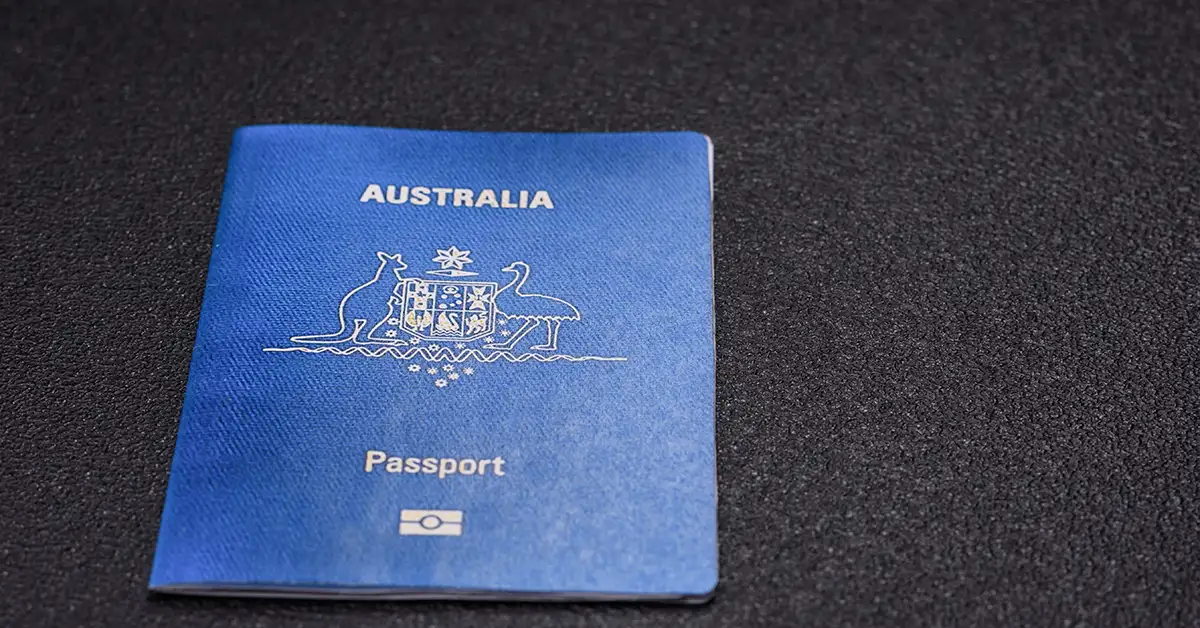
The Australian passport is a travel document issued by the Commonwealth of Australia to individuals holding any form of Australian citizenship.
The document gives access to consular assistance from Australian embassies worldwide, and is issued by the Australian Passport Office, an agency of the Department of Foreign Affairs and Trade (DFAT), and Australia Post.
As of July 2024, Australian citizens had visa-free or visa-on-arrival access to 188 countries and territories, ranking the passport eighth in the world for travel freedom according to the Henley Passport Index.
Since 24/10/2005, Australia has issued only biometric passports, known as ePassports, containing a chip that holds the same personal details as the passport’s colour photograph page, including a digital photograph. As all earlier passports have now expired, every Australian passport is biometric.
SmartGates have been installed at Australian airports to allow holders of Australian ePassports and of ePassports from certain other countries to clear the border more quickly, and facial recognition technology has been installed at entry points.
Message
Overview of the Australian passport
- Issued by: the Australian Passport Office (DFAT)
- First issued:
- 1901 (first post-Federation version)
- 1984 (machine-readable passport)
- 24/10/2005 (biometric passport)
- 9/2022 (current version)
- In circulation: 14.2 million (2023)
- Purpose: Identification & travel
- Valid in: All countries
- Eligibility: Australian citizens
- Validity:
- 10 years for adults aged 16 and over
- 10 or 5 years for adults aged 75 and over
- 5 years for children under 16
- Expense:
- Adults (16+): 10-year passport: $412 AUD
- Adults 75+ (optional): 5-year passport: $208 AUD
- Children (under 16): 5-year passport: $208 AUD
Considering a residency programme? The Prosperous Living Investment team assesses your profile free of charge and advises on the pathway that fits your goals.
History
Before 1901, Australia consisted of six separate British colonies. The use of passports was not widespread, and where one was required a British or other national passport was used.
In 1912 the first federal passport regulations were introduced, and passports issued by the Australian government continued to carry the words “British Passport” on the cover until 1967. During the First World War, monitoring and identifying those crossing international borders was regarded as important to the security of Australia and its allies, and the War Precautions Act 1914 required all persons aged 16 and over to hold a passport when leaving Australia.
Australian citizenship came into being on 26/01/1950 when the Nationality and Citizenship Act 1948 took effect, and Australian passports began to distinguish between Australian citizens and other British subjects. British subjects who were not Australian citizens remained eligible for an Australian passport. The term “British subject” has a particular meaning in Australian nationality law. It covered all nationals of the countries on a list contained in the Nationality and Citizenship Act 1948.
In 1980, the ledger registers were replaced by a computerised processing and registration system known as the Passport Issue and Control System (PICS). Since 1984, in order to speed up the processing of arriving and departing passengers and data entry, Australia has issued passports with a machine-readable line, in line with the ICAO Document 9303 standard.
Since 24/10/2005, Australia has issued only biometric passports, known as ePassports, containing an RFID chip that holds the same personal details as the passport’s colour photograph page, including a digital photograph. Australia was only the fourth country in the world (after Malaysia, Thailand and Sweden) to introduce biometric passports.
All Australian passports are now biometric, as all passports issued before 2006 have expired. SmartGates have been installed at Australian airports to allow holders of Australian ePassports, and holders of ePassports from certain other countries, to clear the border more quickly, and facial recognition technology has been installed at entry points to capture and store passport holders’ biometric records and to compare them against immigration databases and watchlists.
Types of passport
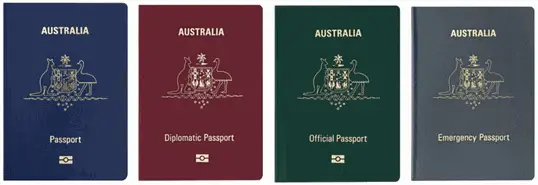
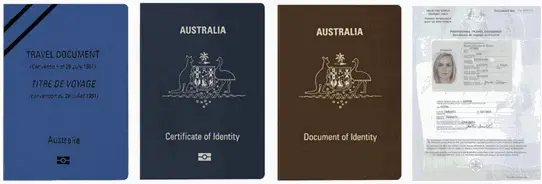
The Australian Government issues passports to provide internationally accepted certification of its citizens’ identity. To facilitate this global recognition, several types of passport are issued.
They are generally issued in the following categories:
- Ordinary passport
- Diplomatic passport
- Official passport
- Emergency passport
Certain non-passport travel documents may also be issued, eligibility for which is not limited to citizens:
- Convention Travel Document
- Certificate of Identity
- Document of Identity
- Provisional Travel Document
Ordinary passport
These are the most common passports issued to Australian citizens. Applicants must meet the identity and citizenship requirements. Where they cannot meet these, a Limited Validity Passport (LVP) or a Document of Identity may be issued on compassionate grounds. An LVP is like an ordinary passport, but is valid for up to 12 months.
Ordinary passports are generally valid for 5 or 10 years. Children under 16 are issued 5-year passports, and adults aged 75 and over may choose 5 or 10 years’ validity. Other adult applicants are generally issued passports valid for 10 years. Exceptions exist, such as in the case of parallel passports.
As of 2024, ordinary passports have 34 usable visa pages. The frequent-traveller variant with 66 visa pages was phased out in December 2017 as demand fell, with many countries no longer using physical visas or stamps.
Diplomatic and official passports
These are issued to people working for or representing the Australian Government, and mainly to individuals in defined categories and roles requiring official Australian government representation abroad. These passports are sometimes issued to dependants of the principal applicant where necessary to facilitate their travel or safety.
These passports may only be issued to Australian citizens whose role or purpose of travel is consistent with the Minister’s Guidelines. Issuance is tightly controlled, given what it signifies about an individual acting officially abroad on behalf of the Australian Government.
Unlike Ordinary passports, individuals take on certain legal and contractual obligations towards the Australian Government when using or holding these passports. These passports may be cancelled without notice if used outside the relevant provisions of the Minister’s Guidelines.
Emergency passport
These are issued at overseas posts to facilitate emergency travel by Australian citizens who meet all requirements but cannot wait the three weeks needed to issue a full-validity passport. These passports do not contain a passport chip, as they are issued by overseas posts that are not able to produce ePassports. As they are not biometric travel documents, travel on these passports may require a visa, even though Australian citizens usually travel visa-free.
Australian citizens who cannot meet all the requirements for an ordinary passport, but can meet the citizenship and identity requirements, or who need to travel urgently and cannot wait for an ordinary passport. Issuance is strictly controlled, particularly where the usual requirements are not met.
They are valid for up to 12 months, although they are usually valid for 7 months.
Special circumstance passports
In limited cases, Australian citizens may be issued a passport outside the usual requirements. Such passports are always issued in one of the categories above: ordinary, official or diplomatic. Apart from emergency passports, they are identical in appearance.
Parallel passports
A parallel passport is an additional passport issued to an individual who already holds a valid passport of the same type (ordinary, official or diplomatic). The issue of these is very tightly controlled, and they are granted to permit travel in exceptional circumstances.
These passports are most often issued where travel to (or transit through) a country would not accept evidence of travel to certain destinations, or where a significant delay would mean waiting for a passport to be returned after a visa has been issued (for an unrelated country). Other cases may be considered, requiring authorisation by a more senior officer.
These passports are valid for up to 3 years, except for emergency passports, which are valid for up to 12 months. The validity period is usually limited to the duration of the travel need plus 6 months.
Design
The current series of the Australian passport is blue, with the Australian coat of arms embossed at the top of the front cover. “AUSTRALIA” is written beneath the coat of arms and, below that, “PASSPORT”. Towards the bottom of the cover is the international e-passport symbol (). The standard passport contains 42 visa pages.
Identity information page
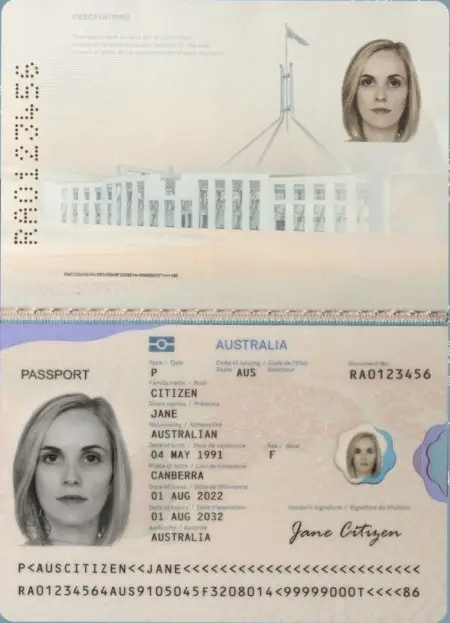
The Australian passport contains the following data:
- Photograph of the passport holder
- Type (of document, “P” for “personal”)
- Issuing country code (shown as “AUS” for “Australia”)
- Document number
- Surname
- Given names
- Nationality (“Australian”)
- Date of birth
- Sex (M, F or X)
- Place of birth (only the city or town is listed, even if born outside Australia)
- Date of issue
- Date of expiry
- Holder’s signature
- Authority (“Australia” if issued in Australia, or the name of the issuing mission if issued abroad – e.g. London)
The information page ends with the machine-readable zone.
Language
The passport is printed in English. A French translation is provided on the identity information page.
Biometric chip
The embedded chip stores the holder’s digital photograph, name, sex, date of birth, nationality, passport number and passport expiry date. This is the same information that appears on the printed information page of every passport.
Facial recognition technology was introduced with the launch of the ePassport to improve identity verification and reduce identity-related fraud.
Passport application
The 100-point personal identification system applies to new applicants for an Australian passport, and an Australian passport may in turn be used as an identity document for its holder (worth 70 points in the 100-point check system).
The 100-point personal identification system does not apply to passport renewals, whether in Australia or abroad, using form PC7. To qualify for form PC7, the most recent adult passport issued is required, and it must have been issued with a validity of at least 2 years (that is, not an Emergency Passport or a limited-validity document); AND issued in the current name, date of birth and sex; AND not lost, stolen or damaged; AND either current or expired less than three years ago.
The required dimensions for an Australian passport photograph are:
- 35–40 mm (1.4–1.6 in) – width
- 45–50 mm (1.8–2.0 in) – height
- 32–36 mm (1.3–1.4 in) – maximum size of the face from chin to crown
An Australian passport can be applied for on the Australian Passport Office portal athere.
Renewal
Australian citizens aged 18 and over who hold a valid Australian adult passport issued with at least two years’ validity, issued on or after 01/07/2000, in their current name, date of birth and sex, or who hold a valid Australian child passport issued with at least 2 years’ validity, issued on or after 01/07/2005 and issued when they were aged 16 or over, may apply for a renewal online. If abroad, this can be done by contacting the nearest Australian mission.
Renewal is not available for lost or stolen passports, in which case an application for a new passport must be made.
Five Nations Passport Group
Detailed article onFive Nations Passport Group.
Since 2004, Australia has taken part in the Five Nations Passport Group, an international forum for cooperation between the passport issuing authorities of the United Kingdom, Canada, New Zealand and the United States to “share best practice and discuss innovation relating to the development of passport policy, products and practice”.
Accompanying you on your journey in residency investment
The Prosperous Living Investment team advises on pathways, assesses profiles and manages investments transparently for every residency, citizenship and international property objective.
Free profile assessmentWhere life gets prosperous