

Dubai is one of the seven emirates making up the United Arab Emirates (UAE) and is also the largest city in the federation. With a population passing 4 million in 2025 (up 5.4% on 2024), GDP of around USD 180 billion and more than 92% of residents being foreign nationals, Dubai has become one of the most multinational global cities in the world. This article gathers together the full picture of modern Dubai, from its founding history, geography, economy and population to the opportunities to live and invest there for Vietnamese people.
The information is drawn from the official sources of the Government of Dubai, the Dubai Statistics Center and multilateral economic reports, updated to the beginning of 2026.
A detailed article onUAE.
Message
An overall profile of Dubai
Dubai lies on the south-eastern shore of the Arabian Peninsula, at the south-western corner of the Persian Gulf (Arabian Gulf), in the Middle East. The emirate covers around 4,114 km² — the second largest in the UAE after Abu Dhabi. The capital and urban centre of the same name, Dubai, holds most of the emirate’s population.
It was founded at the beginning of the 18th century as a fishing village and pearl trading centre. After oil was discovered in 1966, the city entered a period of unprecedented rapid growth. The UAE was founded on 02/12/1971 with the union of Dubai, Abu Dhabi, Sharjah, Ajman, Umm Al Quwain and Fujairah (with Ras Al Khaimah joining in early 1972). The Al Maktoum royal family has ruled Dubai continuously from 1833 to the present day, according to theofficial portal of the Government of Dubai.
The current head of Dubai is Sheikh Mohammed bin Rashid Al Maktoum, who serves as Vice President and Prime Minister of the UAE as well as Ruler of Dubai since 2006. Under this leadership, Dubai has successfully positioned itself as the leading business, financial, logistics, tourism and technology centre of the Middle East and North Africa.
The population now stands at 4 million (2025), with a distinctive structure: more than 92% are foreign nationals (expatriates) from more than 200 different countries. According to theDubai Statistics Center (DSC), the large communities comprise Indians (around 35%), Pakistanis (15%), Bangladeshis (10%), Filipinos (7%), together with European, North American, East Asian and South-East Asian communities. The Vietnamese community in Dubai currently numbers around 5,000–8,000 people, growing steadily in recent years.
Considering a residency programme? The Prosperous Living Investment team assesses your profile free of charge and advises on the pathway that fits your goals.
The history of development and economic transformation
Modern history can be divided into three main periods. The pre-oil period (before 1966) with an economy based on pearl diving, fishing, maritime trade and nomadic camel herding. Dubai was then a small trading port with a population below 60,000.
The oil period (1966–2000) saw an infrastructure boom funded by oil revenue. However, what was distinctive was the strategic vision of the Al Maktoum leaders: recognising early that Dubai’s oil reserves were not large and would run out within a few decades, they invested proactively in infrastructure, ports, airports and, in particular, Free Zones.
The post-oil diversification period (from 2000) has seen Dubai become an emblem of long-term vision. The law permitting foreign property ownership (2002), the building of the artificial Palm Jumeirah island (2001–2006), the opening of the world’s tallest building, the Burj Khalifa (2010), hosting Expo 2020 (postponed to 2021–2022 because of COVID-19) and the COP28 climate conference (2023) — all part of the strategy of turning Dubai into a global services and tourism centre.
The result of this strategy shows clearly in the current GDP structure. Oil now contributes less than 1% of Dubai’s GDP — a figure that surprises many who still think the city is rich from oil. Instead, wholesale and retail trade services account for 23.8% of GDP, finance and insurance 12.5%, transport and logistics 12%, property 8.2% and construction 6.7%.
Geography and climate
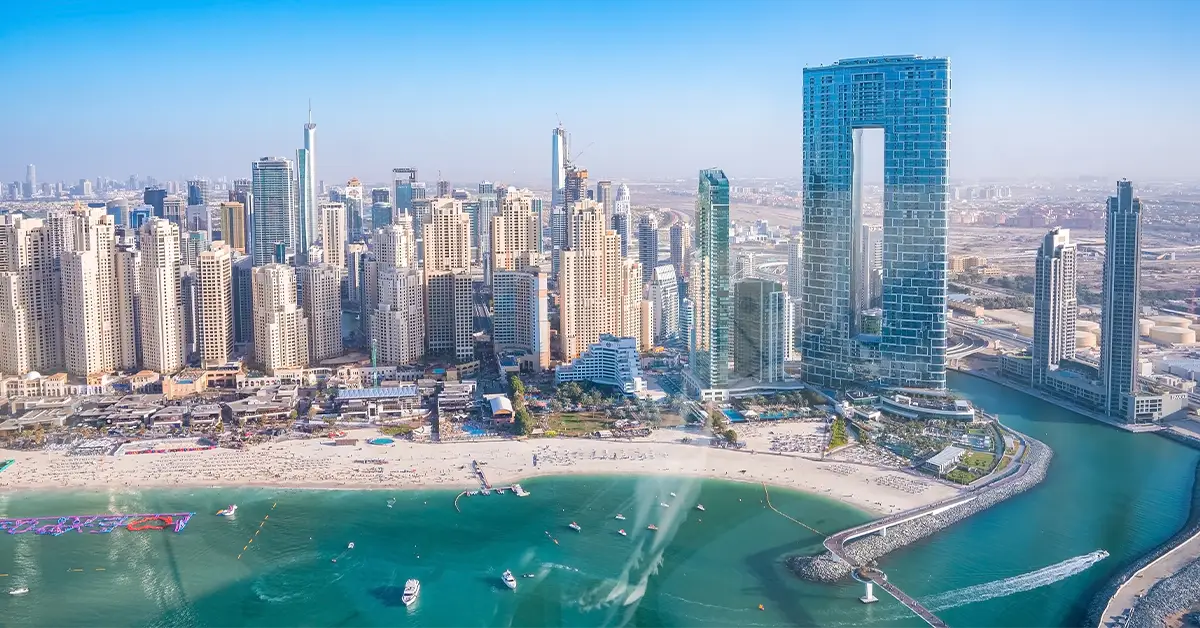
Dubai’s terrain is mainly flat sandy desert, interspersed with some large dunes in the east and south. The roughly 72 km coastline along the Persian Gulf is the foundation for the development of maritime trade and tourism. The main urban area stretches along the coast, with the major centres comprising Downtown Dubai, Dubai Marina, Jumeirah, Deira, Bur Dubai and Business Bay.
Dubai’s climate is hot desert, with two main seasons. Summer runs from May to September and is extremely hot, with daytime temperatures usually 40–48°C and high humidity in the coastal areas (70–90%) meaning the feels-like index can exceed 55°C. Winter from November to March is far more pleasant with temperatures of 18–28°C, little rain and usually clear skies — this is the peak tourist season.
Rain is very rare, averaging only 90–100 mm a year, concentrated in a few days between December and February. However, climate change has brought some unusual extreme weather events. The historic downpour of April 2024 dropped a whole year’s rainfall in a single day, causing widespread flooding and paralysing Dubai International Airport for several days.
Geopolitically, Dubai has a strategic position at the meeting point of Asia, Europe and Africa. Dubai International Airport (DXB) is the world’s busiest international airport by international passenger numbers, serving around 88.8 million passengers in 2023 and connecting more than 240 destinations worldwide through Emirates and flydubai.
The economy and the key sectors
Dubai is the UAE’s second largest economy after Abu Dhabi, accounting for around a third of national GDP. Dubai’s GDP in 2023 reached AED 429 billion (equivalent to around USD 117 billion), and in the first half of 2025 reached AED 241 billion (around USD 65.6 billion) — up 4.4% on the same period. Emirates NBD forecasts Dubai’s economy growing 4.5% in 2026, above the global average of 3.1%.
Four spearhead sectors make up Dubai’s strength. Trade and logistics is the historic pillar, with Jebel Ali Port — the largest container port in the Middle East and 10th largest in the world — together with the JAFZA free trade zone attracting more than 10,000 multinational companies. Emirates Airlines and DXB form a global air transit hub.
The financial sector is concentrated in the Dubai International Financial Centre (DIFC), a special financial district applying its own Common Law-style international commercial law separate from UAE law. The DIFC brings together more than 5,000 financial firms managing assets of over USD 500 billion, contributing around AED 39.4 billion a year to Dubai’s GDP. It is the largest financial centre in the Middle East, North Africa and South Asia (MENASA).
Tourism and hospitality play an ever more important role. Dubai received more than 17 million international visitors in 2023, expected to pass 25 million in 2025 and heading for 40 million by 2040. Tourism contributes around 11.5% of GDP with revenue of USD 44 billion. The tourist emblems comprise the Burj Khalifa (828 m — the world’s tallest building), the Burj Al Arab (the famous 7-star hotel), the Dubai Mall (the world’s largest shopping centre by area), Palm Jumeirah and the Museum of the Future.
Property is the fourth driver, attracting more than USD 15 billion in foreign direct investment each year. New projects are constantly under way: Dubai Creek Harbour, Emaar Beachfront, MBR City, Dubai Hills, Jumeirah Bay. Prices for luxury property in Dubai rose sharply over 2021–2024, although they have cooled in 2025 as supply has increased.
Free Zones — Dubai’s distinctive model
Free Zones are one of Dubai’s most important institutional inventions. Each Free Zone is an area with its own legal and tax regime, permitting 100% foreign ownership (where general UAE law previously required a UAE partner to hold 51%), partial corporate tax exemption, exemption from import duty within the zone, and unrestricted repatriation of profits.
Dubai now has more than 30 sector-specific Free Zones. The notable ones comprise: Jebel Ali Free Zone (JAFZA) for trade and logistics, DIFC for finance, Dubai Internet City for technology, Dubai Media City for media, Dubai Healthcare City for health, Dubai Airport Free Zone (DAFZA) for aviation and airport logistics, and the Dubai Multi Commodities Centre (DMCC) for commodities and financial services.
From 01/06/2023, the UAE has applied a federal corporate tax of 9% on profits above AED 375,000 a year. However, qualifying companies in Free Zones (Qualifying Free Zone Persons) still enjoy 0% tax on qualifying income. The conditions comprise: maintaining substantive activity within the Free Zone, not doing business with mainland UAE citizens or companies, and complying with the reporting and filing rules.
For individual investors, Free Zones are a popular choice for setting up international trading companies, consultancies, IT companies, e-commerce businesses or holding companies. The cost of setting up and maintaining a small Free Zone company is usually AED 15,000–35,000 a year depending on the type of licence and location. The set-up process can be completed in 5–10 working days.
The UAE Golden Visa and the residence options in Dubai
Dubai offers many residence options for foreign nationals wanting to live, work or invest. The most popular option for investors is theGolden Visa UAE— the 10-year long-term residence visa introduced in 2019 with widened conditions from 2022.
The UAE Golden Visa has several routes. The property investment route requires assets of at least AED 2 million (around USD 545,000) in the UAE. The entrepreneur route requires setting up a business with capital of at least AED 500,000 or recognition by the Chambers as a project with potential. The professional route is for doctors, scientists, technology specialists, athletes and artists recognised under specific sectoral criteria.
Besides the Golden Visa, the UAE has other categories: the ordinary Work Visa (2 years, tied to the employer), the Freelance Visa (for independent workers), the Student Visa, the Retirement Visa (requiring age 55 and over with minimum financial resources or pension income of AED 20,000 a month), and the Green Visa (5 years for skilled workers and professional freelancers). Each has its own process and requirements depending on the purpose of migration.
A common feature of UAE visas is that they require no English or Arabic, being assessed mainly on finances, qualifications, employment or investment. All residents holding a visa can access private healthcare in Dubai with a compulsory insurance package. Dubai also makes it easy for visa residents to open bank accounts, own property and do business.
Living costs and quality of life
Dubai has a high cost of living but is far more competitive than London, New York, Singapore or Hong Kong. A single person on a comfortable budget needs around AED 8,000–12,000 a month (USD 2,180–3,270); a family of 4 needs AED 20,000–35,000 a month (USD 5,450–9,540) depending on lifestyle and area.
Rent is the largest expense. A 1-bedroom apartment in Dubai Marina or Downtown is around AED 6,000–10,000 a month; a 2-bedroom AED 9,000–15,000 a month; a 3–4 bedroom villa in Arabian Ranches or Dubai Hills around AED 20,000–40,000 a month. Areas further from the centre such as Dubai Silicon Oasis and Jumeirah Village Circle are 30–50% cheaper.
Dubai has high-quality private healthcare and education. International school fees are around AED 30,000–90,000 a year per pupil depending on the stage and the school. The well-known schools comprise GEMS, Dubai International Academy, British International School, American School of Dubai, and the French and German international schools. Most schools offer British (IGCSE, A-Level), American (High School Diploma, AP), IB or Indian (CBSE, ICSE) curricula.
Dubai’s particular strengths are security and its multicultural policy. The city has a very low crime rate compared with cities of similar size. The naturally multicultural environment, with communities from more than 200 nationalities, creates a welcoming space for foreign nationals. The absence of personal income tax is one of the greatest financial benefits, applying to all residents.
What it means for Vietnamese investors and settlers
For Vietnamese people, Dubai offers several particular opportunities. First, its geographical position at the meeting point of Asia, Europe and Africa makes the city an ideal hub for international traders, particularly for import and export between Vietnam and the Middle Eastern, African and South Asian markets.
Second, Dubai is one of the settlement options requiring no second language — unlike Europe, North America, Australia and New Zealand. This suits Vietnamese investors and professionals who do not have English or a Western language at a high level. The working environment mostly uses basic English, with no requirement for IELTS or a formal language certificate.
Third, Dubai property is an attractive investment channel with rental yields of 6–9% a year — considerably higher than the European capitals (3–5%). Combined with the UAE Golden Visa, investors can generate passive income while holding renewable 10-year long-term residence rights. This is important leverage for a strategy of international asset diversification.
However, several points should be noted. Dubai has no route to naturalisation for foreign nationals (apart from special cases granted by the Sheikh). So even with a 10-year Golden Visa, settlers do not become UAE citizens. The desert climate with its harsh summer is a challenge for many, particularly families with young children or older people. UAE law, though open, still carries cultural and religious differences to respect (dress in public, public behaviour, the rules during Ramadan).
Conclusion
Dubai is the most modern global city in the Middle East, having transformed successfully from a fishing village into a world-class business, financial, tourism and property centre in little more than 50 years. With a population of 4 million (92% foreign nationals), GDP of nearly USD 180 billion, more than 30 Free Zones, and a flexible visa system led by the 10-year UAE Golden Visa, Dubai offers a particularly attractive environment in which to live, work and invest.
For Vietnamese people, Dubai is an option worth weighing in a strategy of international asset diversification and long-term residence — particularly for international traders, technology professionals, buy-to-let property investors and those seeking an environment with no personal income tax. Understanding the Free Zone system, the property ownership laws, the residence visa categories and the true cost of living is an important foundation before deciding to move to Dubai.
Accompanying you on your journey in residency investment
The Prosperous Living Investment team advises on pathways, assesses profiles and manages investments transparently for every residency, citizenship and international property objective.
Free profile assessmentWhere life gets prosperous