
Studying in Prince Edward Island is a popular choice for international students who set their sights on Canada. It is a place where international students can secure work after graduation and follow a promising immigration pathway.
Canada’s smallest province offers some very substantial higher education opportunities, particularly in the trades and the sciences.
Prince Edward Island (PEI) lies on the coast of Eastern Canada and is known for its beautiful shoreline and relaxed way of life. About half of the island’s population lives in the capital, Charlottetown – also the home of the province’s only university.
The number of international students in Prince Edward Island tripled between 2005 and 2015.
Overview
- Population: 184,596 (updated 18/11/2025)
- International students: 5,355 (2023 data from ICEF Monitor)
- Main places of study: Charlottetown
Considering a residency programme? Prosperous Living Investment's advisers carry out a profile assessment and recommend a pathway that suits your family's goals.
Book a profile assessmentAdvantages of studying in Prince Edward Island
- Lower tuition fees:The University of Prince Edward Island has relatively low tuition fees in Canada.
- Credit transfer between institutions:The University of Prince Edward Island follows the Pan-Canadian Protocol on the Transferability of University Credits, under which all credits completed by transferring students during their first 2 years of university study in Canada (including the final year of programmes leading to a college diploma in Quebec, and university transfer courses offered by community colleges and university colleges in British Columbia and Alberta) are fully recognised towards a degree.
- Outstanding natural beauty:Rolling hills, woodlands, sandy beaches, bays and the famous red soil have given Prince Edward Island its well-deserved reputation as a province of outstanding natural beauty.
Immigrating after studying in Prince Edward Island
- Prince Edward Island Provincial Nominee Program: Through the PEI PNP, international graduates of designated learning institutions in PEI can obtain Canadian permanent resident status. The PEI PNP Labour Market category includes an employer-driven International Graduate Stream, giving businesses in Prince Edward Island the opportunity to hire recent graduates of recognised universities or colleges in the province.
- Atlantic International Graduate Program (AIGP): The Atlantic International Graduate Program (AIGP) allows international students graduating from eligible institutions in Atlantic Canada to apply for permanent residence without prior work experience. The AIGP forms part of theAtlantic Immigration Program (AIP), a new Canadian immigration initiative that began in 2017 and has continued since.
- Express Entry: Candidates immigrating to Canada through the federalComprehensive Ranking System (CRS)federal system who have completed their studies at a school in Prince Edward Island may be awarded a significant number of additional points for their higher level of education. Moreover, international students graduating from Canadian institutions may already have Canadian work experience, a factor highly valued in the Express Entry system.
Schools in Prince Edward Island
These institutions are featured for their size, their proximity to urban centres, and their tradition of recruiting international students into their student body.
University of Prince Edward Island
- Website: https://www.upei.ca/
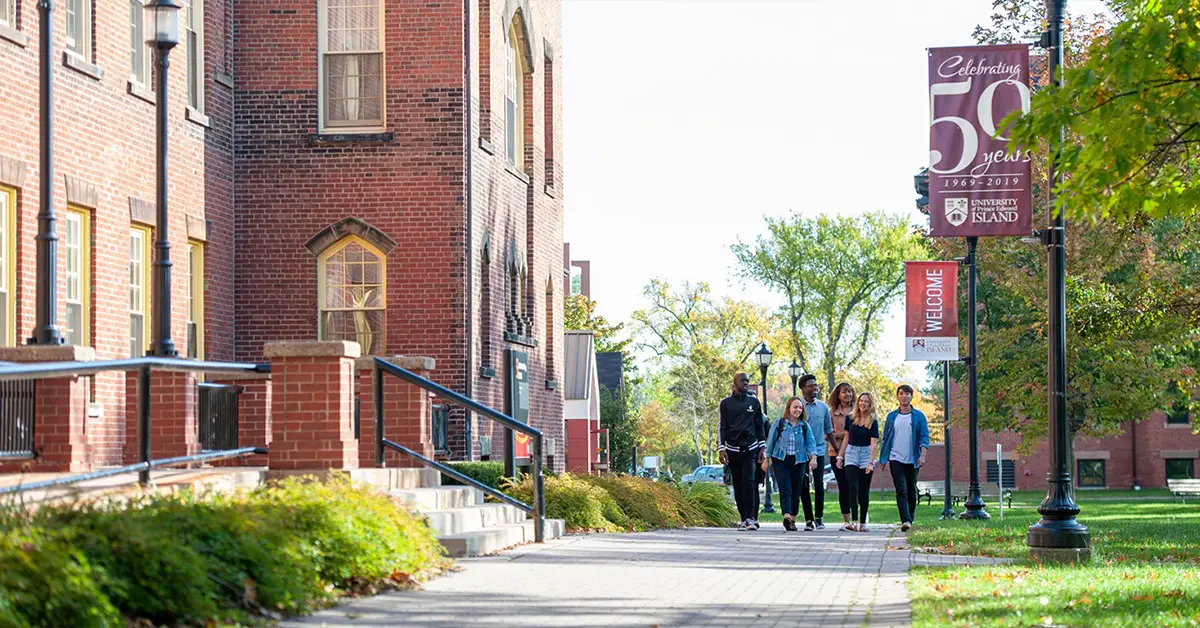
- UPEI – a university on Prince Edward Island – takes a comprehensive approach to higher education. Its postgraduate programmes are also well developed and strongly funded. UPEI is increasingly known for its many successful internationalisation initiatives.
- Featured programmes: Education, Nutritional Sciences, Veterinary Medicine, Computer Science
- Location: Charlottetown
Saint Mary’s University
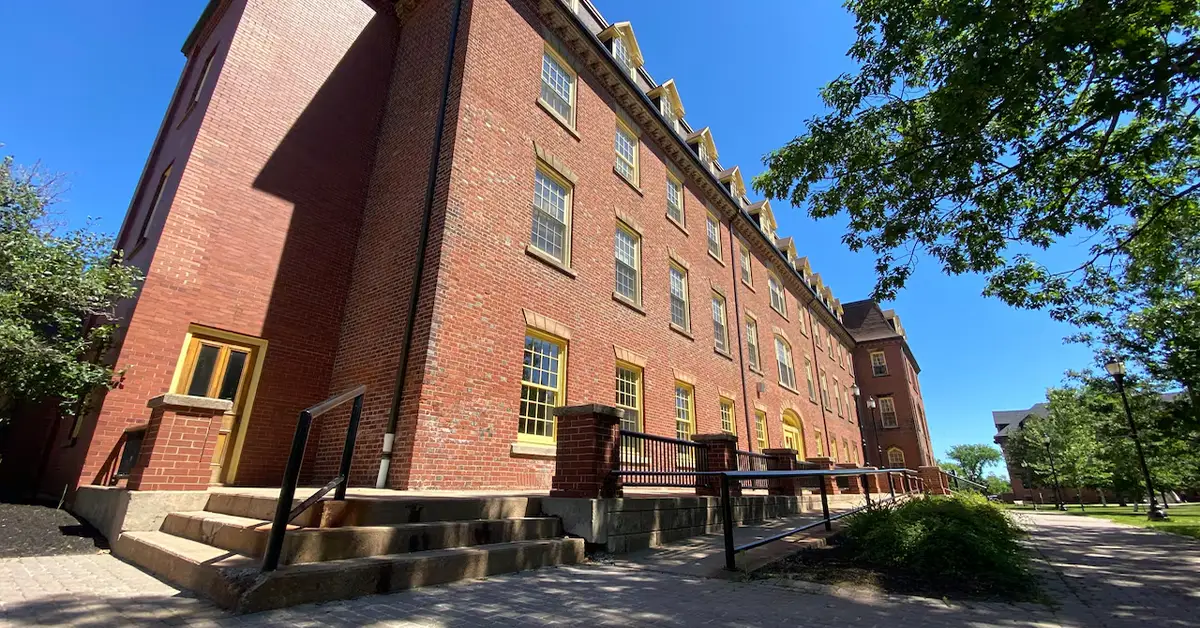
- Website: https://www.hollandcollege.com/
- Holland College is renowned for its excellence in the trades, and is particularly noted for the Culinary Institute of Canada and its internationally recognised Marine Training Centre. Both bring the college considerable prestige and attract learners from within Canada and abroad.
- Featured programmes: Culinary Institute of Canada, Marine Training Centre, Applied Science and Engineering Technology, Business, School of Performing Arts
- Location: Charlottetown

Frequently asked questions (FAQ) about studying in Prince Edward Island
1. How does a prospective international student apply to study in Prince Edward Island?
To apply for a CanadianStudy Permit, a prospective international student must first receive aLetter of Acceptance (LOA)from aDesignated Learning Institution in Canada (DLI). As each institution may have different admission requirements and application procedures, interested applicants may contact their chosen institution directly.
2. What are the top universities in Prince Edward Island?
PEI has only one university — the University of Prince Edward Island, also known as UPEI. Even so, it covers every field, with faculties of Arts, Science, Education and Veterinary Medicine, along with separate schools of Business and Nursing. It serves mainly undergraduate students, although it also has successful postgraduate programmes.
UPEI places particular emphasis on student success: all first-year Bachelor’s students must take foundation courses to prepare them for academic life. Students may choose between Writing Studies, Inquiry Studies and University Studies.
Featured programmes: Education, Nutritional Sciences, Veterinary Medicine, Computer Science, Education
3. What are the top colleges in Prince Edward Island?
- Holland College is an English-language post-secondary college on the island. Since its founding in 1969, the college has built a strong reputation for its vocational programmes. It operates 11 campuses and learning centres, among them such well-known facilities as the Canadian Culinary Institute and the Marine Training Institute.
- Flagship programmes: Canadian Culinary Institute, Marine Training Centre, Applied Science and Engineering Technology, Business, School of Performing Arts
- Collège de l’Île (formerly Collège Acadie Î.P-É.) is a French-language college established in 1994. Its main campus is in Wellington, PEI, with satellite centres in both DeBlois and Charlottetown. To serve students better, the college maintains partnerships with Holland College and the University of Prince Edward Island. Students benefit from a low teacher-to-student ratio and career-focused programmes.
- Flagship programmes: Practical Nursing, Youth Work, Welding, Early Childhood Education.
4. Which fields of study are particularly popular in Prince Edward Island?
- The Marine Training Institute and the Canadian Culinary Institute at Holland College attract students who wish to study marine management and hospitality trades.
- Beyond the programmes listed above, PEI’s educational institutions offer a wide range of other courses.
5. How much is tuition for international students in Prince Edward Island?
- Tuition for international students in PEI varies considerably between colleges and universities, as well as between individual programmes. Fees at language schools and for postgraduate study can differ substantially.
- At the University of Prince Edward Island, international students can expect to pay between $10,000 CAD and $65,000 CAD per year, depending on the programme. Tuition fees may be updated or revised annually.
- At Holland College, international students can expect to pay between $6,701 CAD and $22,040 CAD per year, depending on the programme. Tuition fees may be updated or revised annually.
- At Collège de l’Île (formerly Collège Acadie Î.P-É.), international students can expect to pay between $6,000 CAD and $7,750 CAD per year, depending on the programme. Tuition fees may be updated or revised annually.
6. What healthcare and insurance options are available in Prince Edward Island?
International students studying in Canada are required to hold health insurance. This is normally arranged through the university or college itself. The University of Prince Edward Island, Holland College and Collège de l’Île (formerly Collège Acadie Î.P-É.) all offer student health insurance plans.
7. What is the average monthly cost of living for a student in Prince Edward Island?
To obtain a study permit, prospective international students must demonstrate that they have at least $10,000 CAD (in addition to tuition) to cover living costs in PEI. That figure works out at $833 CAD per month.
The table below sets out estimated living costs in PEI. Residence and meal-plan prices at the University of Prince Edward Island and Holland College are also listed. Collège de l’Île (formerly Collège Acadie Î.P-É.) does not provide student residences.
| Item | Per month (estimate) | Per year (estimate) |
|---|---|---|
| Housing (living independently, off campus) | 600 CAD | 7.200 CAD |
| Suite room in UPEI residence (meal plan included) | 4,407 – 5,443 CAD per semester | 8,814 – 10,886 CAD per year (2 semesters) |
| Room in Holland College residence | 638 – 887 CAD | 5,108 – 7,102 CAD (September to April) |
| Food (self-catering) | 250 CAD | 3.000 CAD |
| UPEI meal plan | 2,104 – 2,186 CAD per semester (about 3 months) | 4,208 – 4,372 CAD per year (2 semesters) |
| Clothing and sundry expenses | 150 CAD | 1.800 CAD |
| Entertainment and leisure | 150 CAD | 1.800 CAD |
| Transport (prices in Charlottetown) | 40 CAD | 480 CAD |
| Phone bill | 60 CAD | 720 CAD |
| Internet | 50 CAD | 600 CAD |
| Utilities | 100 CAD | 1.200 CAD |
| Total living costs (excluding the institution-specific costs listed above) | 1.400 CAD | 16.800 CAD |
8. What financial support options are available in Prince Edward Island?
International students in PEI can access private loans on the same terms as Canadian citizens and permanent residents. Loans may be offered by banks, student organisations or other bodies. It is essential to research the loan options carefully and to understand the interest rates and repayment plans before signing any agreement.
Many organisations and educational institutions offer scholarships or bursaries to international students studying in PEI. For further information, students are encouraged to contact the international student services department at their own institution.
Postgraduate programmes in particular often carry a range of financial support options for students pursuing a Master’s or Doctoral degree. Contacting the institution directly is necessary for detailed information.
9. Which colleges and universities in Prince Edward Island offer engineering programmes?
- Holland College offers a range of Engineering Technology programmes, along with trades and technology programmes related to engineering.
- The University of Prince Edward Island does not have a faculty of engineering, but it recently opened the School of Sustainable Design Engineering.
10. Which colleges and universities in Prince Edward Island offer computer technology programmes?
- Holland College has a dedicated Computer Studies department offering numerous programmes in information systems and network technology.
- The University of Prince Edward Island offers a Bachelor of Computer Science through its Faculty of Science.
11. Which colleges and universities in Prince Edward Island offer nursing programmes?
As a popular course of study across Canada, Nursing and related health programmes can be taken at all three of PEI’s public post-secondary institutions:
- The University of Prince Edward Island offers Bachelor’s and Master’s degrees in Nursing. Collège de l’Île (formerly Collège Acadie Î.P-É.) and Holland College both run Practical Nursing courses.
- Holland College additionally offers eight health-related programmes, including Paramedicine and Dental Assisting.
12. Where in Prince Edward Island can STEM qualifications be obtained?
STEM stands for Science, Technology, Engineering, and Mathematics.
Although careers in STEM fields are highly sought after, there is at present no programme named “STEM” at any college or university in PEI.
Prospective students are encouraged to look into the specific programmes that match their field of interest.
13. What are the employment prospects for international students after graduating in Prince Edward Island?
Job prospects for young people in PEI are very promising, as the province is working to attract more young workers to the region.
Health Care and Social Assistance is a major employing sector in the province, while employment in Information, Culture and Recreation as well as in Agriculture is growing strongly.
14. How can international graduates work in Prince Edward Island?
Graduates of a Designated Learning Institution (DLI) in Prince Edward Island may apply forPost-Graduation Work Permit (PGWP)after graduating from an eligible programme of study.
15. Does studying in Prince Edward Island offer international students a route to permanent immigration to Canada?
The International Graduate stream within thePEI PNP Labour Impactcategory of thePrince Edward Island Provincial Nominee Program (PEI PNP)is an employer-driven stream that allows businesses in PEI to recruit recent graduates from recognised universities and colleges in the province.
International graduates of an eligible post-secondary institution in PEI may apply if they have been hired by a PEI employer into a skilled position that matches their field of study.
International graduates may also pursue permanent residence through the federalExpress Entrysystem. Candidates for Canadian immigration who have completed a programme at a PEI institution earn additional points for their higher level of education. Furthermore, international graduates of Canadian institutions may have accumulated significant Canadian work experience – a factor rated very highly in the Express Entry system.
16. What is the climate like in Prince Edward Island?
PEI is a small island whose climate is strongly influenced by the surrounding sea. The weather can change quickly from one day to the next. Temperatures are milder than in other parts of Canada, averaging around -5°C in winter and 20°C in summer. Summer and autumn remain pleasantly warm because the surrounding ocean holds off the frost until winter arrives.
17. What are the advantages of studying in Prince Edward Island?
- PEI has relatively low international student tuition fees in Canada. For anyone seeking a friendly, close-knit learning environment with a small-town atmosphere, PEI may be a good choice.
- Its rolling hills, woodlands, white sand beaches, coastal bays and, above all, its famous red soil have earned Prince Edward Island a well-deserved reputation as a province of outstanding natural beauty.
- The University of Prince Edward Island adheres to the Pan-Canadian Protocol on the Transferability of University Credits, under which all credits completed by transferring students during their first two years of university study in Canada (including the final year of programmes leading to a college diploma in Quebec and the university transfer courses offered by community colleges and university colleges in British Columbia and Alberta) are fully recognised towards a degree.
18. What are the major cities and towns in Prince Edward Island?
- Charlottetown, the provincial capital, has a population of roughly 35,000. The University of Prince Edward Island and several Holland College campuses are located in Charlottetown.
- The province’s second-largest city is Summerside, the main urban centre in the west of the island. Four Holland College campuses are based here.
Related topics