
Saint Lucia

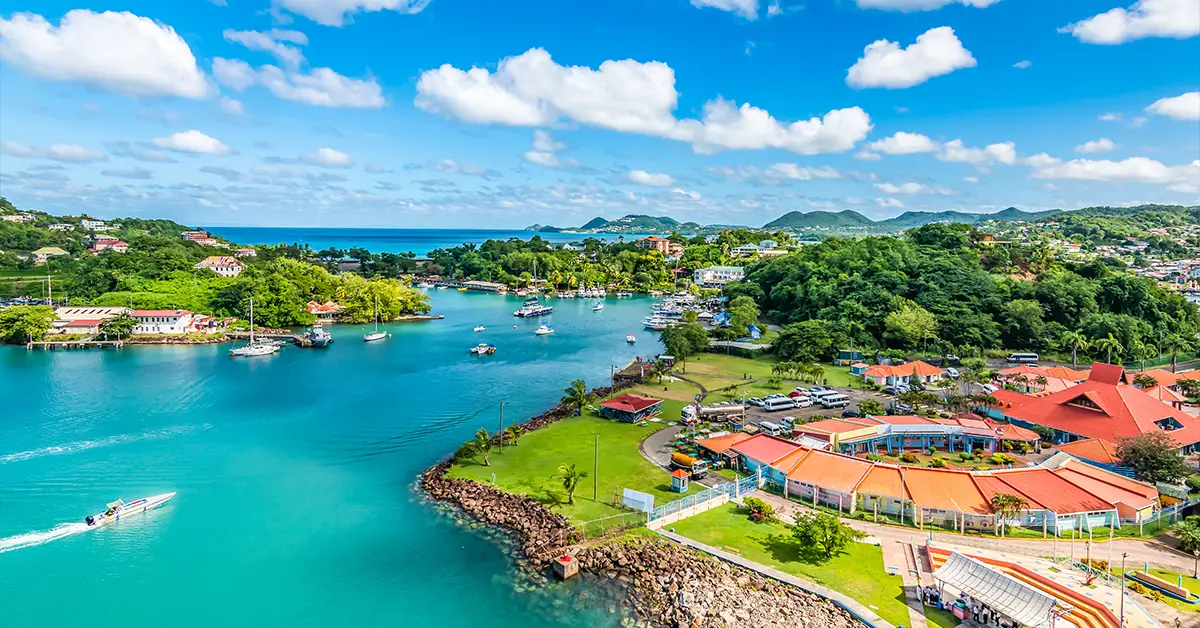
Saint Lucia is a tropical island nation in the eastern Caribbean, part of the Windward Islands of the Lesser Antilles. With an area of only 616 km² and a population of around 180,000, Saint Lucia is one of the world’s smallest countries, but has the highest number of Nobel Laureates per capita in the world and one of the most reputable citizenship-by-investment programmes in the Caribbean.
This article gives an overview of Saint Lucia across 8 basic aspects: history, geography, politics, the economy, demographics, education, culture and international relations. This is foundational information for anyone interested in the country, particularly Vietnamese investors considering theSaint Lucia citizenship by investment (CBI)programme for a second passport.
Message
Basic information
| Item | Information |
|---|---|
| Official name | Saint Lucia |
| Capital | Castries |
| Area | 616 km² |
| Population | around 180,000 |
| Official language | English |
| Common language | Saint Lucian Creole (Kwéyòl) |
| Currency | The East Caribbean dollar (XCD) |
| Time zone | UTC-4 |
| Telephone code | +1 758 |
| System of government | Constitutional monarchy, parliamentary democracy |
| Head of state | King Charles III (represented by the Governor-General) |
| Prime Minister | Philip J. Pierre |
| Independence day | 22 February 1979 |
| Membership | The Commonwealth, CARICOM, the OECS, the United Nations |
| Government website | https://www.govt.lc/ |
Considering a residency programme? The Prosperous Living Investment team assesses your profile free of charge and advises on the pathway that fits your goals.
History
Saint Lucia’s history stretches back more than 2,000 years, from the presence of Caribbean Indigenous peoples through a long colonial period and finally to independence in 1979.
The island’s first inhabitants were the Arawak, who came from mainland South America around 200 AD. Around 800, the Kalinago (also known as Carib) displaced the Arawak and became the dominant Indigenous community until Europeans arrived.
Shipwrecked French sailors set foot on the island on 13/12/1502, the feast day of Saint Lucy of Syracuse, and named the island after this saint. Saint Lucia is therefore the only country in the world named after a woman. The French and British contested the island continuously for more than 150 years, with Saint Lucia changing hands 14 times – the most of any Caribbean island, earning it the name “Helen of the West Indies”.
In 1814, the Treaty of Paris formally recognised Saint Lucia as belonging to Britain. The sugar plantation economy grew strongly with labour provided by Africans brought there through the slave trade. After slavery was abolished in 1834, many indentured labourers from India were brought to work on the plantations.
Saint Lucia gained independence from the United Kingdom on 22/02/1979, under the leadership of Prime Minister John Compton. The country chose a constitutional monarchy model, keeping its links with the Commonwealth and recognising the British monarch as head of state.
Geography
Saint Lucia lies at around 13°53′ North and 60°58′ West, in the eastern Caribbean. The island is around 43 km long and up to around 23 km wide, 39 km south of Martinique (France) and 34 km north-east of Saint Vincent.
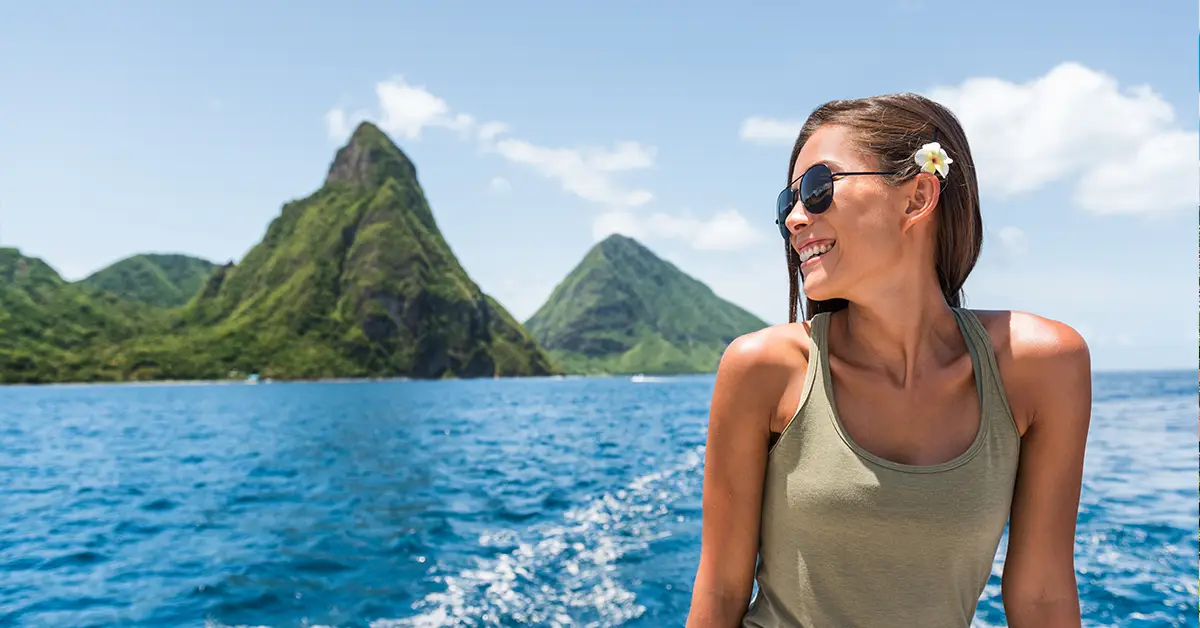
Saint Lucia’s terrain is mainly volcanic and mountainous, interspersed with fertile valleys. The island’s highest point is Mount Gimie at 950 metres. The most famous geographical emblem is the pair of volcanic peaks Gros Piton (798 metres) and Petit Piton (743 metres), two conical peaks rising sheer from the sea on the island’s south-west coast. The Pitons area was designated a UNESCO World Heritage Site in 2004.
Saint Lucia is also home to La Soufrière – one of the only volcanoes in the world where visitors can drive directly into the crater to see the hot springs and geothermal activity. The island also has many mineral springs, rainforest and a variety of black and white sand beaches.
Saint Lucia’s climate is tropical maritime, moderated by the north-easterly trade winds. Average temperatures range from 21°C to 31°C year round. The dry season runs from January to April, the wet season from May to August. Average annual rainfall ranges from 1,500 mm on the coast to 3,500 mm in the inland mountains. Saint Lucia lies in the tropical hurricane belt, with a hurricane season from June to November.
Politics
Saint Lucia is a constitutional monarchy and parliamentary democracy, inheriting the British Westminster model. The head of state is King Charles III of the United Kingdom, represented in Saint Lucia by a Governor-General appointed by the King on the Prime Minister’s recommendation.
The Parliament of Saint Lucia has two chambers: the House of Assembly with 17 directly elected members serving 5-year terms, and the Senate with 11 appointed members. The executive is headed by the Prime Minister, usually the leader of the party holding a majority in the House of Assembly. The incumbent Prime Minister is Philip J. Pierre of the Saint Lucia Labour Party (SLP), in office since 2021.
The two dominant political parties are the Saint Lucia Labour Party (SLP) and the United Workers Party (UWP). The legal system is based on English common law, with the Eastern Caribbean Supreme Court having jurisdiction across the whole OECS region.
Administratively, Saint Lucia is divided into 10 districts: Anse-la-Raye, Castries, Choiseul, Dennery, Gros Islet, Laborie, Micoud, Soufrière, Vieux Fort and Canaries.
Economy
Saint Lucia’s economy is small but relatively diverse compared with other Caribbean island nations. Saint Lucia’s GDP in 2024 was estimated at around USD 2.5 billion, equivalent to around USD 13,000 per capita at purchasing power parity (PPP). According toCIA World Factbook, Saint Lucia’s economy depends on three main pillars: tourism, agriculture and financial services.
Tourism
Tourism contributes around 65% of GDP and is the largest source of foreign currency. The famous destinations are the Pitons, Rodney Bay beach, the Soufrière area with its hot springs and the cruise tourism industry calling at the port of Castries. Saint Lucia welcomes around 1.2 million visitors a year, mainly from the United States, the United Kingdom and Canada.
Agriculture
Bananas were Saint Lucia’s main export in the 20th century, accounting for more than 40% of export earnings. However, after the EU adjusted its trade policy in the early 2000s, the banana industry declined sharply. Today, alongside bananas, Saint Lucia also exports coconuts, cocoa, tropical fruit and vegetables. Agriculture contributes around 3% of GDP and employs around 15% of the workforce.
Financial services and citizenship by investment
Saint Lucia has developed an international financial services industry, including offshore banking, insurance and investment funds. One important new source of revenue is the Citizenship by Investment (CBI) programme, established in 2015. According toCitizenship by Investment Unit Saint Lucia, the programme offers four main investment routes:
- A contribution to the National Economic Fund (NEF) from USD 240,000 for the main applicant and up to 3 dependants
- Investment in approved property from USD 300,000
- Investment in an approved enterprise from USD 3,500,000
- Purchase of government bonds from USD 300,000 (refunded after 5 years, interest-free)
The programme requires applicants to be 18 or over, have a clean police record, pass the vetting process and demonstrate the lawful origin of their funds. Average processing time is 6–10 months. There is no residence requirement, no language test and no requirement to visit the island.
Currency and trade
Saint Lucia uses the East Caribbean dollar (XCD), issued by the Eastern Caribbean Central Bank (ECCB) and pegged to the USD at a fixed rate of USD 1 = XCD 2.7. Saint Lucia’s main trading partners are the United States, the United Kingdom, the CARICOM countries and the European Union.
Demographics
Saint Lucia’s population was around 180,000 on 2024 estimates, distributed mainly along the coast because of the mountainous interior. Around half the population lives in the capital Castries and its surroundings. Other important population centres are Vieux Fort in the south and Soufrière on the south-west coast.
On ethnic composition, more than 85% of the population is of African descent – the legacy of the sugar plantation era. Around 10% are of mixed heritage, mainly African-European-Carib. The Indian-descended community (around 2%) are the descendants of indentured labourers who came to the island in the 19th century. Communities of European, Syrian and Chinese descent account for a very small proportion.
The official language is English, used in education, administration, media and commerce. However, the everyday language of most of the population is Saint Lucian Creole (Kwéyòl) – a French-based Creole, reflecting the long French colonial legacy. This is a distinctive feature of Saint Lucia: a country whose official language is English but whose people use a French-based Creole in daily life.
On religion, more than 90% of the population is Roman Catholic, reflecting the long-standing influence of French culture. The remainder follow Protestant denominations, Islam, Hinduism or no religion.
Life expectancy in Saint Lucia in 2021 was 71.1 years. Literacy is around 90%. Population growth is around 0.3% a year, partly because of the high rate of emigration.
Education
Saint Lucia’s education system follows the British model, comprising three levels: primary, secondary and university/college. Education is compulsory from ages 5 to 15 and free at state schools. Public spending on education accounts for around 4% of GDP.
At secondary level, the best-known school is St. Mary’s College – the school attended by both of Saint Lucia’s Nobel Laureates (Sir Arthur Lewis and Sir Derek Walcott). After finishing secondary school, students sit the CSEC and CAPE examinations run by the Caribbean Examinations Council.
At tertiary level, Sir Arthur Lewis Community College in Castries is the largest higher education institution in the country, offering college programmes and links with regional universities. Many Saint Lucian students study at the University of the West Indies (UWI) – a regional university with campuses in Jamaica, Trinidad and Tobago, Barbados and the Bahamas.
Culture
Saint Lucian culture is a distinctive blend of African, French, British and Caribbean heritage. It is this intermingling that creates a cultural identity hard to find elsewhere.
Hai Nobel Laureate
This is the most striking feature of Saint Lucian culture. An island of only 180,000 people is the birthplace of two Nobel Laureates, putting Saint Lucia in first place for Nobel Laureates per capita in the world.
- Sir Arthur Lewis (1915–1991): awarded the Nobel Prize in Economics in 1979 – the same year Saint Lucia gained independence – for his foundational contributions to development economics, particularly his model of the shift of labour from agriculture to industry in developing countries. His theory profoundly influenced small island states such as Singapore.
- Sir Derek Walcott (1930–2017): awarded the Nobel Prize in Literature in 1992 for his poetry and drama reflecting Caribbean identity. His best-known work is the epic poem Omeros – a Homeric epic telling of the lives of Saint Lucian fishermen.
Notably, both were born on 23/01 and both studied at St. Mary’s College. Each year on 23/01, Saint Lucia holds Nobel Laureate Week to honour these two outstanding figures.
Festivals and music
Saint Lucia has many festivals with a strong Caribbean identity:
- Saint Lucia Jazz & Arts Festival: a jazz and arts festival held in May, attracting international artists
- Saint Lucia Carnival: a lively carnival held in July, with vibrant costume parades and soca and calypso music
- Creole Heritage Month: each October celebrates Creole heritage, culminating in Jounen Kwéyòl – the national Creole-speaking day
- The Feast of La Rose and La Marguerite: two distinctive Saint Lucian traditional festivals, with “flower societies” competing in music, dance and fashion
Food
Saint Lucia’s national dish is green fig and saltfish – boiled green bananas served with salted fish. Saint Lucian cuisine is also notable for Indian-influenced curries, French-influenced stews, tropical vegetables, fresh seafood and local rum. Other specialities include bouyon (a mixed soup), accra (fried fish cakes) and lambi (curried conch).
International relations
Although a small country, Saint Lucia plays an active role in international and regional organisations. The country has been a member of the United Nations since 1979 (the year of independence), and is also a member of the Commonwealth, CARICOM (the Caribbean Community), the OECS (the Organisation of Eastern Caribbean States) and the Organization of American States (OAS).
Saint Lucia has diplomatic relations with most Western countries, particularly the United Kingdom, the United States, Canada and the EU countries. The capital Castries hosts the diplomatic missions of many countries, while Saint Lucia also has embassies and high commissions in London, Washington DC, Ottawa and other major capitals.
On relations with China and Taiwan, Saint Lucia is one of the few countries recognising the Republic of China (Taiwan) rather than the People’s Republic of China, giving it a distinctive diplomatic relationship with Taipei.
The Saint Lucia passport ranks highly in the world for freedom of movement, allowing citizens visa-free entry or visa on arrival in more than 145 countries and territories, including the whole Schengen bloc, the United Kingdom, Singapore and Hong Kong.
Conclusion
Saint Lucia is a small Caribbean island nation but has many notable features: the highest number of Nobel Laureates per capita in the world, the Pitons landscape designated a UNESCO World Heritage Site, a distinctive blend of British, French and African culture, and one of the most reputable citizenship-by-investment programmes in the Caribbean. The island also has stable politics, a legal system based on the British model and an extensive network of international relations.
For Vietnamese investors, Saint Lucia is a choice worth considering for a second passport with a minimum investment from USD 240,000, fast processing, no residence requirement and a passport giving visa-free access to more than 145 countries. The programme also allows a spouse, children, parents and in some cases siblings to be included in the application.
Accompanying you on your journey in residency investment
The Prosperous Living Investment team advises on pathways, assesses profiles and manages investments transparently for every residency, citizenship and international property objective.
Free profile assessmentWhere life gets prosperous