

Study in Newfoundland and Labrador – Canada


Studying in Newfoundland and Labrador is one of the leading choices for international students who set their sights on Canada. It is a place where international students can secure work after graduation and follow a promising immigration pathway.
More and more international students are choosing to study in Newfoundland to build their careers. Study in Newfoundland (also known as “The Rock”) focuses largely on courses tied to the local economy, which benefits individuals aiming for careers in the trades, maritime industries and natural resources. Higher education in Newfoundland is concentrated mainly in the beautiful city of St. John’s.
Message
Overview
- Population: 545,884 (updated 02/06/2025)
- International students: 7,430 (2023 data from ICEF Monitor)
- Main places of study: St. John’s, Stephenville
Considering a residency programme? The Prosperous Living Investment team assesses your profile free of charge and advises on the pathway that fits your goals.
Advantages of studying in Newfoundland and Labrador
- A bridge into the local economy: Students studying at undergraduate or postgraduate level in Newfoundland can build themselves a launch pad into some of the province’s most sought-after and well-paid occupations, in a province that has seen an energy and resources boom since the turn of the century.
- Low tuition fees: More than a decade ago, the political leaders of Newfoundland and Labrador chose to go against the national trend of cutting university funding by reducing tuition fees and then freezing them. Government funding accounts for roughly 85% of the budget of the province’s only university, Memorial University, with the remainder coming from tuition fees. This is a major draw bringing people to the province to study, not only from other Canadian provinces but from overseas.
- Experiencing life on “The Rock”: Newfoundland has a distinctive culture and a proud history. Local people, often called “Newfies”, are known for the exceptional welcome they extend to newcomers to their province. In Newfoundland you can find peace, calm and opportunity.
Immigrating after studying in Newfoundland and Labrador
- Newfoundland and Labrador Provincial Nominee Program (NLPNP)International Graduate stream:The Government of Newfoundland and Labrador is seeking to welcome the brightest and most talented people to the province. The Newfoundland and Labrador Provincial Nominee Program (NLPNP) therefore includes an International Graduate stream, through which international students who graduate from a recognised post-secondary institution in Canada may be considered for nomination for permanent residence in Canada.
- Atlantic International Graduate Program (AIGP): The Atlantic International Graduate Program (AIGP) allows international students graduating from eligible institutions in Atlantic Canada to apply for permanent residence without prior work experience. The AIGP forms part of theAtlantic Immigration Program (AIP), a new Canadian immigration initiative that began in 2017 and has continued since.
- Express Entry: Candidates immigrating to Canada through the federalComprehensive Ranking System (CRS)who have completed their studies at a school in Newfoundland and Labrador may be awarded a significant number of additional points for their higher level of education. Moreover, international students graduating from Canadian institutions may already have Canadian work experience, a factor highly valued in the Express Entry system.
Schools in Newfoundland and Labrador
These institutions are featured for their size, their proximity to urban centres, and their tradition of recruiting international students into their student body.
Memorial University of Newfoundland
- Website: https://www.cna.nl.ca/
- Memorial University of Newfoundland is one of Canada’s leading comprehensive universities. With a wide range of academic programmes and more than 18,000 students, it is also the largest university in Atlantic Canada.
- Featured programmes: Maritime Studies, Maritime Management, Engineering, Physics and Physical Oceanography, Business Administration
- Location: St. John’s (with an additional campus in Corner Brook)
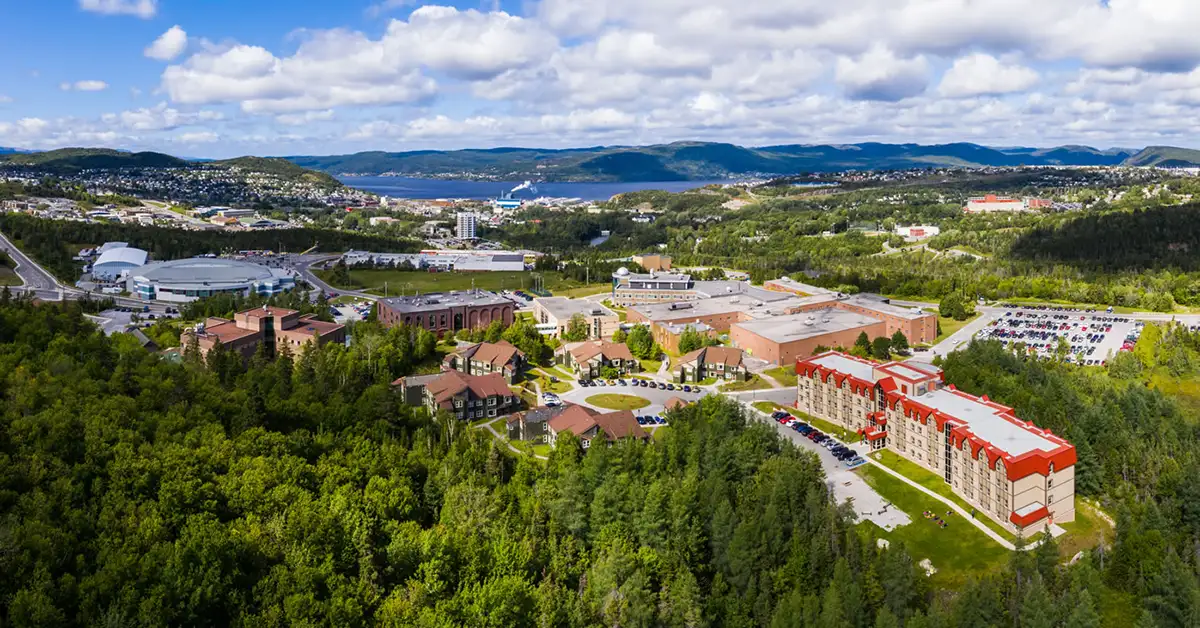
College of the North Atlantic
- Website: https://www.mun.ca/
- Graduates of CNA have higher employment rates in well-paid jobs specific to their field of study than graduates of other post-secondary institutions in the region. It also has the lowest tuition fees of any post-secondary school in Atlantic Canada.
- Featured programmes: Academics, Applied Arts, Business Studies, Health Sciences, Engineering Technology, Industrial Trades, Information Technology, Tourism, Natural Resources
- Location: Stephenville

Frequently asked questions (FAQ) about studying in Newfoundland and Labrador
To apply for a CanadianStudy Permit, a prospective international student must first receive aLetter of Acceptance (LOA)from aDesignated Learning Institution in Canada (DLI). As each institution may have different admission requirements and application procedures, interested applicants may contact their chosen institution directly.
- Memorial University of Newfoundland: The province’s only university, commonly known as MUN. It has a well-known tradition of learning by doing. As it sits on the edge of the North Atlantic, that often means training and research in cold oceans and other harsh environments. More than 18,500 full-time and part-time students study at Memorial at both undergraduate and postgraduate level, across 4 campuses including one in Essex, England. Memorial has more than 2,200 academic and support staff and offers over 100 degree programmes through six faculties and six schools.
- Featured programmes: Maritime Studies, Maritime Management, Engineering, Business Administration
- College of the North Atlantic (CNA): The province’s largest publicly funded college. With more than 17 campuses across the province — and one in the Gulf state of Qatar — the College of the North Atlantic trains more than 25,000 students a year across almost 100 programmes. Its programmes are built on industry standards, and the college boasts some of the lowest tuition fees and highest graduate employment rates in the Atlantic provinces.
- Featured programmes: Business Administration and Management, Health Informatics, Engineering Technology, Tourism and Hospitality. Newfoundland and Labrador also has a number of private career colleges, which operate under the oversight of the Department of Education. A career college is a private institution offering career-focused programmes, usually in the skilled trades. Prospective international students should note that some qualifications from career colleges do not qualify for a Post-Graduation Work Permit.
- Maritime studies are a speciality in Newfoundland and Labrador, largely because of the province’s geography and industry.
- Memorial University of Newfoundland hosts the Marine Institute, renowned for its expertise in maritime studies, maritime management, and related environmental and engineering programmes. It offers postgraduate programmes in maritime studies (including fisheries and resource management, and marine spatial planning and management) and maritime management, as well as undergraduate courses in oceanography.
- Other specialised Natural Resources programmes are also popular, at both Memorial University of Newfoundland and the College of the North Atlantic.
Beyond the programmes above, institutions across Newfoundland and Labrador offer a wide and varied range of programmes.
International students at Memorial University of Newfoundland can expect to pay around $8,800 CAD per year, although some programmes may be more expensive.
College tuition can vary by institution and by programme, particularly between private and public colleges. International students at the College of the North Atlantic can expect to pay around $6,600 CAD per year.
International students studying in Canada are required to take out health insurance before arriving in Canada. This is usually arranged through the post-secondary institution.
Memorial University of Newfoundland and the College of the North Atlantic both offer health insurance plans for international students.
To apply for a Study Permit, a prospective international student must show that they have $10,000 CAD in addition to tuition fees to cover living costs in Newfoundland and Labrador, equivalent to $833 CAD per month. Costs such as health insurance, accommodation and meal plans may vary, and prospective students are advised to contact their chosen institution for further information.
| Item | Per month | Per year |
|---|---|---|
| Accommodation (single, off campus) | $600 CAD | $7,200 CAD |
| On-campus housing at Memorial University | $649 – $864 CAD (per semester) | $3,894 – $5,182 CAD (September to April) |
| Food | $250 CAD | $3,000 CAD |
| Meal plan at Memorial University | $767 – $837 CAD (per semester) | $4,710 – $4,905 CAD (September to April) |
| Clothing and other expenses | $150 CAD | $1,800 CAD |
| Entertainment and activities | $150 CAD | $1,800 CAD |
| Health insurance | $34 CAD | $410 CAD |
| Transport (St. John’s student fare) | $69 CAD (per semester) | $825 CAD (12 months) |
| Phone bill | $50 CAD | $600 CAD |
| Internet | $50 CAD | $600 CAD |
| Utilities | $100 CAD | $1,200 CAD |
| Total living costs(excluding institution-specific costs) | $1,453 CAD | $17,435 CAD |
International students in Newfoundland and Labrador can access private loans on terms similar to those offered to Canadian citizens and permanent residents. Loans may be provided by banks, student organisations or other groups.
It is important to research the loan options thoroughly, and to understand the interest rates and repayment schedules, before committing to any agreement. Many organisations and institutions may offer scholarships or grants to international students studying in Newfoundland and Labrador.
For further information, students are encouraged to contact the international student services office at their institution. Postgraduate programmes in particular often have funding options for students pursuing a Master’s or Doctoral programme. It is important to contact the institution directly for further information.
- Memorial University of Newfoundland: Combines theoretical study with practical experience in a five-year undergraduate Engineering programme. Notable courses include electives in oil and gas engineering, drawing on the industry connections and geography of Newfoundland and Labrador.
- College of the North Atlantic: Offers more than 20 engineering technology programmes.
- Memorial University of Newfoundland: Offers undergraduate and postgraduate Computer Engineering programmes, with co-operative placement options. Students may also pursue Computer Science and Software Engineering programmes, with a range of interdisciplinary options.
- College of the North Atlantic: Offers qualifications relating to computer systems and networks.
- Memorial University of Newfoundland: Offers a Bachelor of Nursing programme.
- College of the North Atlantic: Offers a Practical Nursing qualification.
STEM stands for Science, Technology, Engineering and Mathematics. Although careers in STEM fields are very popular, there is no specific programme named “STEM” at any college or university in Newfoundland and Labrador. Prospective students are encouraged to research programmes in their particular field of interest.
As in many parts of Canada, Health Care and Social Assistance is a major employer in the province, and job growth in this sector was considerable between September 2015 and September 2016.
Agriculture and natural resource management are traditionally strong industries in Newfoundland and Labrador, and many graduates enter the sector after pursuing specialised programmes in the province.
Accommodation and food services is also a growing sector in the province
Graduates of a Designated Learning Institution (DLI) in Newfoundland and Labrador may apply for aPost-Graduation Work Permit (PGWP)after graduating from an eligible programme of study.
The International Graduate stream of the Newfoundland and Labrador Provincial Nominee Program (NLPNP) accepts applications from recent graduates of an eligible Canadian post-secondary institution who are remaining in Canada on a Post-Graduation Work Permit.
Applicants must also have current employment or a job offer from an employer in Newfoundland and Labrador, and must be working in their field of study at the time of application. International graduates may also pursue permanent residence through the federal Express Entry system.
Candidates immigrating to Canada who have completed their studies at a school in Newfoundland and Labrador may be awarded additional points for their higher level of education. Moreover, international students graduating from Canadian institutions may already have Canadian work experience, a factor highly valued in the Express Entry system.
Owing to its maritime climate, Newfoundland and Labrador enjoys moderate temperatures all year round. Summers can reach the low 20s in degrees Celsius, with winter temperatures hovering around 0 degrees Celsius.
- The post-secondary institutions of Newfoundland and Labrador boast some of the lowest tuition fees for international students in Canada.
- For prospective students interested in the trades, maritime industries and natural resources, the specialised programmes and local economy of Newfoundland and Labrador may be a good fit.
- Most of the province’s population lives on the island of Newfoundland. The capital city,St. John’s(not to be confused with the city of Saint John, New Brunswick), is the largest city, with a population of around 215,000. The main campus and the Marine Institute of Memorial University of Newfoundland are both located in St. John’s.
- The province has two other cities,Corner BrookandMount Pearl— although the island’s largest town,Conception Bay South, has a larger population than either of these cities. One of the campuses of the College of the North Atlantic is located in Corner Brook.
Accompanying you on your journey in residency investment
The Prosperous Living Investment team advises on pathways, assesses profiles and manages investments transparently for every residency, citizenship and international property objective.
Free profile assessmentWhere life gets prosperous