


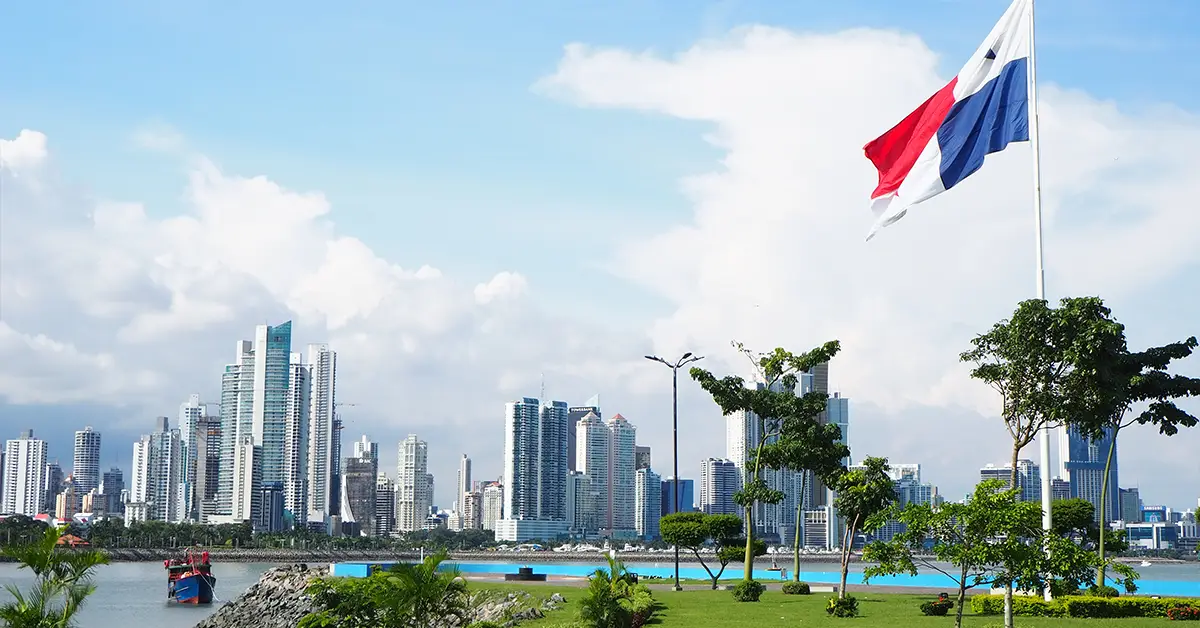
Panama residence by investment through the Qualified Investor Visa (QIV) programme is one of the fastest routes to permanent residence in Latin America, with a processing time of only 30-90 days and permanent residence granted from day one. The minimum property investment of USD 300,000 is in force until 15/10/2026, after which it rises to USD 500,000 under Decree 193 issued in 2024.
The programme has 3 investment routes, a flexible family policy covering spouse and dependent children, favourable tax rates under the territorial system and no actual residence requirement to maintain permanent resident status. This article analyses in detail the conditions, benefits and risks of the programme for Vietnamese investors, particularly with the USD 300,000 window about to close.
Message
An overview of Panama and the settlement programme
Panama is a country in Central America, the bridge between North and South America, with the famous Panama Canal linking the Pacific and the Atlantic. Panama covers around 75,000 km² with a population of approximately 4.5 million. Panama City is the capital and a major financial centre for the region.
Panama uses the United States dollar (USD) alongside the Panamanian Balboa (pegged 1:1 to the USD). Spanish is the official language, but English is widely used in business and finance. The legal system is based on continental European civil law.
Panama has several different settlement programmes for investors, retirees and professionals. Of these, the Qualified Investor Visa is the residence by investment route best suited to Vietnamese investors, for the following reasons:
- Vietnamis NOTon Panama’s Friendly Nations list, so the Friendly Nations Visa programme does not apply
- The QIV requires no particular nationality and is open to every international investor
- The QIV grants permanent residence from the outset, without a temporary residence stage
Considering a residency programme? The Prosperous Living Investment team assesses your profile free of charge and advises on the pathway that fits your goals.
Understanding the Panama Qualified Investor Visa correctly
The Qualified Investor Visa (QIV), commonly called the “Panama Golden Visa”, was established by Executive Decree no. 722 issued in October 2020 and amended by Decree no. 193 of 2024.
A particularly important point for investors to note: Decree 193 extended the favourable property investment level of USD 300,000 (instead of the USD 500,000 in the original rules) until15 October 2026. After that date, the minimum returns to USD 500,000 under the original Decree 722. This is an important window of opportunity for investors wanting to save USD 200,000.
The QIV differs from Panama’s other settlement programmes:
- Friendly Nations Visa: requires citizenship of one of 50+ “friendly” countries (not including Vietnam), granting 2 years of temporary residence before moving to PR
- Pensionado Visa: for retirees with a pension of USD 1,000 a month or more
- Forestry Investor Visa: investment in the forestry sector at a lower level but requiring a longer period
- Self-Economic Solvency Visa: investing USD 200,000 over 3-5 years, granting temporary residence first
The QIV is the only route grantingpermanent residence directlyto Vietnamese investors without a temporary residence stage.
The three QIV investment routes
The QIV offers 3 investment routes, each suiting a different financial objective. All require the investment to be maintained for at least 5 years.
Route 1: property investment
This is the route most Vietnamese investors choose because it gives a tangible asset with the potential to rise in value. The specific conditions:
- Minimum investment:$300,000 USD(until 15/10/2026) or$500,000 USD (sau 15/10/2026)
- The property must be in Panama, registered as freehold (with no mortgage)
- Buying off-plan (pre-construction) or completed property is permitted
- Ownership is permitted in a personal name, through a Panamanian company (the investor must own 100% of the shares) or through a Private Interest Foundation (with the investor as beneficiary)
- Where bought with a mortgage, the investor’s equity must be at least USD 300,000 — for example, buying a property for USD 500,000 with USD 200,000 borrowed from a bank leaves USD 300,000 of qualifying equity
- Ownership must be maintained for at least 5 years
After 5 years, the investor may sell the property without affecting the PR status already granted.
Route 2: securities investment
A minimum investment of USD 500,000 in securities listed on the Panama Stock Exchange (Bolsa de Valores de Panamá). The transaction must be carried out through a brokerage licensed by the Superintendencia del Mercado de Valores.
This route suits investors wanting to diversify their portfolio without managing a real asset. However, the liquidity and market risk of the Panamanian exchange need weighing carefully.
Route 3: fixed-term deposit
A minimum investment of USD 750,000 in a 5-year fixed-term deposit with a licensed Panamanian bank. This is the lowest-risk route but has the highest investment level, suiting investors who prioritise absolute capital preservation.
The deposit must be locked for the whole 5 years, and cannot be withdrawn early without losing PR status.
Fees and additional costs
Besides the main investment, investors need to prepare for the following additional fees for the main applicant:
- Application fee to the National Treasury: USD 5,000
- Repatriation Deposit to the Immigration Service: USD 5,000
- Lawyer and advisory fees: by agreement, usually USD 8,000 – 15,000 for the main applicant
- Fees for dependants: a further USD 1,000 – 2,000 each
- Property transfer tax (where applicable): 2-3% of value
- Notary and property title registration fees: around 1-2% of value
- VAT (ITBMS) on newly built property: 7%
The true total cost on the property route is usually around 10-15% above the main investment, equivalent to USD 330,000 – 345,000 of total capital to prepare for the USD 300,000 route.
The dependants who may be included in an application
The Qualified Investor Visa has a fairly flexible family policy. Those who may be included in an application comprise:
- A lawful spouse
- Unmarried children under 18
- Unmarried children aged 18 to 25 studying full-time at a recognised educational institution and financially dependent on their parents
- Children with a disability, with no age limit (financially dependent)
- Parents financially dependent on the main applicant (subject to strict proof of dependency)
Each dependant must provide their own documents comprising a birth certificate, marriage certificate (for a spouse), criminal record certificate and medical certificate. All must be legalised byApostilleor consular certification.
The rights of Panama permanent residents
Panama permanent residents enjoy many rights, although the limits of PR compared with citizenship need to be clearly understood.
Residence and work rights
- Permanent residence in Panama with no time limit
- No minimum actual residence required to maintain PR (only entering Panama once every 2 years)
- Permission to work, be self-employed and set up a company in Panama
- Unlimited asset ownership including property and company shares
- Opening bank accounts, taking out mortgages, and participating in the Panamanian financial system
- Being issued a cédula (Panamanian identity card) for administrative dealings
Tax advantages
Panama applies a territorial tax system, an important feature that makes Panama attractive to international investors:
- Tax only on income arising in Panama
- No tax on foreign income even for tax residents
- No inheritance tax on assets outside Panama
- No worldwide wealth tax
- Progressive personal income tax of 0-25% applying only to domestic income
- Corporate income tax of 25% on profits in Panama
For Vietnamese investors whose income comes mainly from abroad, this policy is particularly favourable where they become Panamanian tax residents.
The limitations of Panama PR
Several important limitations of Panamanian permanent residence need to be made clear:
- PR is NOTgrant a Panamanian passport or global visa-free travel rights
- Permanent residents still use their Vietnamese passport for international travel
- Visa-free rights depend on the Vietnamese passport and are not upgraded by holding Panama PR
- No right to vote in Panamanian elections (only citizens have that right)
- The cédula (PR card) must be renewed periodically
To obtain a Panamanian passport and visa-free access to 140+ countries (including the Schengen area, the United Kingdom and South Korea), investors must follow the naturalisation route after 5 years.
The route to Panamanian citizenship
After 5 years holding Panama permanent residence, investors may apply for naturalisation. The basic conditions:
- Holding Panama PR continuously for 5 years (in practice, actually residing in Panama for most of that time)
- Reaching a level of Spanish sufficient to communicate and understand Panamanian law
- Passing an examination on Panamanian history, geography and the constitution
- No criminal record
- Proving a stable source of income
- Having a close connection with the Panamanian community (work, assets, family)
The question of dual nationality
Panama is one of the few countries that formallydoes not recognise dual nationality— requiring renunciation of the original citizenship on naturalisation. However, in practice:
- The renunciation rule is a formality and is not strictly enforced in law
- Panama does not require proof that renunciation formalities have been completed in the country of origin
- In practice, most people who naturalise in Panama keep their original passport alongside
Even so, Vietnamese investors need to consult a lawyer before naturalising to understand the legal risks clearly, particularly in matters of entry to and exit from Vietnam, tax obligations and inheritance rights.
Once naturalised, the person may hold a Panamanian passport with visa-free access to around 140-145 countries, including the Schengen area and the United Kingdom.
QIV eligibility and application documents
To be eligible for the Qualified Investor Visa, the main applicant must meet the following:
- Aged 18 or over
- No criminal record
- Proving the lawful origin of the investment capital
- Not being on any international sanctions list
- Holding valid health insurance in Panama
- The investment capital must be transferred from a personal account outside Panama into a Panamanian account
The basic document list
The documents to be prepared:
- A valid passport with at least 6 months remaining
- Birth certificate, marriage certificate (where applicable)
- Criminal record certificates from every country of residence for more than 6 months (issued no more than 6 months before filing)
- A general medical certificate and HIV test
- Proof of the source of capital: bank statements, tax returns, employment contract, asset sale contract
- A bank reference letter
- The property sale contract or investment certificate from the brokerage or bank
- Certification of the transfer of the investment capital into Panama
- Photographs to the required standard
All Vietnamese documents must be officially translated into Spanish by a translator recognised in Panama.
The application process and timescale
The Panama QIV process is very quick compared with other settlement programmes, usually lasting 30-90 days from the filing of a complete application:
- Advice and choice of investment route: the Panamanian lawyer carries out a preliminary assessment and determines the appropriate investment route.
- Opening a Panamanian bank account: the investor opens an account with a Panamanian bank, and must attend in person for identity verification.
- Making the investment: transferring the capital into the Panamanian account and carrying out the property, securities or deposit transaction.
- Preparing the file and verifying the investment: the lawyer gathers all the documents and asks the Ministry of Trade and Industry to verify the investment transaction. This is what distinguishes the QIV from the other programmes — the investment must be verified by a government body before the visa application is filed.
- Filing with the National Immigration Service: the lawyer files the complete application on the investor’s behalf with thePanama National Immigration Service.
- Approval and entry to Panama: once approved, the applicant and family must travel to Panama to give biometrics and collect the cédula (permanent residence card).
- Renewing the cédula periodically: the PR card usually has a 2-year term for the first cycle and is then renewed. PR status is permanent; only the physical card needs reissuing.
A great advantage of the QIV is that most of the process can be carried out remotely through a lawyer; the applicant need only travel to Panama 1-2 times (to open the bank account and collect the cédula).
The Panama QIV compared with the other settlement programmes in the Americas
The Panama QIV has several distinctive features when compared with the other Latin American settlement programmes:
| Criterion | Panama QIV | Paraguay Investor | Mexico Temporary | Uruguay |
|---|---|---|---|---|
| Minimum investment | USD 300,000 in property | $70,000 USD | Not required | USD 500,000 in property |
| Type of residence granted | Permanent PR | PR (after 2 years) | 4 years’ temporary residence | 3 years’ temporary residence |
| Processing time | 30-90 days | 4-6 months | 2-3 months | 6-12 months |
| Residence requirement | Once every 2 years | Once every 3 years | 180 days a year | 183 days a year |
| The tax system | Territorial | Territorial | Worldwide | Worldwide |
| Naturalisation after | 5 years | 3 years | 5 years | 3 years |
| Dual nationality | Not officially | Yes | Yes | Yes |
The Panama QIV’s strengths are the fastest processing in the region, permanent PR granted directly, territorial taxation and a light minimum residence requirement. Its main weaknesses are a higher investment level than Paraguay and Mexico, together with the fact that dual nationality is not officially recognised.
For further reference on citizenship by investment or residence by investment programmes, investors may consult theMap of residence and citizenship by investment.
Risks and points to note in Panama residence by investment
Before deciding on Panama residence by investment, investors need to weigh several risks:
Risk on the USD 300,000 deadline
The USD 300,000 investment window formally closes on 15/10/2026. A complete application must be filed before that date to qualify for the favourable level. With an average preparation time of 3-6 months, investors need to start the process by mid-2026 at the latest to be sure of meeting the deadline.
Whether the Panamanian government will extend it again cannot be known, but the risk of a rise to USD 500,000 is real and should be planned for.
Property risk
The Panamanian property market is less liquid than the major cities of Europe or North America. Resale value after 5 years may not meet expectations, particularly for pre-construction projects or property outside Panama City. The project needs careful investigation before purchase.
Policy risk
Residence by investment programmes worldwide are under review pressure from the Organisation for Economic Co-operation and Development (OECD) and the Financial Action Task Force (FATF). Panama has reformed its screening rules several times over the past 5 years. Policy may continue to be adjusted in future.
Dual nationality risk
Although Panama does not strictly enforce the renunciation rule, Vietnamese investors need to weigh matters carefully before naturalising in Panama. Vietnam officially recognises only one citizenship, so naturalising in Panama may lead to complex legal situations over tax, inheritance and entry to and exit from Vietnam.
Conclusion
Panama residence by investment through the Qualified Investor Visa is an attractive option for Vietnamese investors wanting Latin American permanent residence quickly at an investment level of USD 300,000 through property (until 15/10/2026). The programme particularly suits investors with international income who want to take advantage of the territorial tax system, those wanting to diversify their assets geographically, or those preparing a foundation for their children to study in the United States later.
However, investors need to understand clearly that Panamanian permanent residence does not automatically bring global visa-free rights — that comes only with naturalisation after 5 years. The dual nationality question also needs weighing carefully with a lawyer before deciding to naturalise. Most importantly, the USD 300,000 window is counting down and closes on 15/10/2026.
To assess how the Panama QIV compares with the other residence by investment programmes, choose the optimal investment route and make sure the application is filed before the October 2026 deadline, investors should consult a specialist adviser. PLI provides full advisory services on the Panama residence by investment programme as well as the other Latin American settlement programmes, supporting Vietnamese investors from the preliminary assessment stage through to receiving the permanent residence cédula.
Accompanying you on your journey in residency investment
The Prosperous Living Investment team advises on pathways, assesses profiles and manages investments transparently for every residency, citizenship and international property objective.
Free profile assessmentWhere life gets prosperous