

Immigration New Zealand (INZ)


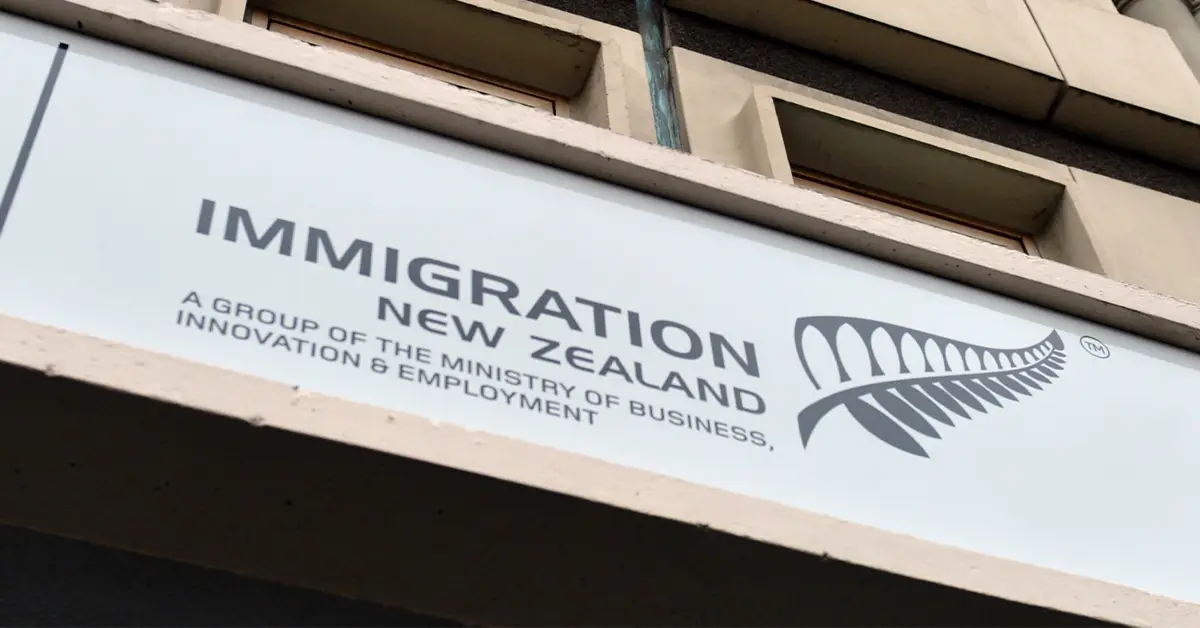
Immigration New Zealand (Māori: Te Ratonga Manene; INZ), formerly the New Zealand Immigration Service (NZIS), is the agency within the New Zealand Ministry of Business, Innovation and Employment (MBIE) responsible for border control, issuing travel visas and managing immigration to New Zealand.
Message
Overview
| Information fields | Contents |
|---|---|
| Established | 1912 |
| Responsible ministers | Erica Stanford, Minister of Immigration Chris Penk, Associate Minister of Immigration |
| Administering department | The Ministry of Business, Innovation and Employment (MBIE) |
| Website | immigration.govt.nz |
Considering a residency programme? The Prosperous Living Investment team assesses your profile free of charge and advises on the pathway that fits your goals.
History
The Immigration Department, 1909–1946
The origins of Immigration New Zealand can be traced to an informal “Immigration Department” established within the Department of Lands and Survey in 1909. The Immigration Department was tasked with finding work for new immigrants.
To meet greater labour demand in the manufacturing sector, Prime Minister William Massey announced the establishment of a formal Immigration Department in 1912. The Immigration Department initially had six staff and was headed by J.E. Smith. It took over the immigration functions of the Public Works Department and the Department of Lands and Survey.
However, the First World War halted the large-scale assisted immigration programme to New Zealand. In 1931, the Immigration Department and the Labour Department were merged into a combined “Department of Labour and Immigration”.
The Immigration Division, 1946–1988
By 1946, the immigration functions of the Department of Labour had been transferred to a newly established “Immigration Division” headed by Jack Brennan. The Immigration Division was tasked with administering New Zealand’s post-war assisted immigration programme and came under the oversight of the newly created ministerial portfolio of Immigration.
After the Second World War, Secretary of Labour Herbert Leslie Bockett expanded the Immigration Division by establishing sections in the Auckland, Wellington, Christchurch and Dunedin district offices. A Migration Office was also opened in London opposite the New Zealand High Commission in London.
The Department of Labour used advertising and materials to encourage European immigration to New Zealand during the post-Second World War boom.
In 1971, the Immigration Division worked with the then Department of External Affairs to expand immigration for Asians with professional and technical qualifications, English language skills and specific jobs.
By 1975, rising unemployment led the New Zealand government to end the assisted migration programme for migrants. Under Assistant Secretary J.L. Fouhy, the Immigration Division was tasked with enforcing the Immigration Act 1964.
During the 1970s and early 1980s, the Immigration Division and the Department of Labour were tasked with managing various issues including overstayers from the Pacific and refugees in South East Asia.
In response, the Department of Labour established a work permit scheme for Tongan, Fijian and Samoan migrants in 1975. The Immigration Division also established a resettlement unit to manage the resettlement of Indochinese refugees in New Zealand. By 1985, more than 6,000 Vietnamese and Cambodian refugees had settled in New Zealand. By 1984, the Department of Labour’s Immigration Division had 157 staff.
The Immigration Service, 1988–2004
Following a review of the Department of Labour in 1988, the Immigration Division was restructured into the “Immigration Service”. The Immigration Service established 3 regional offices and four branches. Staff numbers rose from 139 to 324 by 1992. By the early 1990s, Asia and the Pacific islands had replaced the United Kingdom and Europe as New Zealand’s main sources of immigration.
In 1993, the Immigration Service was reorganised to match the rising number of visitors and moved the majority of immigrant processing to staff overseas. In response to the growing pressure that immigration placed on New Zealand’s social infrastructure, particularly housing and education, the Department of Labour tightened the English language and capital requirements.
Immigration New Zealand, 2004–present
In 2004, Immigration New Zealand was designated the government agency responsible for migrant settlement. In 2005, the Fifth Labour Government established a Pacific Division to improve visa and immigration services in the Pacific islands and for Pasifika people living in New Zealand.
In 2009, a report by the Controller and Auditor-General identified numerous problems including poor leadership, mismanagement, a lack of accountability and transparency, poor service and a “fiefdom” mentality. In response to the report, the Fifth National Government disbanded the Pacific Division and reintegrated it into INZ.
After the Department of Labour was merged into the Ministry of Business, Innovation and Employment (MBIE) in July 2012, Immigration New Zealand was integrated into the new ministry.
Functions
Immigration New Zealand is the agency within the Ministry of Business, Innovation and Employment responsible for promoting and managing immigration, tourism, international students and foreign workers, and foreign investment in New Zealand.
Immigration New Zealand’s other responsibilities include attracting migrants, visa support, border protection and refugee resettlement. As at 2017, the division had 5 branches:
- Compliance, Risk and Intelligence
- Visa Services, which provides immigration advice, services and visa application processing.
- Service Design and Performance
- Settlement, Protection and Attraction
- Vision 2015, an initiative launched in 2012 to upgrade INZ’s information and communications technology.
Oversight
Administratively, Immigration New Zealand is headed by Deputy Secretary Alison McDonald. Politically, the agency comes under the portfolio of the Minister of Immigration, created in 1946.
Immigration New Zealand provides operational support to the Minister of Immigration, while MBIE’s Immigration Policy Group advises the Minister on policy matters. Immigration New Zealand (INZ) and the Minister of Immigration are also governed by the Immigration Act 2009. As at 2022, the current Minister is Erica Stanford.
Offices
Immigration New Zealand currently has very few offices, as users generally use INZ’s online services. Find out how to contact Immigration New Zealand athere.
Immigration New Zealand also operates a number of Visa Centres overseas. Look them up athere.
Refugee resettlement
Immigration New Zealand also manages the Mangere Refugee Resettlement Centre, which provides English language orientation classes, health screening and mental health support for refugees entering New Zealand under the Refugee Quota Programme.
In 2016, the Centre reopened after a major refurbishment.
Visa
Visas are issued by INZ staff at offices across New Zealand and around the world. Visa Services is the group within Immigration New Zealand responsible for providing immigration advice, services and visa application services.
These visa application centres allow Immigration New Zealand to share resources with its partners in theFive Country Conference: Australia, Canada, the United States and the United Kingdom.
Under the Immigration Act 2009, a visa is the entitlement for an individual to travel to or stay in New Zealand (under the Immigration Act 1987 a visa only permitted travel to New Zealand and a permit allowed a person to stay). A visa has conditions setting out what the visa holder may do.
Immigration New Zealand issues 4 main types of visa:
- The Visitor Visa, which allows a person to stay in New Zealand for a period in order to visit or study short-term.
- The Student Visa, which allows a person to study full-time in New Zealand.
- The Work Visa, which allows a person to work part-time or full-time in New Zealand
- The Resident Visa, which allows a person to study, work and live permanently in New Zealand.
Because of staff shortages, visa application processing times have gradually increased over the years. INZ currently expects to process a visa application within 60 working days of it being submitted. According to INZ, processing a residence application usually takes 6 to 9 months, while stamping a passport with a Permanent Resident Permit and a Returning Resident Visa after “approval in principle” has been granted takes up to 30 working days.
Accompanying you on your journey in residency investment
The Prosperous Living Investment team advises on pathways, assesses profiles and manages investments transparently for every residency, citizenship and international property objective.
Free profile assessmentWhere life gets prosperous