German Skilled Immigration

Introduction
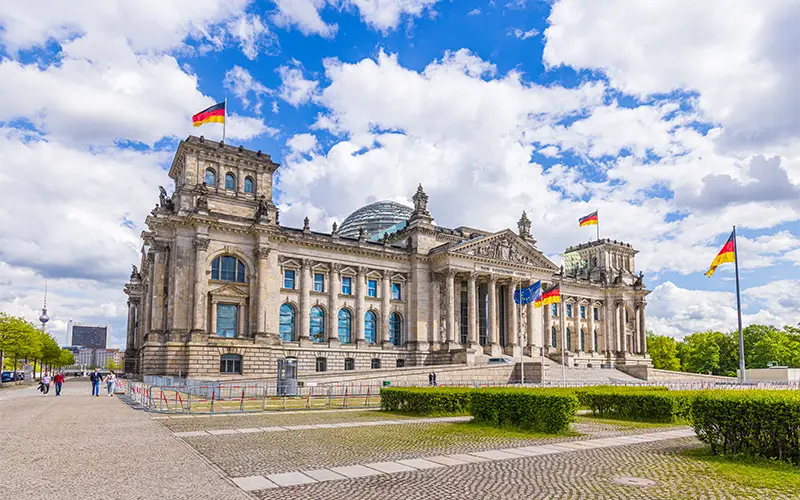
The German skilled immigration service from Prosperous Living Investment (PLI) supports candidates in obtaining a German residence permit through the EU Blue Card, Opportunity Card (Chancenkarte), Skilled Worker Visa, and other pathways following the 2024 Immigration Act reform.
PLI assesses professional profiles, assists with qualification recognition, connects candidates with German employers, and coordinates with immigration lawyers. We provide support from the initial assessment until the day you receive your residence permit, EU long-term residence permit, and German citizenship after 5 years.
Introduction to the German Skilled Immigration Programme

Programme Overview

Many flexible pathways:

Germany has many skilled immigration pathways: EU Blue Card (experts with a university degree), Opportunity Card (job seeking based on a points system), Skilled Worker Visa (with an employment contract), Vocational Training Recognition Visa, and visas for IT experts without degrees.

Processing time

EU Blue Card: 4–20 weeks from application submission. Opportunity Card: 2–12 weeks. Skilled Worker Visa: 8–16 weeks. Times vary depending on the consulate and the completeness of the application.

Benefits

A German residence permit allows you to live, work, and study in Germany. After meeting the conditions, you are eligible to apply for an EU Long-Term Residence Permit or a Settlement Permit (Niederlassungserlaubnis).

Residence requirement

After 33 months of holding an EU Blue Card (or 21 months if you achieve B1 German proficiency), you are eligible to apply for a permanent Settlement Permit. Skilled Worker Visa: 4 years. Maintain actual residence in Germany during the initial period.

Family

Spouses and children under 18 are eligible for family reunification under a simplified process for EU Blue Card holders – no German language requirement for spouses. Spouses are free to work in Germany immediately upon arrival.

Citizenship

Eligible to apply for German citizenship after 5 years of legal residence (or 3 years if C1 German proficiency is achieved and special integration achievements are met). Since 2024, Germany officially recognises dual citizenship – there is no need to renounce Vietnamese citizenship.

Benefits of German permanent residency
The largest economy in the EU
Germany is the largest economy in the European Union and the third largest in the world. It is home to global corporations such as Volkswagen, Siemens, BMW, Mercedes-Benz, and SAP – a massive labour market with high salaries, particularly in IT, engineering, healthcare, and scientific research.
Dual citizenship recognised since 2024
From 27 June 2024, Germany officially recognises dual citizenship through the Modernisation of Citizenship Law (StARModG). This is a historic change – previously, Germany was one of the few EU countries that did not allow dual citizenship. Vietnamese citizens naturalising in Germany do not need to renounce their Vietnamese citizenship.
Citizenship roadmap
The new 2024 Citizenship Law shortens the naturalisation period from 8 years to 5 years (or 3 years if C1 German proficiency + special integration achievements are met). The German passport is ranked in the top 3 globally, offering visa-free access to over 189 countries, including the United States and the United Kingdom.
Benefits of German permanent residency
High-quality education
Germany is a major EU country with a public university system that is TUITION-FREE for international students (except in the state of Baden-Württemberg). Children of residents receive free education from preschool to university at public schools. Universities such as TU München, LMU München, and Heidelberg are ranked in the world's top 50.
Healthcare and social security
The German public healthcare system is among the best in the world – mandatory health insurance provides comprehensive coverage. The robust social security system includes unemployment insurance, pension schemes, and long-term care. Long-term residents have full access to these benefits.
Free movement within the EU
The EU Blue Card allows for flexible movement between EU countries – after 12 months of holding a Blue Card in Germany, one can transfer to work in another EU country under simplified conditions. A German residence permit allows free travel across the 29 Schengen countries.

Skilled immigration pathway

Standard EU Blue Card

EU Blue Card: Standard

For professionals with a university degree and an employment contract with a minimum salary of €50,700/year (2026). A 4-year residence permit is issued, which is renewable. After 33 months, one is eligible to apply for a permanent Settlement Permit (or 21 months if B1 German proficiency is achieved). Simplified family reunification – no German language required for spouses.
Shortage Occupation EU Blue Card

EU Blue Card: Shortage occupations

A lower minimum salary of €45,934.20/year applies to shortage occupations: Engineers, Doctors, IT specialists, Scientists, and Teachers. This also applies to graduates from the last 3 years. From 2024, IT specialists without a university degree can apply for a Blue Card if they have 3 years of IT experience within the last 7 years.
Direct Recognition Opportunity Card

Opportunity Card: Direct recognition

The Chancenkarte launched in 06/2024 – a 12-month job-seeker visa that does NOT require a prior employment contract. A direct recognition pathway is available for candidates with degrees recognised in Germany via ANABIN. Only proof of financial means of €13,092/year is required. Holders may work part-time for up to 20 hours/week while job-seeking.
Points-based Opportunity Card

Opportunity Card: Points-based

For candidates whose degrees are not yet fully recognised in Germany – using a points-based system. Applicants must score at least 6 points based on qualifications, experience, language, age, and previous experience in Germany. A1 German or B2 English proficiency is required. Once a job is secured, one can transition to a Blue Card or Skilled Worker Visa.
Skilled Worker Visa

Skilled Worker Visa

For skilled workers who already have an employment contract with a German employer. A university degree or a vocational certificate of ≥2 years that is recognised is required. There is no minimum salary requirement like the Blue Card. Suitable for nurses, caregivers, electricians, and mechanics. A 4-year residence permit is issued, followed by eligibility for a Settlement Permit.
Vocational Training Recognition Visa

Vocational Training Recognition Visa

For individuals with foreign qualifications that are not yet fully recognised. This visa allows one to come to Germany to complete supplementary training or take a qualification recognition exam (Anerkennung). Holders may work for up to 20 hours/week. After completion, one can transition to a Skilled Worker Visa or EU Blue Card.

Start your journey with
Prosperous Living Investment

Free consultation – a personal solution for every client
The Prosperous Living Investment team is ready to stand beside you in every global investment and residency decision.

Programme requirements

Qualifications and Expertise

EU Blue Card: university degree recognised in Germany (or 3 years of IT experience). Skilled Worker Visa: university degree or vocational certificate of ≥2 years that is recognised. Opportunity Card: university degree or vocational certificate of ≥2 years recognised in the country of origin. Recognition check via the ANABIN database or ZAB process.

Salary

Standard EU Blue Card 2026: €50,700/year. EU Blue Card for shortage occupations and recent graduates 2026: €45,934.20/year. Salaries are updated annually based on a formula of 50% (or 45.3%) of the pension insurance contribution ceiling. The Skilled Worker Visa has no fixed minimum salary.

Employment contract

EU Blue Card and Skilled Worker Visa: MANDATORY to have a valid employment contract with a German employer before submitting the application. Opportunity Card: DOES NOT require a prior employment contract – it is a job-seeker visa.

Financial proof

Opportunity Card: minimum €13,092/year (€1,091/month), proven via a blocked account (Sperrkonto), a letter of commitment (Verpflichtungserklärung), or a part-time employment contract. EU Blue Card and Skilled Worker Visa: no proof of financial means required (as an employment contract is already in place).

German or English language

EU Blue Card: no German language required for most industries. Opportunity Card: minimum A1 German or B2 English. Skilled Worker Visa: A2-B1 German depending on the industry. B1 German or higher helps shorten the time to apply for a Settlement Permit from 33 months to 21 months (for Blue Card holders).

Health and background

No criminal record – provide a criminal record certificate from Vietnam. Health insurance valid in the Schengen area during the initial period (travel insurance), then transition to German public health insurance. Passport valid for at least 3 months after the intended date of entry.

Implementation process

Obtain a German residence permit through the skilled immigration route for the whole family with the team of experts at Prosperous Living Investment.

Profile assessment and pathway selection

PLI specialists assess the professional profile: qualifications, experience, German/English proficiency, and immigration goals. Check qualification recognition via the ANABIN database or recommend the ZAB process. Advise on the appropriate pathway: EU Blue Card, Opportunity Card, Skilled Worker Visa, or Vocational Training Recognition. Assessment is completely free. Duration: 1–2 weeks.

Qualification recognition and condition preparation

PLI guides candidates in completing prerequisites: qualification recognition via ZAB (Zentralstelle für ausländisches Bildungswesen) if necessary, achieving required German/English language levels, and preparing professional documentation according to German standards. For healthcare professions: guidance on the specific professional recognition process. Duration: 2–6 months.

Job seeking or Opportunity Card application

For EU Blue Card and Skilled Worker Visa: PLI connects with partner employers and supports the interview process and employment contract negotiation to meet the required salary threshold. For the Opportunity Card: PLI prepares the application based on the points system or direct recognition and provides guidance on opening a blocked account (Sperrkonto). Duration: 1–4 months.

Visa application at the Embassy

Upon receiving an Invitation to Apply (ITA) from Express Entry or a provincial/community nomination, candidates have 60 days to submit a complete permanent residency application (e-APR), including educational documents, experience, police clearance, medical exams, and supporting materials. IRCC processes the PR application. Duration: 6 months (Express Entry) to 24 months (Quebec, RCIP/FCIP).

Entry into Germany and residence registration

After receiving the visa, the candidate enters Germany. Within 14 days: register the residential address at the Einwohnermeldeamt, open a bank account, and register for health insurance. Schedule an appointment at the Ausländerbehörde (Immigration Office) to receive the official residence permit card. After 33 months (or 21 months if B1 German is achieved) with a Blue Card: eligible to apply for a Settlement Permit. After 5 years: eligible to apply for German citizenship.
Free Consultation

Start your residency journey with
Prosperous Living Investment

Prosperous Living Investment is with you from the first assessment to the day residence or citizenship is granted — transparent, professional and entirely personal.

Entirely free
Confidential
End-to-end support

Why choose PLI?
transparenteffectiveprofessional

Effectiveness

There is no one-size-fits-all here. Prosperous Living builds a personal strategy for each file based on financial capacity, business experience and family goals. That strategic approach makes the best use of time and resources and improves the chance of success.

Transparency

Prosperous Living advises within the law, works to a clear process and keeps up with the latest policy from each host government. Every pathway, cost and risk is explained in detail from the outset, so clients can make their investment decision with complete peace of mind.

Professionalism

The Prosperous Living advisory team works to a standard process, coordinating closely between immigration specialists, legal experts and partners worldwide. From assessment and documentation to post-arrival support, every step is methodical and joined up.

Frequently Asked Questions (FAQs)

Below are common questions from clients regarding the German skilled immigration programme. If you need more detailed advice, please contact us.
Frequently Asked Questions (FAQs)

The EU Blue Card is for professionals with a university degree who already have an employment contract with a minimum salary of €50,700/year (or €45,934/year for shortage occupations) – a 4-year residence permit with a fast-track Settlement Permit route. The Opportunity Card (Chancenkarte) is a 12-month job-seeker visa – no prior employment contract is needed, only 6 points under the points system or a recognised degree. Holders may work part-time for 20 hours/week while job-seeking.

In 2026, the EU Blue Card salary threshold is set at a minimum of €50,700 per year gross (equivalent to €4,225 per month). A lower threshold of €45,934.20 per year (€3,827 per month) applies to shortage occupations (engineers, doctors, IT specialists, scientists, teachers), recent graduates within the last 3 years, and IT specialists without a university degree. Salary thresholds are updated annually via an automatic formula.

It depends. Germany uses the ANABIN database (https://anabin.kmk.org) to verify foreign qualifications. If the candidate's Vietnamese university is listed as “H+” (recognised as equivalent), the degree is recognised automatically. If not, the recognition process must be completed through ZAB (Zentralstelle für ausländisches Bildungswesen) – this takes 2–3 months and costs approximately €200. PLI provides support for ANABIN checks and guidance on the ZAB process.

Yes, there are several pathways. IT specialists without a university degree can apply for an EU Blue Card if they have 3 years of IT experience within the last 7 years and an employment contract meeting the €45,934 per year salary threshold. The Skilled Worker Visa (§18a) accepts recognised vocational training certificates of ≥2 years. The Opportunity Card also accepts 2-year vocational certificates. For medical and nursing professions, there is a separate professional recognition process.

Yes. Spouses and children under 18 are eligible for family reunification. For the EU Blue Card: the process is simplified – the spouse does NOT need German language skills and is permitted to work freely immediately upon arrival in Germany. For the Skilled Worker Visa: the spouse requires A1 German language skills (with some exemptions). Children receive free education in German public schools.

It depends on the pathway. EU Blue Card: NO German language requirement for most sectors (English is the common working language in IT, research, and international corporations). Opportunity Card: minimum A1 German OR B2 English. Skilled Worker Visa: A2-B1 German depending on the sector. However, B1 German or higher helps shorten the time to apply for a Settlement Permit from 33 months down to 21 months with a Blue Card.

YES, as of 27/06/2024. This is a historic change via the Modernisation of the Nationality Act (StARModG). Previously, Germany was one of the few EU countries that did not allow dual citizenship – naturalised citizens had to renounce their original nationality. From 2024, Vietnamese citizens naturalising in Germany do not need to renounce their Vietnamese citizenship. This is a major advantage for the programme.

Under the new 2024 Nationality Act, the standard is 5 years of legal residence (reduced from 8 years previously). For those who achieve C1 German and have special integration achievements (e.g., excellence at work, social contributions, academic achievements): it is possible to apply after just 3 years. Requirements include basic B1 German, passing the naturalisation test (Einbürgerungstest), and financial self-sufficiency. The German passport is ranked in the top 3 globally, offering visa-free access to over 189 countries.